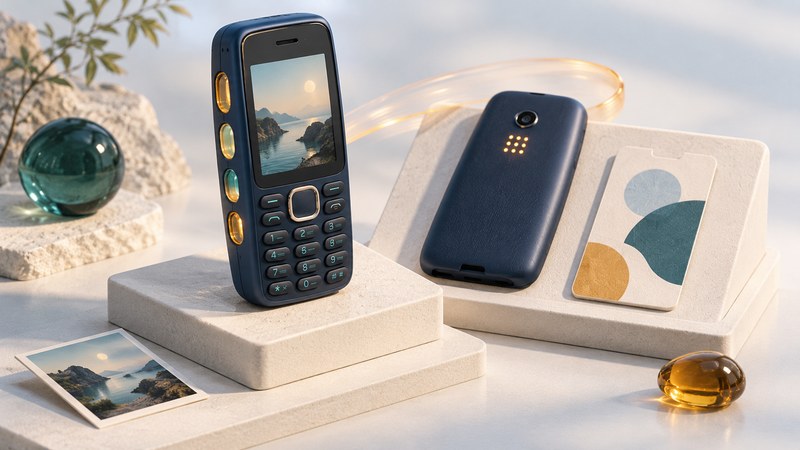
The Nokia 3220 made personalization visible beyond the screen. Its illuminated side grips could accompany alerts and ringtones; a separate Xpress-on Fun Shell added wave messages and motion-controlled games. Distinguishing those parts explains both the design and what a surviving handset can actually demonstrate.
Three different kinds of personalization
Nokia announced the 3220 on May 31, 2004. Its light effects, themes, and cut-out covers let owners change sound, screen appearance, and the physical exterior. The launch also described the Fun Shell, but that accessory's capabilities should be recorded separately from the handset's own features.
| Feature | Where it belongs | Evidence to look for |
|---|---|---|
| Side-light effects | Phone lights visible through the grips. | Matching grips and a demonstrated alert or ringtone effect. |
| Custom back appearance | Cover and cut-out insert. | The insert and compatible cover; a decorative insert adds no motion sensor. |
| Wave messages | Optional Xpress-on Fun Shell and its application. | Correct shell, connector, installed application, and a demonstration. |
| Motion games | Fun Shell sensor and supported games. | The accessory and its AirExpress or SwampRacer software. |
| Camera and MMS | Camera in the phone; message delivery through a service. | Assess image capture and message transmission separately. |
A collection listing should therefore say which parts are included. “Lights work” might mean an alert effect, while “wave messaging works” describes a different assembly and test.
The optional shell turned motion into a display
The Nokia-authored Fun Shell user guide (archived manual) describes the shell, a required connector, the Wave message application, and two motion games. The shell draws power from the phone. It is more than a cosmetic replacement cover.
For a wave message, the user moves the device while its LEDs display a changing pattern that an observer sees as a message. This is a local visual effect. It does not send a text message to another phone, and the appearance of lettering in the air does not mean a projector is creating an image on a distant surface.
The accessory's motion games used tilting as an input. Its instructions name AirExpress and SwampRacer and describe their controls. That specific hardware-and-software pairing matters: a generic game installed on the phone does not acquire motion control merely because the case has lights.
Taking a picture and sharing it were separate steps
The 3220's built-in VGA camera belonged to an era when small photographs and short clips were central phone features. Nokia's handset user guide (archived PDF, part 9235308) separates camera and Gallery functions from messaging and network services. A saved image demonstrates capture and storage; successful MMS delivery requires additional service and recipient compatibility.
For a preservation project, identify what is already stored before attempting synchronization or deletion. Keep an original copy of an exported image and check that it opens. If you enlarge or enhance a copy, retain the original dimensions and file so the historic camera output remains distinguishable from later processing.
Record the variant and every accessory
The launch described different GSM band combinations for regional versions. A “3220” label alone therefore does not establish radio compatibility. Consult documentation for the particular variant and evaluate any intended network service independently of the phone's appearance.
Use the 3220 accessory identification record to list the handset, covers, grips, connector, installed applications, and observed behavior. It includes a place to distinguish seller claims from your own tests. When inspecting covers or fitting accessories, follow the corresponding Nokia manual rather than forcing parts that merely look similar.
The 3220 is a useful example of personalization spread across several layers: visual themes, physical decoration, illuminated alerts, an electronic accessory, and network messaging. Each tells a different part of the design story. Compare this with the A780's organizer functions and the optics of stereoscopic phone displays.