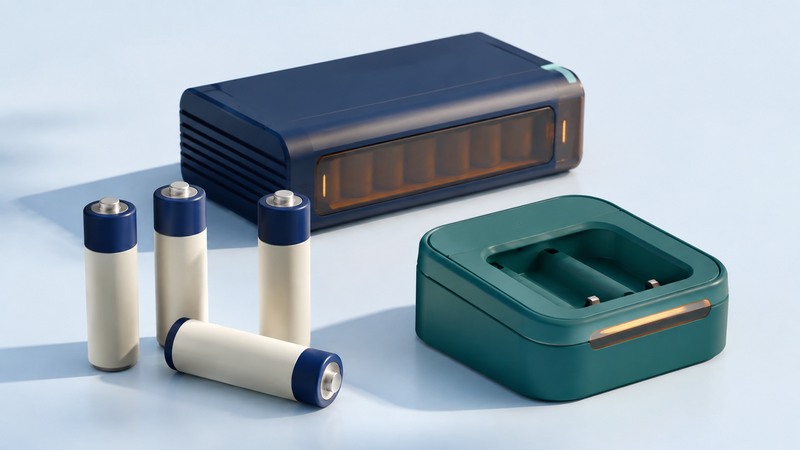
Nickel-metal hydride, or NiMH, is a rechargeable battery chemistry used in ordinary portable equipment and in some hybrid-vehicle battery systems. For an everyday device, start with its approved battery types and a charger explicitly designed for the exact cells. A familiar case size or a larger mAh number is only part of the decision.
The practical selection steps here cover supported consumer equipment. A vehicle traction pack is a managed high-voltage system with model-specific service requirements; use its manufacturer’s approved service route.
Read capacity with its conditions
Energizer’s NiMH application handbook explains the chemistry and its dependence on discharge rate, temperature and charging. It is a technical background reference dated 2018; current exact-model documentation should supply the limits for a purchase.
Milliampere-hours describe electrical charge delivered under a test procedure. Compare minimum versus typical capacity, discharge current, cutoff voltage and temperature. Watt-hours describe energy. Nominal voltage multiplied by ampere-hours gives a useful nominal-energy estimate, while actual delivered energy depends on the changing voltage and load.
On a narrow screen, scroll the table sideways. Keyboard users can focus the table region and use the arrow keys.
| Field | What to verify | Why it matters |
|---|---|---|
| Device support | Exact size, chemistry and supported battery types | A nominal 1.2 V cell must fit the device’s electrical requirements. |
| Capacity and duty | Minimum/typical mAh, test conditions and expected load | Published capacity and useful runtime can differ. |
| Storage behavior | Self-discharge information and intended idle period | An infrequently used device needs charge available after storage. |
| Charging | Exact supported cells, slot rules, temperature and indication meanings | A matching physical slot does not establish charger compatibility. |
Panasonic’s eneloop FAQ describes nominal 1.2 V operation, self-discharge and model/region differences. It also explains that cycle-life test methods have changed. Keep the test standard beside a cycle-count claim and compare equivalent conditions.
Understand a set of cells
Fictional supported four-cell device: four identical nominal 1.2 V, 2,000 mAh cells connected in series by the device form a nominal 4.8 V, 2 Ah set. Nominal energy is 4.8 × 2 = 9.6 Wh. The series connection adds voltages; the set remains 2 Ah.
If that complete device averaged 2 W and could use all 9.6 Wh, ideal arithmetic would give 4.8 hours. Real runtime needs allowance for the device’s cutoff, load peaks, conversion losses, temperature and battery condition. Measure the supported setup through a representative session instead of using this ideal value as a promise.
Keep a device’s cells together as a matched set. Follow its instructions and the battery maker’s guidance on replacement and charging. Panasonic warns against mixing cells of different types, capacities, brands, ages or charge states because unequal cells can be overstressed.
Use the exact charger instructions
A NiMH charger manages a charging process; nominal cell voltage is not a charging setpoint. Obtain the manual for its exact model and regional version. Check supported chemistry, cell sizes, whether slots operate independently, completion indication and fault meanings.
For a concrete example, Panasonic’s BQ-CC55 documentation describes individual charge control for supported eneloop and eneloop pro AA/AAA cells. It distinguishes charging indications from flashing fault indications. These features belong to that model and should not be assumed for another charger.
If charging fails, check the documented polarity, supported-cell list, temperature and fault explanation. Replace a damaged or leaking cell through an appropriate collection route; do not force charging or improvise a repair. EPA’s household battery guidance explains U.S. collection options for rechargeable batteries.
Choose for the actual pattern of use
For a frequently used device, compare supported sets by useful sessions per charge and service history. For long idle periods, prioritize the manufacturer’s storage and self-discharge data. A higher advertised capacity may come with different cycle or storage characteristics, so choose the tradeoff that fits the task.
Keep a short record of cell model, purchase date, charger, device and observed runtime. If performance declines, compare a known-good supported set under similar conditions; this helps separate cell aging from a device setting or charger problem.
For a hybrid vehicle, chemistry alone says little about pack interchangeability. Cooling, controls, voltage and vehicle integration belong to the complete system. For photography, use the camera battery planning guide; for another chemistry, see sealed lead-acid replacement specifications.
NiMH cell and charger selection record
NiMH cell and charger selection record — plain-text download. Save a copy and fill it in with your own information. The file includes instructions, assumptions and references so it can be used independently.