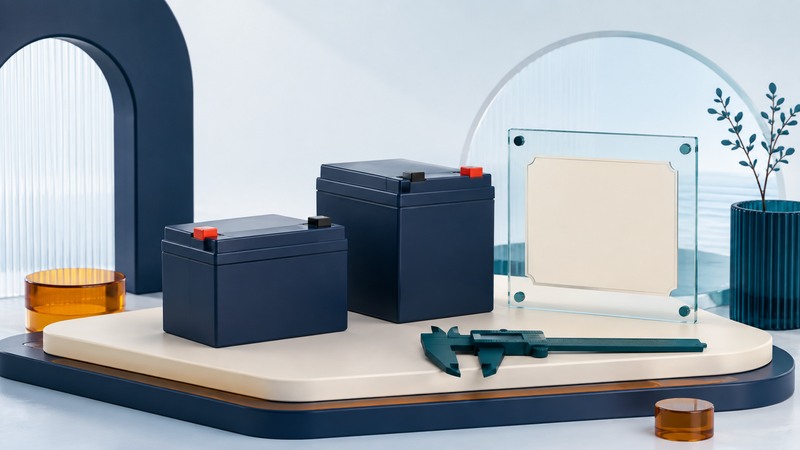
Choose a sealed lead-acid replacement from the equipment maker’s supported battery or cartridge list. Match the complete specification before comparing price or ampere-hours. Nominal voltage and a familiar rectangular case are only the starting point.
This guide helps owners of ordinary supported backup and low-voltage equipment prepare a replacement inquiry. Medical equipment, mobility and traction systems, large battery strings and other critical applications require their specific approved service arrangements.
Read the chemistry and duty correctly
Sealed lead-acid (SLA) batteries commonly use valve-regulated lead-acid (VRLA) construction. AGM holds electrolyte in absorbent glass material; gel immobilizes it in a gel. These terms describe construction, and the supported charging profile still belongs to the exact model.
Yuasa’s explanation of standby and cyclic applications separates a battery maintained ready for occasional backup from one repeatedly discharged and recharged. Choose a product supported for the intended duty, temperature and service schedule. A design-life classification is a test-based description under stated conditions, so keep the manufacturer’s conditions beside it.
Assemble a complete replacement specification
Photograph the accessible equipment and battery labels without opening a restricted enclosure. Record the exact device model, revision and existing cartridge number. Find the equipment manual’s replacement section, then send the following comparison to the supplier or service provider.
On a narrow screen, scroll the table sideways. Keyboard users can focus the table region and use the arrow keys.
| Field | Record | Why it affects the decision |
|---|---|---|
| Approval and chemistry | Supported cartridge or battery model; AGM or gel | Confirms the intended system and charging arrangement. |
| Electrical rating | Nominal volts; Ah with discharge period, endpoint and temperature | Makes the capacity comparison meaningful. |
| Physical fit | Length, width, total height, polarity layout and terminal size | Ensures the approved connections and enclosure fit. |
| Duty and environment | Standby/cyclic use, temperature and enclosure requirements | Connects the rating to actual operation. |
| Charging and service | Supported charger/profile, replacement procedure and service interval | Keeps the battery within its specified operating conditions. |
For a concrete example of the fields, Yuasa’s NP7-12LFR listing identifies a 12 V, 7 Ah at 20-hour rate battery with 151 × 65 × 97.5 mm dimensions and 6.35 mm Faston terminals. These values identify that model; use your device’s approval list to establish whether it belongs in your equipment.
Use discharge data for runtime
Ah is charge capacity at stated test conditions. Amperes measure current, watts measure power, and watt-hours measure energy. A brief peak-current claim describes a different capability from sustained backup runtime.
The manufacturer’s NP application manual shows how discharge rate and temperature affect available capacity. Its dated general curves explain the principle; obtain the current datasheet for the exact replacement and the equipment’s cutoff voltage. A high-rate load needs the applicable constant-current or constant-power discharge data.
Fictional label exercise: a battery rated 7 Ah over 20 hours was rated at an average current of 7 ÷ 20 = 0.35 A under its specified conditions. Multiplying its nominal 12 V by 7 Ah gives 84 Wh as a nominal comparison. Treating that as a guaranteed 84 W for one hour would discard the discharge-rate, cutoff, temperature, aging and conversion-loss information needed for a runtime estimate.
For a UPS, compare complete-system runtime curves at the intended load, as explained in the UPS sizing guide. Ask for the supported battery cartridge when the equipment uses one.
Confirm charging, handling and end of life
Use the battery and equipment manufacturers’ compatible charging instructions, including temperature compensation where specified. Avoid substituting a generic voltage setting or a charger chosen only because it says “12 V.” Have the supplier resolve conflicting specifications in writing before purchase.
Yuasa’s battery safety guidance addresses electrical short circuits, electrolyte and gases. VRLA batteries can vent; enclosure ventilation and handling requirements still apply. Do not open a sealed battery or add water. A swollen, leaking or unusually hot battery calls for the equipment maker’s fault procedure and qualified service.
Keep the replacement date, model, approval evidence and required follow-up test with the equipment record. A successful replacement should pass the device’s prescribed status or self-test checks. Persistent alarms call for diagnosis of the charger, load or equipment rather than another speculative battery swap.
EPA’s battery disposal guidance directs lead-acid batteries to a retailer or household hazardous-waste program. Do not put them in household trash or municipal recycling. Confirm the receiving program’s packaging instructions. For starting batteries in vehicles, use the car-battery guide.
Sealed lead-acid replacement record
Sealed lead-acid replacement record — plain-text download. Save a copy and fill it in with your own information. The file includes instructions, assumptions and references so it can be used independently.