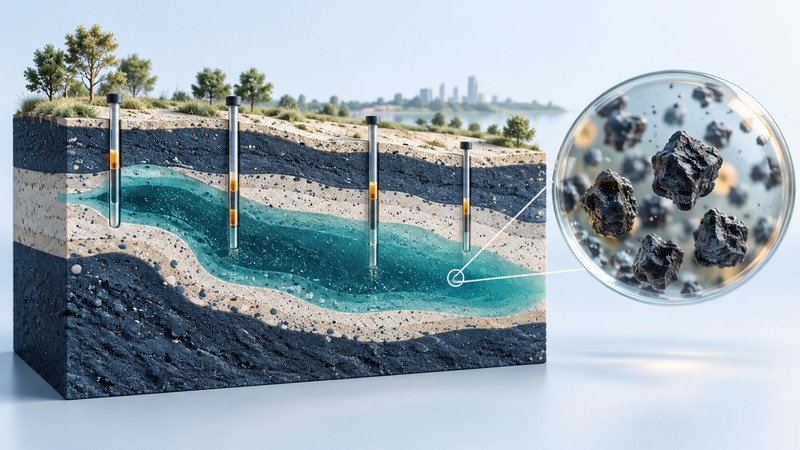
Nanoscale zero-valent iron, often shortened to nZVI, is elemental iron prepared as very small particles for applications including environmental remediation. Its reactive surface can help transform certain contaminants under suitable conditions.
A useful cleanup proposal explains both chemistry and contact: what reaction is intended, how the material will reach the contamination, and how sustained improvement will be demonstrated. This guide helps community reviewers and project owners read that evidence with the site’s environmental professionals.
Identify the reaction and the material
EPA’s CLU-IN nanotechnology application overview describes iron oxidation, contaminant reduction and competing reactions. Its examples and references include early research and demonstrations; use them as technical background, with current site-specific evidence for a new project.
Ask for the exact formulation, target contaminant and expected products. Bare iron, coated particles, bimetallic materials and emulsified formulations can have different transport and reaction behavior. Evidence for one formulation needs justification before it is applied to another.
Transformation also differs by contaminant. An organic molecule may follow a degradation pathway; a metal remains an element even if its oxidation state or mobility changes. The evaluation should track products and their fate, along with the original target.
On a narrow screen, scroll the table sideways. Keyboard users can focus it and use the arrow keys.
| Claim | Evidence to request | Decision it supports |
|---|---|---|
| The material reacts with the contaminant. | Test conditions, formulation and measured products. | Whether the chemistry fits the target. |
| It can reach the treatment zone. | Geology, delivery observations and monitoring locations. | Whether useful contact is demonstrated. |
| Concentrations declined. | Comparable samples, units and multiple locations. | Where and when improvement occurred. |
| The remedy is durable. | Post-treatment trends, rebound checks and agreed criteria. | Whether the endpoint is sustained. |
Explain what the groundwater system changes
Particles can aggregate, attach to sediment or lose reactivity as surface conditions change. Other groundwater constituents can consume reducing capacity. Geology and groundwater flow influence where the material travels and where contaminants persist.
A proposal should connect laboratory tests using site material to a field pilot and a conceptual site model: contaminant sources, pathways, aquifer layers and potential receptors. Ask where contact may be poor, how those areas will be investigated and what alternative or complementary treatment is available.
Delivery design, worker protection, permissions and injection activities belong with qualified professionals and the responsible regulator. This reading guide supplies no material dose, mixing recipe or injection procedure.
Read the whole monitoring sequence
Retain sampling location, screened interval, collection date, method, detection limit and quality flags. Keep units consistent: 1 mg/L equals 1,000 µg/L. A nondetect needs its reporting limit and method to be interpreted.
Review groundwater chemistry as well as contaminants and products. Changes in pH and oxidation-reduction conditions can help explain treatment behavior. Separate observations made during active treatment from those collected later, when persistence and rebound can be assessed.
Ask for a reviewable treatment case
Request a concise account of the site model, chosen formulation, laboratory and pilot evidence, uncertainties, monitoring plan and regulator-agreed objectives. Define the locations, constituents, concentrations and duration relevant to completion.
Compare the proposed remedy with feasible alternatives on the same site objectives. Include mobilization, testing, delivery, repeat applications, long-term monitoring and residual management in the cost scope. An old price per kilogram says little about a current completed remedy.
Agree what triggers further investigation or a change of approach: missed contact zones, unexpected products, rebound or failure to meet milestones. Record who makes that decision and what data they will use. The monitoring guide provides a companion framework for keeping a question, method and conclusion aligned.
Nanoscale iron proposal review record
Nanoscale iron proposal review record — plain-text download. Save a copy and fill it in with your own information. It includes instructions, example assumptions and source references.