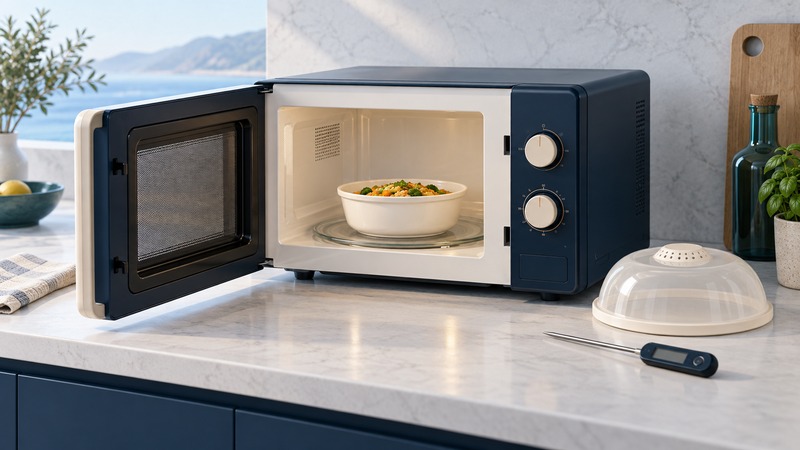
Choose a microwave around the dishes and installation space you use, then learn a small number of reliable settings. For everyday leftovers, the useful result is food heated throughout with an acceptable texture. A sensor program can help choose a cooking cycle, while a food thermometer checks the result.
Choose the installation format first
| Format | Main benefit | What to verify |
|---|---|---|
| Countertop | Flexible placement and straightforward access. | Exterior dimensions, required air space, door swing, outlet and the largest dish you use. |
| Built-in | A planned position in cabinetry. | Explicitly approved model and trim-kit combination, opening dimensions and ventilation route. |
| Over the range | Combines microwave placement with a hood arrangement. | Mounting requirements, access height, exhaust configuration and cooking-surface clearances. |
Measure your dinner plate and a typical casserole, including handles. A large capacity number does not tell you whether an awkward dish rotates or clears the door. Compare cooking output wattage with recipe instructions; electrical input is a different specification. Save the installation sheet for the exact model before buying cabinetry or a trim kit.
Convection and combination models add operating modes with their own cookware rules. Check the selected mode each time. A container suitable for one mode may be unsuitable for another.
Use the sensor within its intended task
Sensor programs respond to conditions such as steam from food. The Sharp SMC1452CH manual, sensor section, specifies vented covers, a dry cavity and utensils, and restrictions on opening the door during sensing. It also excludes certain foods from sensor reheating. Those details belong to that model; use your own program chart for portions and supported foods.
Read the chart before choosing a button merely because its name sounds close. If a portion falls outside the program's range, use a supported manual method. A sensor detecting steam has not measured every part of the food.
A practical leftover-reheating sequence
Start with leftovers that have been stored safely, a microwave-safe dish and cover, and a clean food thermometer. USDA's microwave guidance recommends arranging food evenly, covering with a vent for steam, stirring or rotating, and allowing standing time. It specifies reheating leftovers to 165°F.
- Transfer the portion to an appropriate dish and spread it into an even layer. Follow the food instructions for added liquid.
- Cover with a microwave-safe vented cover. Choose the food's instructions or the applicable program in the oven manual.
- Stir or rotate at the instructed point. Follow a sensor program's timing for opening the door.
- Allow the prescribed standing time. Then check several places with a food thermometer.
- If a location is below 165°F, continue heating, stir where appropriate, allow the required standing time and check again before serving.
USDA's leftover guidance specifically calls for checking several locations. Open a hot cover away from your face and hands to release steam.
Fix a poor result systematically
A hot edge and cool center suggest the portion arrangement or heat distribution needs attention. On the next attempt, use a shallower layer or smaller portion and follow the stirring instructions. A dried surface calls for checking the cover, liquid and power setting. Change one variable at a time so you can tell which adjustment helped.
Keep food-spatter cleanup part of the routine, following the oven manual. Repeated arcing, a damaged door or unusual operation calls for manufacturer guidance rather than repeated trial cycles. For a microwave-assisted legacy wall oven, use the separate GE Trivection guide.