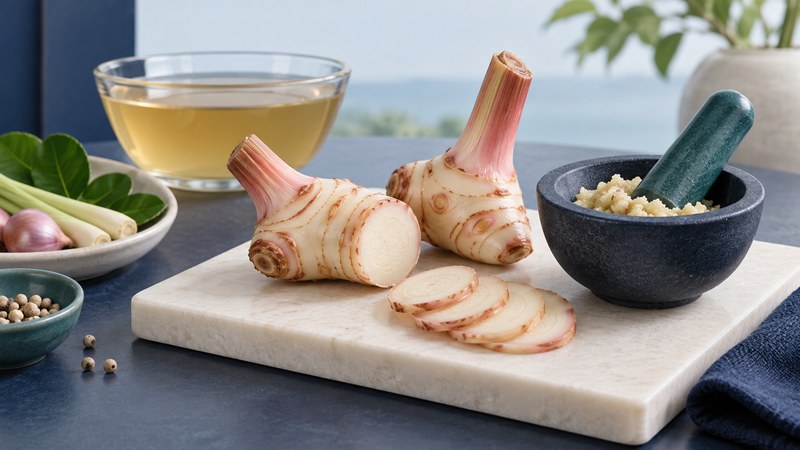
Choose how you will use galangal before cutting it. A soup needs slices that release aroma and can be removed. A curry paste needs pieces small enough to break down thoroughly. Treating those as separate preparation tasks helps you avoid tough chunks in the finished food.
Choose a form for the job
For Thai cooking, galangal usually means the firm aromatic rhizome sold as kha. It has a different aroma and texture from ginger. Look for a clearly labeled culinary product; the ImportFood fresh-galangal listing illustrates both younger and older pieces and the ingredient’s ringed surface.
On a narrow screen, scroll the table sideways. Keyboard users can focus it and use the arrow keys.
| Form | Useful application | What to check |
|---|---|---|
| Fresh rhizome | Slices for broth or finely cut pieces for paste. | Sound condition, manageable pieces and a recipe quantity. |
| Frozen slices | Convenient portions for a cooked soup. | Ingredients and package directions; separate only what you need. |
| Dried slices | A pantry option for a recipe that allows rehydration or longer infusion. | The recipe’s dried amount and preparation method. |
| Paste or powder | A measured ingredient in a recipe written for that product. | Concentration, added salt or other ingredients, and storage directions. |
ImportFood’s dried-galangal directions call for reconstituting its slices in lukewarm water. Use the package and recipe together. An equal spoonful of fresh slices, powder and paste will not give the same moisture, texture or intensity.
Cut for infusion or for eating
Chef Pailin Chongchitnant’s galangal preparation guide distinguishes thin slices for infusion from finely chopped or pounded galangal that becomes part of the food.
- Wash and dry the rhizome. Trim damaged areas and work with a short piece on a stable board.
- For soup, use a sharp, sturdy knife to cut thin rounds across the rhizome. Add the recipe’s measured quantity during its infusion stage.
- Remove the tough slices before serving, or make their presence clear to diners. They have flavored the broth even when they remain firm.
- For paste, slice and chop finely before pounding or processing. Check for remaining fibrous pieces before incorporating the paste into the dish.
Choose a manageable piece rather than forcing a knife through a large hard lump. If you are buying frozen galangal for the first time, sliced portions are easier to use than a solid whole rhizome.
Follow the recipe’s texture and quantity
Galangal can appear in more than one role within a cuisine. ImportFood’s miang kham method, for example, roasts slivers for a sauce and pounds them with shallots. This differs from leaving larger slices in a soup infusion. Follow the specific preparation rather than treating all “chopped galangal” as equivalent.
Freeze usable portions and judge substitutions honestly
Use fresh galangal within a few days or prepare it for freezing. Pailin’s guide recommends washing, drying and slicing it, freezing the slices separately on a lined tray, then transferring them to a freezer bag. Remove excess air, label and keep frozen. Its suggested three-month period is a quality target, not a guarantee for every freezer or starting ingredient.
For the closest practical replacement for fresh galangal, check for frozen galangal before changing the ingredient. Ginger brings a different flavor; it can produce an enjoyable adapted dish, but the result should be described as that adaptation. For a galangal-centered recipe such as tom kha, sourcing the ingredient or choosing a different recipe gives a clearer result than trying to recreate it with increasing amounts of ginger.
The ginger-root guide covers ginger’s own preparation and forms. If the same meal uses a leafy aromatic, see choosing and storing Thai basil.
Explore all seasoning and ingredient guides · Food, cooking and meal planning