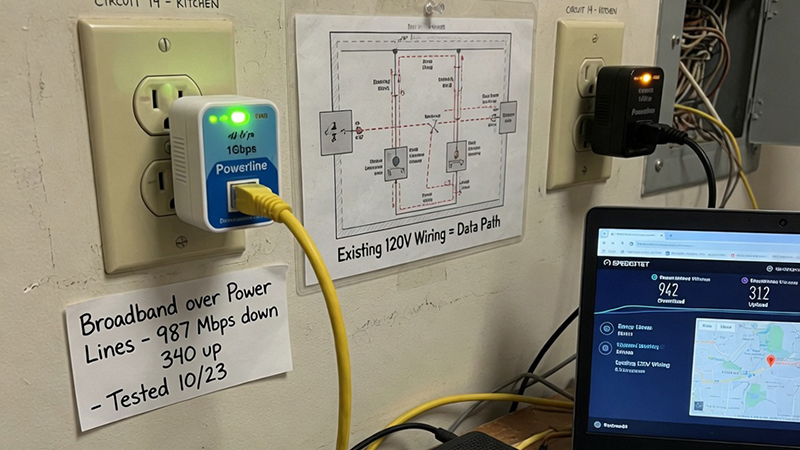
Electrical wiring networks use existing power conductors as a data path. In 2003, Telkonet promoted PlugPlusInternet as a way to deliver high-speed Internet access over the standard electrical wiring already installed in buildings, especially in commercial, residential, hospitality, government, and multi-dwelling environments where new Ethernet cabling could be expensive or disruptive.
The basic appeal is still easy to understand. Nearly every room has power outlets, while Ethernet, coax, and clean Wi-Fi coverage may be missing. A powerline adapter can sometimes turn a difficult wiring project into a plug-in deployment. The catch is that electrical wiring was designed to deliver power, not predictable packet networking. Results depend heavily on circuit layout, panel topology, noise sources, distance, grounding, surge protection, and the other devices sharing the same conductors.
How Powerline Networking Works
Powerline communication (PLC) places data signals onto electrical wiring at frequencies above the ordinary power waveform. A modem or adapter injects the signal at one outlet, and another adapter receives it elsewhere on the electrical system. Modern broadband powerline systems use modulation, error correction, encryption, and coexistence mechanisms to work around the harsh channel created by branch circuits, appliances, motors, power supplies, breakers, and wiring splices.
Unlike a dedicated Ethernet cable, a power circuit is a shared and noisy medium. Signal quality can change when an appliance turns on, a battery charger is plugged in, a motor starts, or traffic crosses between phases or panels. This is why advertised powerline speeds are best understood as physical-layer claims, not guaranteed application throughput.
The Telkonet Context
The original Telkonet article described a product family aimed at Internet access over existing electrical wiring without installing additional cabling or disrupting business activity. That made particular sense for hotels, apartment buildings, older offices, dormitories, and government facilities where running new cable could require tenant coordination, wall work, permits, or downtime.
That use case remains valid, but expectations have changed. In 2003, getting a usable wired Internet connection to a room was the main victory. In 2026, users expect reliable video calls, cloud applications, gaming, streaming, endpoint management, security updates, and Wi-Fi backhaul. Powerline can help in the right building, but it should be tested before it is treated as production infrastructure.
Standards And Technology
Several technology families have shaped electrical-wiring networking:
- Broadband over Power Line (BPL): a broader term for delivering broadband signals over power-line infrastructure, including access-network concepts that raised regulatory and interference concerns.
- HomePlug: a once-common consumer powerline networking family that influenced the market for plug-in adapters.
- IEEE 1901: an IEEE standard for broadband over power line networks covering PHY and MAC behavior for LANs, smart energy, IoT, transportation, and other data distribution uses.
- G.hn: ITU-T home-networking technology, including G.9960, designed to operate over premises wiring such as power lines, coax, telephone wiring, and other media depending on implementation.
The important practical point is interoperability. Do not assume every powerline adapter talks to every other one. Standards family, chipset generation, encryption pairing, MIMO support, regional power characteristics, and vendor firmware all matter.
Where Electrical Wiring Networks Fit
Powerline networking can be useful when:
- Ethernet cabling is unavailable and pulling new cable is impractical.
- Wi-Fi coverage is weak because of masonry, metal, old construction, or crowded spectrum.
- A small number of fixed devices need a better link than marginal wireless can provide.
- A temporary connection is needed during remodeling, events, testing, or staged migrations.
- Hospitality, multi-dwelling, or older commercial properties need connectivity with minimal disruption.
- Industrial or utility environments need low-to-moderate bandwidth telemetry over existing wiring, with proper engineering review.
It is less attractive for high-density access points, multi-gigabit backhaul, latency-sensitive production voice, large surveillance deployments, storage traffic, or any environment where the path must be highly predictable. In those cases, dedicated Ethernet, fiber, MoCA over coax, or a professionally designed wireless system is usually a better answer.
Electrical And RF Realities
Electrical wiring creates several networking surprises:
- Panel and phase boundaries: adapters may perform poorly across electrical phases, subpanels, transformers, or certain breaker types.
- Noise: switching power supplies, dimmers, motors, chargers, UPS units, and appliances can inject interference.
- Surge protection: power strips and surge suppressors can attenuate or block the signal; adapters usually work best directly in the wall outlet.
- Shared medium: all adapters in a powerline domain compete for capacity, so adding nodes can reduce throughput.
- Radio interference: BPL and PLC systems can radiate energy from wiring that was not built as shielded transmission line, so regulatory limits and interference handling matter.
- Security boundary: the electrical system may not align neatly with tenant, room, or business boundaries, making encryption and pairing important.
Because power wiring is part of the building electrical system, network installers should not modify panels, branch circuits, outlets, grounding, or building wiring unless they are qualified to do so and working under the applicable electrical code and local rules. Plug-in networking adapters are one thing; changing electrical infrastructure is another.
Comparison With Alternatives
Electrical-wiring networking sits between several other options:
- Ethernet: the most predictable choice for fixed devices, access points, cameras, and switches when cabling can be installed.
- Fiber: best for long runs, electrical isolation, high bandwidth, and building-to-building links.
- MoCA: often excellent where unused or controllable coax exists, especially for home and multi-dwelling video-era wiring.
- Wi-Fi: flexible and essential for mobile users, but affected by RF design, walls, client behavior, and spectrum congestion.
- G.hn over coax or phone wiring: useful in some buildings where those media are present and powerline noise is undesirable.
- Cellular or fixed wireless: helpful for backup, remote sites, and buildings where inside wiring is not trustworthy.
The best design often combines methods. For example, fiber or Ethernet may serve the core, MoCA or G.hn may reuse coax or phone wiring in hard-to-cable areas, powerline may reach a few stubborn endpoints, and Wi-Fi serves mobile access. Treat the electrical-wiring network as one tool, not the universal answer.
Deployment Guidance
Before deploying powerline networking broadly, test it in the actual building:
- Measure throughput and latency from the exact outlets that will be used.
- Test during business hours, after hours, and while typical appliances or equipment are running.
- Check whether the link crosses panels, phases, AFCI/GFCI devices, UPS systems, or surge protection.
- Use encrypted pairing and document which adapters belong to each network.
- Monitor packet loss and jitter if the link will carry voice, video, or remote desktop traffic.
- Keep spare adapters and label them by location and electrical circuit where possible.
- Have a fallback path for sites where the electrical noise floor changes over time.
The larger lesson from the 2003 Telkonet story still holds: existing building wiring can be valuable network infrastructure when new cabling is difficult. But electrical wiring is a compromise medium. It can be clever, fast to deploy, and cost-effective in the right environment, while disappointing in another room of the same building. Successful deployments start with measurement, safety, and realistic expectations.
References
- WRAL TechWire: Telkonet Internet access over in-home electrical wiring
- IEEE 1901-2020: Broadband over Power Line Networks
- ITU-T G.9960: wireline-based home networking transceivers
- HomeGrid Forum: G.hn FAQ
- 47 CFR Part 15: radio frequency devices and Access BPL
- ARRL: Broadband over Powerline interference background