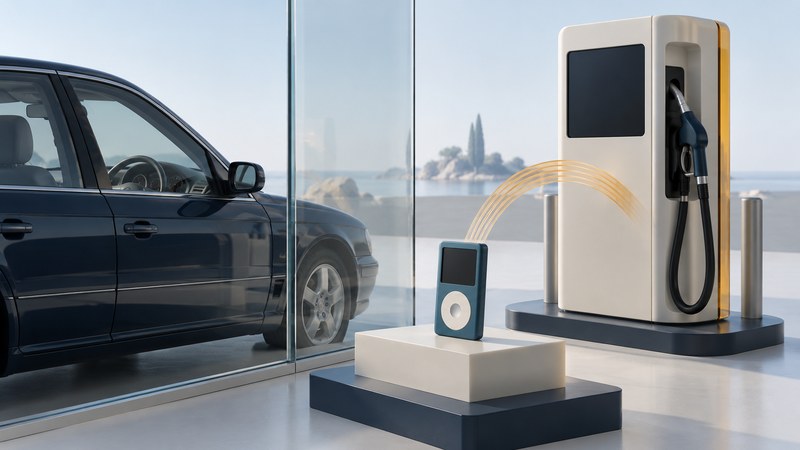
In January 2007, Dresser Wayne and Microsoft's Automotive Business Unit presented an unusual digital-music idea: buy a recording at a fuel dispenser, transfer it to a compatible device and hear it through a car stereo. The interesting part was the chain connecting a retail transaction to playback.
This is a retrospective on the announced CES demonstration. It explains the concept and the evidence needed to distinguish a working demonstration from a widely available service.
What the January 2007 announcement described
Dresser Wayne's January 8, 2007 company announcement, preserved by The Auto Channel, described an Ovation² iX dispenser with Internet connectivity, Wi-Fi, a 15-inch touchscreen and speakers. The planned demonstration paired it with a Windows Automotive-enabled Alpine system in a Lincoln Navigator; downloaded audio would play through an Alpine IVA-W200.
The announcement named Windows CE, .NET and Bluetooth among the integration technologies and scheduled the demonstration for January 8–11. Its availability paragraph distinguished a then-available 10.4-inch-screen dispenser from the larger touchscreen version planned for later that year. Those hardware statements and the proposed music transaction describe different parts of the offering.
Follow the recording from selection to playback
The following is a conceptual reading of the announced transaction, not a recovered engineering diagram. It deliberately keeps the transfer method general: a list of Wi-Fi, Bluetooth and software technologies is insufficient to assign every step to a particular protocol.
- Select and purchase. A screen presents content and accepts the customer's choice.
- Identify a compatible destination. The system must know which device should receive the recording.
- Transfer the file and any required authorization. Delivery must leave the destination with usable content.
- Find and decode the recording. The receiving software must recognize the file and support its format.
- Play it through the car audio system. A completed purchase becomes useful when the listener can actually hear it.
For someone evaluating this kind of system, each arrow raises a concrete question. How is the receiving device selected? What happens if the connection ends? Which formats and permissions are required? Where does a customer find the purchase again? The announcement establishes the intended experience; detailed answers require additional implementation records.
Read demonstration and deployment claims separately
| Question | Evidence to seek | What the 2007 announcement can establish |
|---|---|---|
| Was the concept publicly presented? | Dated company material identifying an event and demonstration configuration. | It names the CES event, intended transaction and participating equipment. |
| Could an ordinary customer buy music at a station? | Named retail locations, service dates and customer instructions. | A hardware availability statement alone leaves this service question open. |
| How many people used it? | Dated transaction or adoption figures with a defined scope. | The announcement provides a concept, not a usage measurement. |
| What became of the music service? | Operator records, later product documentation or a dated closure/migration notice. | Its eventual reach and outcome require further evidence. |
The careful conclusion is limited but useful: the companies announced a specific integration demonstration. The record cited here does not settle how broadly a music-download service later operated. A story about the technology's commercial success or failure would require that missing evidence.
The enduring question is who maintains the chain
The proposal placed music discovery and delivery inside a stop the driver was already making. As an editorial interpretation, its appeal was convenience through integration: the dispenser, content service, receiving device and stereo would work together. Its practical test would be whether all those parts remained compatible and supportable in ordinary use.
Compare that with two ways listeners can prepare music now. A personal-file workflow lets the listener organize and copy compatible files before a journey. A service-managed offline workflow depends on that app's download and account rules. For example, Spotify's current offline instructions require a periodic online connection to keep downloads. These are different responsibilities, even when both produce music with no active connection during playback.
Use the offline-library guide to evaluate files, device support and backups. Use the car-transmitter guide when the remaining problem is getting a working source into an older radio. The 2007 experiment remains a useful case study in separating content delivery, authorization and the final audio connection.
Explore all Digital Audio guides. Technical sources are linked beside the claims they support.