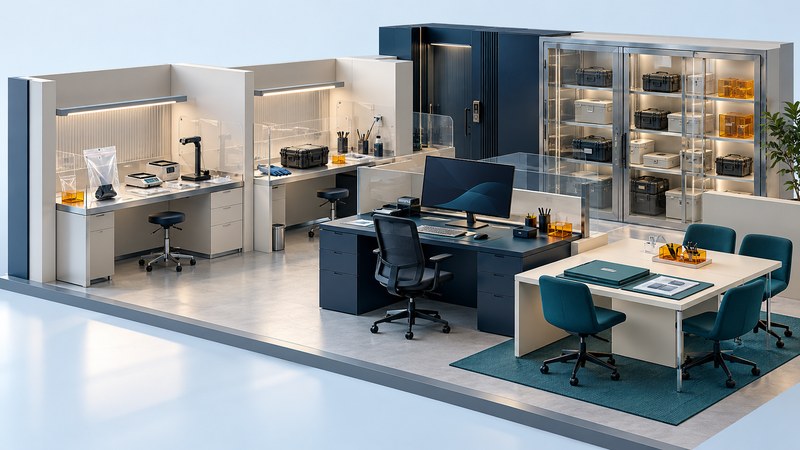
A digital forensics laboratory turns a defined question and identified evidence into a report that explains methods, findings and limitations. Equipment supports that work, but the quality of the result also depends on authority, documentation, competent examination and review. Understanding the stages helps a commissioning organization ask useful questions before sending devices or exports.
Begin with a question and an intake decision
The requester should identify the question, authorized scope, relevant dates, source types and any urgency. The laboratory needs to know what actions have already occurred, including resets, scans, exports or ordinary copying. These facts can affect both the available evidence and the interpretation of its timestamps.
At intake, agree on the sources accepted, their identifiers and condition, handling restrictions, storage and return arrangements. Resolve discrepancies between the request and the material received. A deadline may affect priorities, but it does not create missing evidence or justify an unsupported conclusion.
NIST SP 800-86 describes collection, examination, analysis and reporting from an IT incident-response perspective. Its framework helps organize the conversation; contemporary devices and services require methods appropriate to their specific state and version.
Follow the evidence through the work
| Stage | Work being done | Record or output |
|---|---|---|
| Intake and storage | Identify accepted material and control access. | Item inventory, receipts, condition and custody records. |
| Acquisition | Obtain the relevant data using an appropriate method. | Source, authority, tool/version, actions, errors and integrity checks. |
| Examination | Locate and organize artifacts relevant to the question. | Reproducible notes, selected artifacts and processing limitations. |
| Analysis | Relate the artifacts to time, events and alternative explanations. | Supported interpretation with explicit uncertainty. |
| Review and reporting | Check the work and explain its meaning to the requester. | Report, exhibits, review record and evidence disposition. |
A workstation image, cloud export and phone extraction may capture different kinds of information. Ask what the selected method includes and omits. Preserve the distinction between the original source, an acquired copy and working derivatives. A hash comparison can support byte integrity for the exact item checked, while collection completeness and interpretation require other evidence.
The lab should record the important steps well enough for a competent reviewer to understand them. Useful records include time-zone assumptions, tool settings, errors, transformations and the relationship between each exhibit and its source. A screenshot without context may conceal the information needed to reproduce the finding.
Ask how methods and results are checked
Ask how the lab establishes that a method is fit for its intended use, how changes in software or devices are assessed, and how unexpected results are investigated. A tool may parse one artifact correctly and handle a new application version differently. Examiners need to recognize when a result requires corroboration.
The NIST Computer Forensics Tool Testing program develops specifications, test procedures and test data for assessing forensic tools. Read a test result in the context of its tested function, version and conditions. It should not be expanded into a blanket approval of every product feature or every examiner’s workflow.
Ask who reviews the work, what the review covers, how disagreements are resolved and how corrections are documented. Verify the exact scope of any accreditation claim. Staffing, storage, review time and specialist availability all affect capacity; a purchase of additional computers alone does not establish how many cases a lab can responsibly complete.
Read a case journey critically
In this example, the missing day is part of the finding’s scope. A longer report or another visualization cannot supply events that were never retained. The requester can decide whether other authorized sources justify a follow-up phase, with a new question and approval.
Close with an understandable report
Look for the question, sources, methods, results, reasoning and remaining limits. Ask how reported times were normalized and where supporting exhibits can be found. SWGDE’s report-writing requirements describe minimum report elements; organizational and jurisdictional requirements may add to them.
Agree on return, retention and disposition of evidence, working copies and reports. Record any logging gap that should be addressed after the investigation. For selecting a provider, use the examiner comparison guide; for law-enforcement regional services, see the RCFL guide.