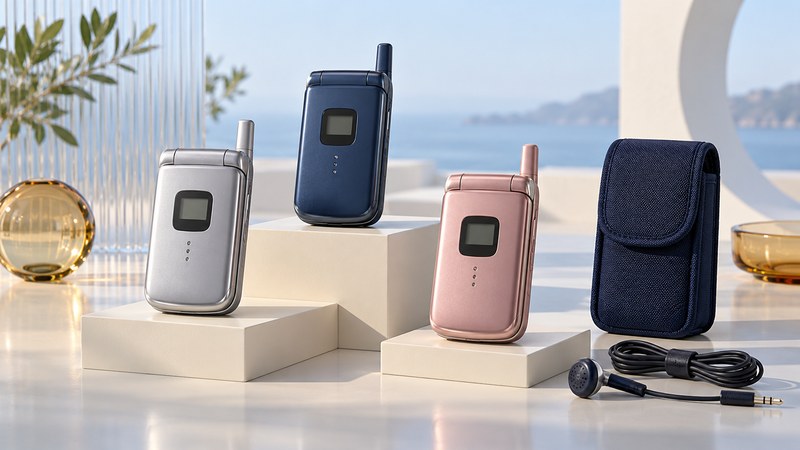
Phone personalization in the Sanyo clamshell era had several layers: the handset's factory finish, accessories carried with it, and sounds or images selected in software. The SCP-200 and VI-2300 help explain why a coordinated appearance and a compatible accessory are separate things to establish.
Color became part of the handset choice
Sanyo's 2005 VI-2300 manufacturer specification brochure, reproduced by ManualsLib, presents six exterior styles. Its illustrated specification page names Silver, Blue Ice, Graphite, Champagne Rose, Satin Red, and Deep Forest Green. The brochure documents a marketed range; it does not establish that every finish was stocked in every shop on the same day.
That distinction matters when dating a collection. An announcement can identify a planned color, a later brochure can show a broader range, and a dated receipt can establish a particular sale. Preserve each piece of evidence with its date instead of collapsing them into a single launch claim.
Personalization also happened inside the phone. The Sprint SCP-200 user guide has separate sound and display settings sections. The Sprint VI-2300 phone guide likewise distinguishes settings from downloaded content and Sprint PCS Vision services. A built-in choice, a file already stored on the phone, and a new download each have different requirements.
Identify what is actually being changed
| Choice | What changes | Evidence to look for |
|---|---|---|
| Factory color | The finish of the handset sold as that version. | A dated manufacturer color listing and matching product identification. |
| Replaceable housing or cover | A physical part of the phone. | Exact-model documentation stating the part and replacement method. |
| Carrying case, headset, or charger | An accessory used with the phone. | Its supported models, fit, connector, and intended function. |
| Ringer, wallpaper, or display setting | Software behavior or displayed content. | The matching manual, supported content type, and any service requirement. |
A range of handset colors establishes choice at purchase. Treat a claim about user-swappable shells as a separate claim requiring instructions. This prevents a common collection error: describing every colored clamshell as a phone with interchangeable covers.
A color-coordinated bundle brings together items selected for appearance. Mechanical fit and electrical compatibility still belong to each individual item. A pouch can fit while a charger from the same mixed lot belongs to another model.
Check a matching set in a useful order
- Identify the phone. Record the exact model and carrier edition from the device and compare them with the manual. A similar silhouette is only a starting clue.
- Identify each accessory separately. Look for its model or part number and documented compatible handsets. Keep the case, earpiece, cable, and power supply as separate entries.
- Inspect everyday fit. For a carrying case, check closure, hinge clearance, and access to needed controls. A tight fit that presses a key or strains the hinge defeats the purpose.
- Verify the intended function. A matching connector shape alone does not establish charging or microphone compatibility. Resolve the equipment specification before connecting an unidentified powered accessory.
- Record appearance and function separately. A set can be visually coordinated, historically authentic, operationally compatible, or some combination of those. State which properties the evidence supports.
Fictional example: a rose phone in a matching pouch
A collector acquires a rose-colored handset, a pink pouch, and an unmarked charger together. The color match supports a description of the display arrangement. To call it an original retail bundle, the collector still needs a dated listing or packaging record; to use the charger, the exact electrical and model compatibility needs verification.
Keep personalization useful and its history clear
For a working display, choose a ringer that can be recognized and screen settings that remain legible. Note whether a selected image or sound was built in or added later. Existing local content can document a person's choices even when the service once used to obtain it is unavailable.
For limited-edition claims, use the Aston Martin Motorola V600 provenance guide to separate ordinary handset features from evidence for a branded edition.
For provenance, photograph the finish under neutral light and keep the device label, packaging, and dated source references together. A marketing color name, a seller's description, and a photograph under warm light can describe the same object differently. Avoid assigning a factory color solely from an online image.
The Sanyo example is useful because it separates personal expression from equipment requirements. Each layer can be chosen and documented on its own. For a contrasting housing design, see Nokia 3100 covers and accessories. For modern protective-case choices, read case fit and protection claims, or browse the Telephone guides.