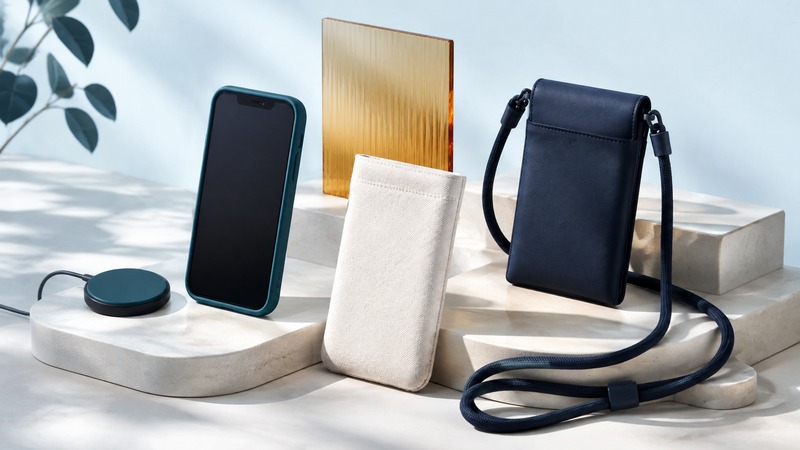
A phone case is both something you wear or carry and a piece of equipment that must fit a particular device. Start with how you reach, hold, charge, and put away your phone. Then choose the color, texture, and shape you enjoy using.
A fitted shell stays on the phone during use. A sleeve protects it while stored. A crossbody pouch provides a place to carry it. You can combine these, but adding layers changes the size, weight, and ease of access.
Check the exact device, not just the screen size
Find the phone’s model name in its settings and match it to the case maker’s compatibility list. Similar-looking phones can have different camera islands, button positions, or dimensions. A broad listing such as “fits large phones” may describe a pouch, not a fitted shell.
With the case installed according to its instructions, check that every corner seats fully and that the phone does not shift. Try the volume buttons, side controls, camera, speaker, microphone, and charging connector. A deep port opening may accommodate one cable plug but obstruct another. A screen protector must also fit without its edges lifting.
For a sleeve or pouch, measure the phone with its everyday case attached. Compare that with the usable internal space and opening, rather than only the carrier’s outside measurements. A flap, curved corner, or thick lining can reduce usable room.
Choose the carrying arrangement
On a small screen, scroll the table sideways to read all columns.
| Style | Useful when | Check before buying |
|---|---|---|
| Fitted case | You want access to the screen and camera without removing protection. | Grip, pocket bulk, button feel, raised edges, and exact-model fit. |
| Sleeve | The phone travels inside a larger bag or a dedicated pocket. | How you hold the bare phone after removal, and where the empty sleeve goes. |
| Wallet case | You want a small set of essentials together. | Card capacity, flap interference, closure, and the charging instructions. |
| Crossbody pouch or case | You want the phone accessible without relying on clothing pockets. | Strap length, secure anchors, bounce, closure, and whether the phone must be removed. |
A slim case may suit a fitted jacket pocket; a textured case may be easier to hold but harder to slide into a fabric lining. Try the combination with the clothes and bag you actually use. For a crossbody carrier, check the strap over both a light top and an outer layer. Notice whether you can sit comfortably and bring the phone to eye level without pulling the strap tight.
Separate magnetic attachment from charging compatibility
A magnetic ring, wireless-charging claim, and certified charging system answer different questions. Confirm the complete combination: phone model, case, charger, cable, and power adapter. A case that attaches to a stand does not by itself establish a charging rate.
Apple’s MagSafe charging instructions explain that actual power depends on the phone, adapter, and conditions. They also advise keeping cards, badges, passports, and key fobs out of the space between the phone and charger. Remove a wallet attachment as directed before charging.
When a charger claims Qi certification, check the exact product in the Wireless Power Consortium’s certified-product resources. Certification for a charger is not a drop-protection rating for its accompanying case.
Use a strap only with attachment points and accessories intended for that case. Inspect the small parts that carry the load: loops, rings, stitching, clips, and any insert tab. A tab that interferes with case seating or a charging connector is a reason to reconsider that combination. Do not assume a decorative charm loop is a phone-carrying anchor.
Read protection claims as test claims
Look for the named method, drop height, number of drops, test surface, and tested device. “Military grade” without that context does not let you compare two cases. For example, OtterBox explains its DROP+ multiples as repeated drops under its stated test approach. A higher multiple there describes more drops, not a promise that a phone survives a proportionally greater height.
Real impacts vary. A case warranty may cover the case rather than a damaged phone; read the actual coverage. A raised rim may keep a screen away from a flat tabletop, but it cannot prevent every impact with an uneven surface. Do not drop-test your own phone to confirm advertising.
Material claims deserve the same care. Ask which part contains recycled material, the stated percentage, and whether the whole case or only its packaging is being described. The FTC’s environmental-claims guidance explains why broad “green” claims need specific support. A plant-derived component does not automatically tell you how to dispose of the finished case.
Try a normal day before keeping it
Within the seller’s return conditions, make a call, take a photograph, use your usual charger, sit with the phone in your pocket, and retrieve it from your bag. Check whether a flap covers the lens or whether a strap twists across the screen. Inspect contact surfaces periodically for trapped grit and follow the case maker’s cleaning instructions.
Invented example: a commuter likes a leather-style wallet case but needs a magnetic desk charger throughout the day. If removing and replacing the wallet becomes a nuisance, a fitted case plus a separate card holder may serve the same style preference with fewer interruptions. This is a routine comparison, not a product test.
Save the phone-case comparison worksheet (CSV) to record fit, carrying, charging, and return checks for two candidates. Treat a failed essential requirement as a reason to reject a case, even if its appearance scores well.
Related resources
- Choose a handbag around what you carry
- Compare wearable technology for daily use
- Explore all fashion resources
Researched and updated September 6, 2026. Sources are linked beside the relevant information. Brand examples illustrate specific features or care instructions; they are not product rankings.