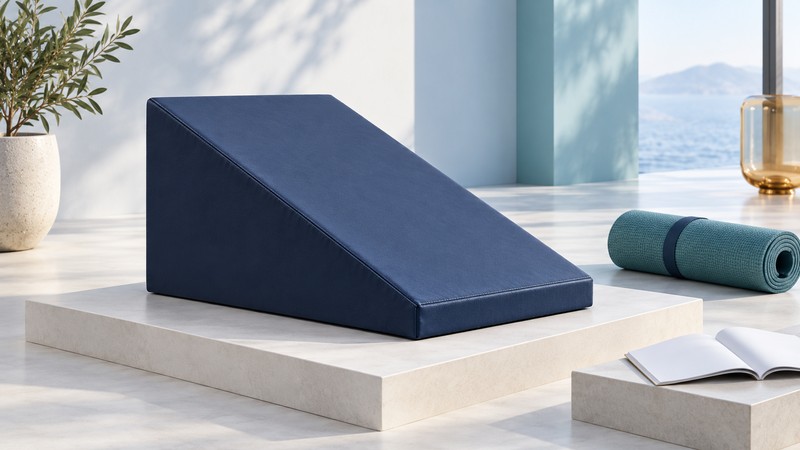
Choose a wedge by the activity its manufacturer supports. A triangular shape can describe a large exercise platform, a small hand or heel support, or a pillow for resting. Start with the exact product identity and instructions before treating any of them as exercise equipment.
Understand the Body Wedge name
Body Wedge 21 was promoted in 2004 as an exercise support, including an inflatable version accompanied by workout material. That history identifies a fitness product; it does not establish current availability, a verified load rating or interchangeability with a bed pillow sold under a similar search term.
For a legacy unit, find the maker’s label, model, material and original instructions. This guide does not provide a verified original Body Wedge 21 manual or load rating. If those cannot be established for your unit, keep exercise use unresolved and ask a qualified instructor about an alternative with current documentation.
Distinguish the intended uses
| Type | Documentation to seek | Question to resolve |
|---|---|---|
| Large exercise support | Supported positions, loads and surfaces | Does the planned movement appear in the instructions? |
| Small hand or heel wedge | Approved contact points and exercises | Is it designed for this placement and movement? |
| Positioning pillow | Resting/support and care instructions | Does its intended use include exercise? |
| Clinical positioning device | Professional model-specific instructions | Does a clinician need to choose or supervise its use? |
Manufacturer examples illustrate the distinction. OPTP’s Performance Wedges are a small paired exercise product. Its Personal Wedge is described for body and leg support and comfort. These are examples of different stated purposes, not substitutes for a Body Wedge or a recommendation for a condition.
Make the intended use specific
Write down what you want the support to do: support a position during an instructor-taught movement, change a contact surface, or provide comfort at rest. Give the manufacturer or instructor the exact product name and intended use. Naming the position, contact points and any added weights makes the question answerable.
- Match the label to a current or preserved manufacturer document.
- Check that the illustrated setup and your intended movement agree.
- Find applicable user/load limits, inflation directions, surface requirements and inspection guidance.
- Ask how to recognize wear or damage requiring removal from use.
- Resolve unclear limits with the manufacturer before loading the product.
A supported-body-weight rating must be interpreted in its stated conditions. Do not calculate an exercise rating from an unrelated pillow specification. For inflatable equipment, a generic pump or guessed pressure is not a replacement for the exact instructions.
Decide whether the support solves your problem
Consider setup, inspection, cleaning and storage. Check return terms and whether manufacturer support or replacement covers are available. A low price offers little value if the intended use remains uncertain.
For rehabilitation, pain relief or post-surgery positioning, take the question to the treating clinician. General fitness instruction cannot select a treatment device. For ordinary training, the beginner strength guide and trainer-selection guide can help you decide whether additional equipment is needed.
Explore the fitness library
Browse fitness guides for planning, movement, equipment and evidence. Source links appear beside the information they support.