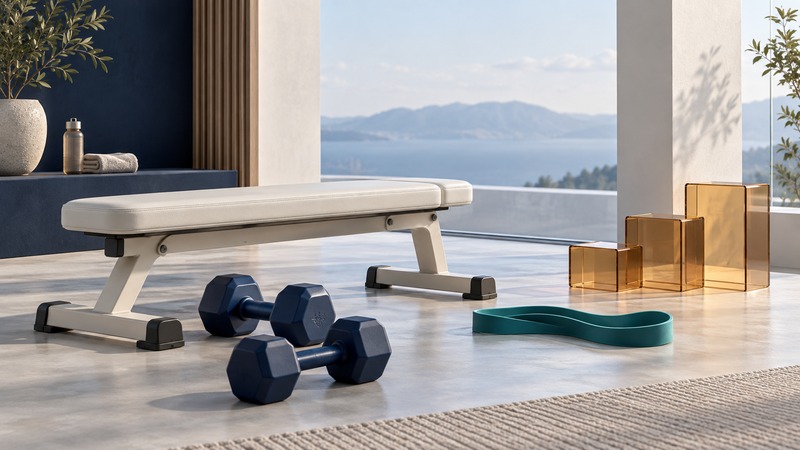
A useful beginner strength routine has a few repeatable exercises, a manageable starting effort and a record of what happened. Learn the movements and build regular participation before adding complexity.
Set a starting point
This guide is for adults beginning general fitness training. If symptoms, recent surgery or a health condition affect exercise, ask a qualified clinician or exercise professional about suitable movements and limits. The CDC guidance for chronic conditions and disabilities explains how activity can be adapted.
Schedule two sessions on separated days, such as Tuesday and Friday. Gather suitable clothing, a stable exercise space and the correct equipment instructions. Practise the movements at an easy level before working sets. A repetition is one complete movement; a set groups repetitions.
The CDC’s general strength guidance covers all major muscle groups on at least two days a week and describes one set of 8–12 repetitions as a starting framework. Someone learning a movement may need fewer repetitions or an easier version first.
Build coverage and learn the exercises
Use this map to discuss a balanced routine with an instructor. These are options to select for your ability, not a compulsory circuit. Learn setup, breathing and controlled return before making an exercise harder.
| Task | Possible starting exercise | What to establish |
|---|---|---|
| Stand and lower | Sit-to-stand | Stable chair, feet planted and controlled sitting |
| Push | Wall press-up | Hand position and manageable wall distance |
| Pull | Resistance-tubing row | Tube placement, neutral back and smooth return |
| Hip movement | Supported standing leg extension | Move the leg without arching the lower back |
| Shoulders and arms | Suitable instructor-taught press or curl | Comfortable range and manageable load |
| Trunk control | Instructor-selected bracing exercise | Position, breathing and an appropriate version |
The NHS illustrated strength exercises cover chair rising, wall press-ups, leg extensions and curls. For a chair rise, place feet on the floor, lean forward and stand slowly; lower with control. For a wall press-up, place hands at chest level, bend the elbows to approach the wall and press back. Use the demonstrations for setup and easier starting amounts.
For a tubing row, Mayo Clinic demonstrates standing on the tube’s center, keeping knees comfortably bent and the back neutral, drawing elbows back near the body, then returning smoothly. Use equipment intended for the movement and its inspection instructions. Ask for another option if the position is unsuitable.
Use effort while maintaining control
The final repetitions should require effort while retaining the movement you learned. End the set when control breaks down. Stop for pain, dizziness or other concerning symptoms and seek appropriate advice. Testing a maximum lift is unnecessary for this starting process.
The 2026 ACSM summary for healthy adults supports regular training with bands, body weight or weights. Training to momentary muscle failure and complicated program changes are optional for general fitness. Rest until you can perform the next planned set with control; record rest time when it affects the comparison.
Use the log to choose one change
- Record exercise version, load and units, sets, repetitions and how the final repetitions felt.
- Repeat a manageable session to distinguish learning from increased workload.
- When the planned work is consistently more manageable, choose a small change: repetitions within your plan, a suitable load increase or an appropriate harder version.
- Check control and recovery again. Return to the easier version or obtain coaching when needed.
Download the strength-session log. For aerobic activity and recovery alongside strength, use ten fitness principles in practice. For help choosing a coach, see the personal-trainer checklist.
Explore the fitness library
Browse fitness guides for planning, equipment, food and movement. Source links appear alongside the guidance they support.