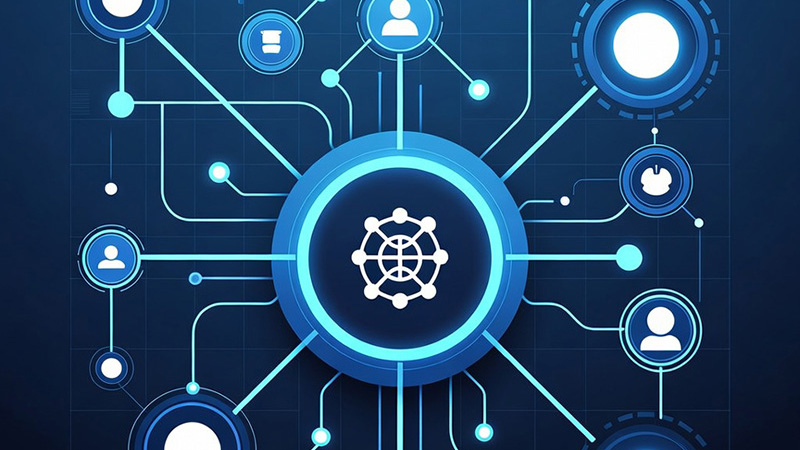
In 2003, NetScaler promoted its Model for Application Intelligent Networking (MAIN) as an example of a broader shift in data-center infrastructure: security, optimization, and Layer 4-7 switching were moving from separate appliances into more unified platforms. Aberdeen Group described that trend as multifunction networking and security, reflecting what many IT buyers wanted at the time: fewer boxes, better application performance, and a stronger connection between network behavior and business-critical applications.
The phrase application intelligent networking sounds period-specific now, but the idea has aged well. Modern networks are judged less by whether packets can move and more by whether applications stay fast, available, secure, observable, and policy-compliant across data centers, public clouds, edge locations, SaaS platforms, APIs, and remote users.
The Original Idea
NetScaler's 2003 message centered on integrating several functions that had often been deployed separately:
- Layer 4-7 traffic management: making forwarding decisions based on transport sessions, application protocols, URLs, cookies, headers, and server health.
- Load balancing: distributing user requests across server pools so applications could scale and survive failures.
- SSL acceleration: offloading cryptographic work from application servers and simplifying certificate handling at the application edge.
- Security: adding application-aware protection closer to the point where traffic entered the data center.
- Optimization: improving response time through connection management, compression, caching, and protocol handling.
That combination became the application delivery controller, or ADC. An ADC was more than a load balancer because it understood enough about application traffic to enforce policy, protect services, improve performance, and provide operational visibility.
NetScaler's Path
NetScaler later became one of the most recognized ADC names. Citrix acquired NetScaler in 2005, and the product was eventually renamed Citrix ADC before the NetScaler name returned as a distinct application delivery and security brand. Today NetScaler sits within the broader Cloud Software Group portfolio, alongside Citrix and other enterprise software businesses created after the Citrix and TIBCO combination.
That lineage matters because it mirrors the market. Load balancing became application delivery. Application delivery absorbed web application firewalling, API protection, bot management, gateway services, telemetry, automation, and cloud deployment models. The appliance in the data center became only one form factor among physical, virtual, containerized, cloud-native, and managed-service options.
What Changed Since 2003
The application edge is no longer a single place. In 2003, many critical applications lived in a small number of enterprise data centers. In 2026, application traffic may pass through a content delivery network, cloud load balancer, API gateway, Kubernetes ingress controller, service mesh, identity provider, zero-trust broker, SD-WAN edge, WAF, bot defense service, and observability pipeline before a user sees a page. Those handoffs are part of the larger problem of IP network borders.
This makes application intelligence harder and more important. Teams need to understand not only the network path, but also HTTP behavior, TLS policy, authentication flows, API schemas, DNS, certificates, user geography, client device posture, dependency latency, and cloud-region failure modes. A modern application delivery design is both a networking design and a software operations design.
Modern Application Delivery Functions
A current application intelligent networking stack may include:
- Global server load balancing: directing users to healthy regions based on availability, proximity, latency, policy, and disaster-recovery state.
- Local load balancing: distributing traffic across application instances, containers, virtual machines, or service pools.
- TLS termination: centralizing certificate handling, cipher policy, mutual TLS, and inspection points.
- Web application firewall: protecting against common web attacks, suspicious payloads, and abusive request patterns.
- API security: enforcing authentication, authorization, schema validation, rate limits, and abuse controls for API endpoints.
- Bot management: distinguishing useful automation from credential stuffing, scraping, fake-account creation, and transaction abuse.
- Acceleration: using caching, compression, HTTP/2 and HTTP/3 handling, connection reuse, and content routing to improve response time.
- Observability: collecting metrics, logs, traces, events, and transaction details that connect user experience to infrastructure behavior.
Application Intelligence And Zero Trust
Application-aware networking now overlaps heavily with identity and security policy. The old assumption that inside-the-network traffic is trustworthy does not fit cloud applications, remote users, contractors, APIs, and service-to-service communication. Zero trust architecture pushes teams to evaluate each access request based on identity, device state, policy, and risk rather than broad network location.
For application delivery, that means the gateway, ADC, WAF, API gateway, identity provider, and security monitoring tools need to share context. A request from a known employee on a managed device may be treated differently from a request using the same credentials from an unmanaged device, a new country, or an automation pattern that looks like abuse. The network becomes useful when it can enforce decisions that reflect application risk.
Where SD-WAN Fits
SD-WAN brought application intelligence to the wide-area network. Instead of steering all traffic through static private circuits, SD-WAN devices classify applications and choose paths across MPLS, Internet, broadband, LTE, 5G, and cloud interconnects according to policy and real-time conditions. Voice, video, transaction systems, SaaS, backups, and guest traffic can receive different routing and security treatment.
That is the WAN version of the same pattern NetScaler described in the data center: the network should understand enough about applications to make better decisions than simple best-effort forwarding. The challenge is keeping those decisions consistent from branch to data center to cloud to user device.
Observability Is Now Required
Application intelligence without visibility becomes guesswork. Modern teams need telemetry that crosses layers: DNS time, TLS negotiation, HTTP status codes, request latency, backend pool health, retransmissions, packet loss, route changes, CPU pressure, database calls, identity failures, WAF decisions, and third-party API errors. OpenTelemetry has become an important open standard effort for collecting metrics, logs, and traces across distributed systems.
The practical goal is simple: when an application is slow, the team should know whether the problem is a network path, a load balancer pool, a certificate issue, a bad release, an overloaded dependency, a security rule, a cloud outage, or a client-side condition. Application intelligent networking should reduce the time between symptom and cause.
Design Guidance
For a current application delivery refresh, evaluate the whole application path:
- Map user flows, API calls, DNS records, certificates, identity checks, gateways, load balancers, service dependencies, and data stores.
- Decide which controls belong at the CDN, cloud edge, ADC, Kubernetes ingress, service mesh, API gateway, or application code layer.
- Use WAF and API security policy with tuning and testing, not as a one-time checkbox.
- Measure real user experience as well as infrastructure uptime.
- Automate certificate renewal, configuration deployment, rollback, and drift detection.
- Keep high-availability designs honest by testing region, pool, DNS, and control-plane failures.
- Review exposed management interfaces and gateway software aggressively; ADCs and remote-access gateways are high-value targets.
NetScaler's MAIN strategy was early language for a lasting requirement: applications need networks that can see, steer, protect, accelerate, and explain application traffic. In 2026, that intelligence is spread across ADCs, cloud load balancers, API gateways, WAFs, SD-WAN, SASE, service meshes, and observability platforms. The winning design is the one that makes those pieces work together instead of creating another set of isolated boxes.