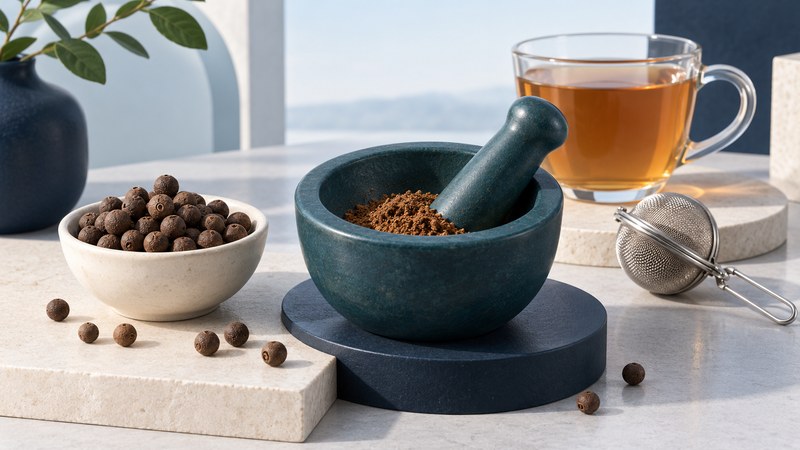
Choose allspice by how it will reach the finished food. Whole berries can flavor a liquid and then be removed; ground allspice disperses through a batter, rub or sauce. Matching that form is more useful than trying to convert a handful of berries into a spoonful by eye.
A single spice with several familiar notes
Allspice is the dried unripe berry of Pimenta dioica. The Spice House’s allspice guide explains the single ingredient and its whole-versus-ground uses. A jar labeled mixed spice or pumpkin pie spice contains a different blend; inspect the ingredients before using it.
On a narrow screen, scroll the table sideways. Keyboard users can focus it and use the arrow keys.
| Recipe task | Useful form | How it reaches the plate |
|---|---|---|
| Infuse a stock or drink | Whole berries. | Strain or remove after infusion. |
| Blend into cake or cookie dough | Finely ground spice. | Mix evenly with the recipe ingredients. |
| Season a rub or smooth sauce | Ground spice. | Measure the powder and distribute thoroughly. |
| Follow a whole-spice recipe | The specified berries. | Retain the author’s quantity and removal step. |
Allspice can support both sweet and savory cooking. The maker’s ground-allspice description includes barbecue sauce, jerk seasoning and baking. Choose an actual recipe for the application; a list of possible foods provides no reliable dosage.
Keep whole berries easy to retrieve
For a liquid preparation, use the recipe’s berry count and cooking time. A food-safe spice sachet or suitable infuser helps you retrieve the berries together; leave enough room for liquid to circulate. The Spice House recommends removing or straining whole berries before serving.
Check the liquid at the recipe’s tasting point, once it is safe to taste. When the aroma is sufficient, remove the spice container. If you are straining the entire liquid, have the strainer and receiving vessel ready before pouring. Account for the berries as deliberately as you would a bay leaf.
Ground powder changes the texture of a clear infusion and can be difficult to strain out. If clarity matters, find a whole-spice version of the recipe. If the finished sauce will be opaque and blended, a measured ground-spice recipe may fit your ingredients better.
Grind first, then measure
A small mortar and pestle or a grinder intended for hard spices can turn whole berries into powder. The Spice House’s grinding guidance discusses dedicated spice grinders and keeping coffee flavors out of a spice batch.
- Check that the tool is clean, dry and suitable for the spice.
- Grind a small amount, then inspect it for hard pieces. Work those pieces again before adding the powder to a smooth batter.
- Measure the finished powder with the spoon or weight specified by the recipe. Berry size and grind fineness make a universal count-to-teaspoon rule unreliable.
- Close the remaining whole-spice jar and label any surplus powder separately.
Make a deliberate flavor substitution
The Spice House suggests a 2:1:1 blend of ground cinnamon, nutmeg and cloves as an allspice substitute. For a ½-teaspoon portion, that gives ¼ teaspoon cinnamon, ⅛ teaspoon nutmeg and ⅛ teaspoon cloves. It supplies related warm notes while changing the flavor.
That compromise is easier to evaluate in a flexible spiced bake than in a dish where allspice defines the seasoning. Check whether the recipe already contains those other spices before adding a substitute; record the change and judge the completed food. Keep the substitute labeled as a blend so it does not become a mystery jar.
Store spice tightly closed away from heat, moisture and light. Replace weak-smelling ground spice rather than repeatedly increasing an uncertain amount. See choosing cinnamon and measuring and grating nutmeg for the other ingredients in that substitution.
Explore all seasoning and ingredient guides · Food, cooking and meal planning