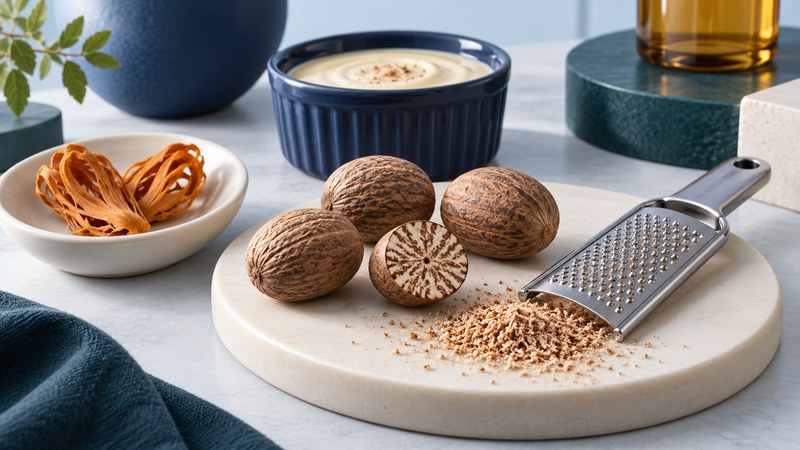
For repeatable nutmeg flavor, measure the spice before it goes into the food. Whole nutmeg lets you grate a fresh portion; ground nutmeg is convenient when you need a quick level spoonful. Both can work in sweet and savory recipes when the form and quantity are clear.
Choose a form you will actually use
Nutmeg and mace come from the same fruit but are separate spices. McCormick’s mace description identifies mace as the lacy covering around the shell containing nutmeg. Buy the one named in the recipe; their relationship does not make the flavor identical.
On a narrow screen, scroll the table sideways. Keyboard users can focus it and use the arrow keys.
| Choice | Useful when | What to plan |
|---|---|---|
| Whole nutmeg | You want to grate small portions as needed. | A suitable fine grater or enclosed spice mill. |
| Ground nutmeg | You need a measured amount quickly. | A level spoon and a tightly closed jar. |
| Mace | The recipe calls for mace or explicitly permits it. | Its own measured quantity and flavor. |
King Arthur Baking’s ground-nutmeg listing includes pies, puddings and savory vegetables among its applications. Decide how often you cook those dishes before buying a large container. A small quantity you can use while aromatic is easier to manage than a jar that remains open for years.
Grate into a dish, then measure
The Spice House’s nutmeg guide describes fine grating and storage away from heat and light. For anyone who finds a small seed awkward to hold, an enclosed tool designed for hard spices, such as the type described in Microplane’s spice-mill guidance, offers another approach.
- Use a dry culinary nutmeg seed and a tool intended for hard spices. Set the grater securely over a small dry dish.
- Hold the seed firmly and make short strokes, keeping fingertips away from the cutting surface. Follow the tool’s directions and use its guard where provided.
- Stop while you can still hold the piece safely; keep the remainder for a suitable enclosed grinder instead of trying to grate it down to nothing.
- Gather the fine gratings and measure the amount the recipe requests. Close the whole-spice container and clean the tool as its maker directs.
Grating directly over the saucepan makes it harder to know how much you added. Measuring separately also avoids holding the spice jar or your hand in steam. A fixed number of strokes is a personal reference only: pressure, tool and seed size all affect the result.
Season in small, recorded steps
Nutmeg contributes aroma as well as visible brown flecks. In a sauce, stir a measured addition through thoroughly before judging it. In a batter or custard, follow the recipe’s mixing stage so the spice distributes evenly. Use the finished, safely cooked food to evaluate the result.
When changing from an older jar to fresh gratings, use the recipe’s advice and evaluate the intensity cautiously. Aroma varies with the spice and storage; a blanket conversion cannot account for every jar. For baking, choose a trusted recipe that specifies the form you have rather than improvising large spice changes.
Keep the supply useful
Store whole and ground nutmeg tightly closed in a cool, dry, dark place. Mark the opening date and keep your notes with the recipe. If the ground spice has little aroma, replace it before judging the recipe itself. Keep mace separately labeled.
Use the small quantities intended in culinary recipes. Poison Control’s kitchen-ingredient guidance warns that swallowing large amounts of nutmeg can cause poisoning and recommends keeping it out of children’s reach. For a suspected excessive ingestion in the US, contact Poison Control at 1-800-222-1222.
For related flavor choices, see whole and ground allspice and using vanilla beans in a recipe.
Explore all seasoning and ingredient guides · Food, cooking and meal planning