Environmental monitoring gets stronger when it shortens the distance between observation and action. That is where AI is proving most useful. Modern monitoring programs pull from satellites, drones, camera traps, buoys, air sensors, water stations, laboratory tests, and administrative records. AI helps those systems absorb more data than people can review manually and surface which changes are worth attention now.
The strongest deployments are not replacing environmental science, field sampling, or regulation. They are improving earth observation, change detection, anomaly detection, sensor fusion, computer vision, and downscaling so environmental teams can target field checks, warnings, and interventions more effectively.
This update reflects the field as of March 17, 2026 and leans mainly on NASA, NOAA, EPA, USGS, DOE, NIST, Wildlife Insights, WRI, and recent peer-reviewed studies. Inference: the biggest environmental-monitoring gains are coming from faster interpretation, better coverage, and stronger prioritization, not from handing critical decisions to a black box.
1. Climate Change Modeling
Climate monitoring becomes more useful when broad Earth-system output can be translated into local conditions without losing uncertainty. AI is helping climate teams accelerate regionalization, sharpen precipitation and heat estimates, and generate finer spatial detail from coarse model fields. The strongest practical value is not replacing physics-based climate models. It is making them more usable for local environmental monitoring and planning.

Two 2025 papers show where this field is moving. A Nature Machine Intelligence study presented fast, scale-adaptive, uncertainty-aware downscaling of Earth-system model fields with generative machine learning. An npj Climate and Atmospheric Science paper extended the pattern by downscaling ERA5 precipitation to kilometer and sub-hourly scales with generative AI. Inference: the strongest climate-modeling gains come when AI improves spatial detail and decision relevance while keeping uncertainty explicit rather than pretending local precision is free.
2. Air Quality Monitoring
Air-quality AI is strongest when it merges many imperfect signals into one operational view. Regulatory monitors, low-cost sensors, satellites, traffic patterns, and wildfire smoke data all have blind spots on their own. AI-assisted sensor fusion helps agencies build a more continuous picture of pollution patterns, hot spots, and exposure changes than any one data stream can provide.

EPA's updated RETIGO geospatial viewer and its Air Sensor Data Tools show where current practice is heading: more real-time integration, more map-based interpretation, and more attention to quality control for sensor-heavy workflows. Inference: air-quality AI adds the most value when it helps agencies reconcile messy observations and identify where human review, public communication, or enforcement should focus next, especially during complex events such as wildfire smoke episodes.
3. Water Quality Assessment
Water monitoring is becoming less episodic and more continuous. AI helps utilities, watershed managers, and public-health teams scan sensor feeds, hydrologic context, and lab data for early signs of contamination, algal blooms, or infrastructure-related quality drift. The strongest gain is faster triage and earlier investigation, not pretending that a model can replace chemistry or field sampling.

USGS has explicitly highlighted deep learning as a growing method for water-quality science, and EPA's Water Quality Data infrastructure shows why that matters operationally: the sector increasingly depends on integrating many observations rather than waiting on isolated tests alone. Inference: water-quality AI is strongest where it can sift high-frequency, incomplete, or multi-source data quickly enough to guide where field teams sample or intervene next.
4. Wildlife Conservation
Wildlife conservation benefits when biodiversity monitoring can happen at ecological scale rather than sample-by-sample. AI-powered computer vision now helps process camera traps, aerial imagery, and even some satellite observations to identify species, count activity, and flag unusual events quickly enough for conservation teams to act. The strongest value is scale, consistency, and faster review of massive observational backlogs.
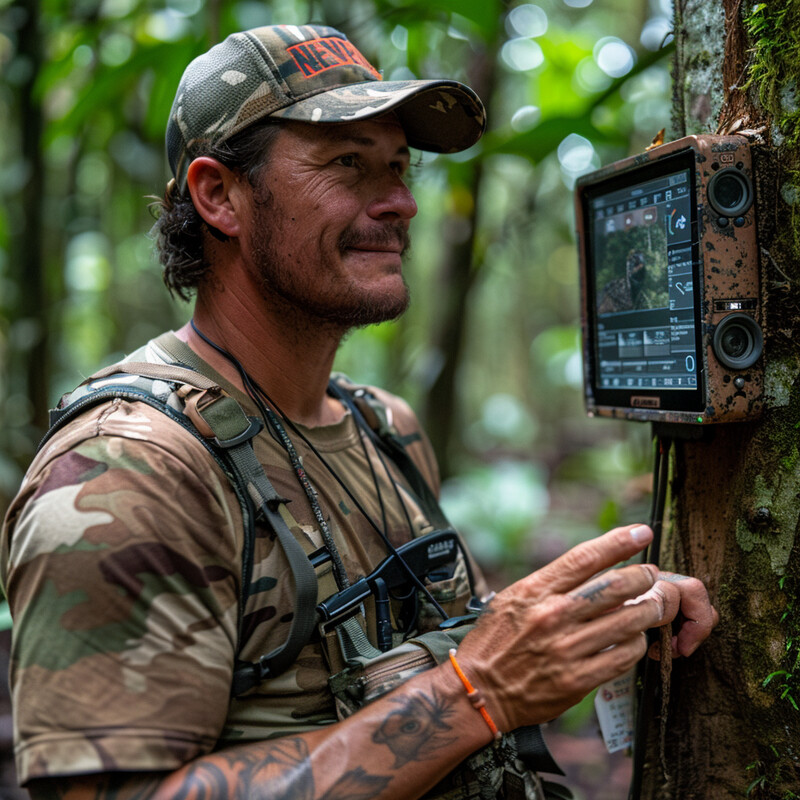
Wildlife Insights is now explicit about AI as a core part of its camera-trap workflow, helping classify huge image collections that would otherwise take experts months or years to review. NOAA Fisheries is pushing a parallel frontier with Geospatial Artificial Intelligence for Animals, which uses overhead imagery to study animals from space. Inference: the strongest biodiversity-monitoring systems increasingly combine automated triage with expert validation so scarce conservation labor is spent on the most meaningful observations.
5. Deforestation Detection
Deforestation detection is fundamentally a change-detection problem across repeated Earth observations. AI helps analysts compare imagery at scale, validate alerts faster, and separate meaningful canopy loss from seasonal or sensor-driven variation. The strongest payoff is earlier triage across enormous territories where manual review cannot keep pace.

WRI reported on April 30, 2025 that global forest loss shattered records in 2024, underscoring how urgent rapid alerting has become. A Nature Ecology & Evolution paper on a high-resolution global canopy-height model shows the measurement side of the story: AI and remote sensing can now characterize forest structure with much finer detail than older global products. Inference: deforestation-monitoring AI matters most when it narrows where enforcement, verification, and restoration teams should look first.
6. Natural Disaster Prediction and Response
Environmental monitoring also includes watching hazards as they emerge. AI is improving this area most clearly through probabilistic forecasting, faster scenario generation, and quicker interpretation of post-impact imagery. The strongest value is earlier situational awareness for planners and responders, not replacing human warning systems or incident command.

The 2024 Nature paper on GenCast showed that machine learning can produce skillful probabilistic weather forecasts at operationally relevant scale, including improved performance on many high-impact events. NASA's work on AI, open science, and hurricane recovery adds the downstream monitoring angle by showing how imagery and machine learning can accelerate disaster research and recovery analysis. Inference: the strongest hazard-monitoring systems increasingly combine forecast uncertainty with rapid post-event environmental assessment.
7. Agricultural Monitoring
Agricultural monitoring is environmental monitoring when farms are treated as dynamic landscapes rather than isolated fields. AI helps combine radar, optical imagery, weather, and management context to track crop stress, soil moisture, flood exposure, and likely yield conditions over time. The strongest value is earlier recognition of where conditions are diverging across space, allowing more targeted intervention and better resource use.

NASA's NISAR mission is expected to map farmland from planting to harvest, which matters because radar expands monitoring continuity beyond cloud-limited optical views. NASA's Agricultural Digital Twin work points to the next step: coupling Earth observation with AI so crop-yield and stress forecasts can update as conditions change. Inference: agricultural AI is strongest when it helps monitor environmental conditions continuously across many farms rather than optimizing one decision in isolation.
8. Energy Consumption Analysis
Energy-consumption analysis belongs in environmental monitoring because emissions often follow operational behavior. AI helps facilities treat telemetry, occupancy, and weather as a live environmental signal, especially when paired with model predictive control. The strongest practical value is revealing where buildings and industrial systems are drifting from efficient operation before wasted energy becomes locked in.

A 2024 Nature Communications study quantified the scale of the opportunity by estimating that AI could materially reduce commercial-building energy use and emissions when deployed broadly in HVAC control. DOE's AI for Energy work reflects the larger operational picture: AI is increasingly treated as an enabling layer for monitoring, optimization, and resilience across energy systems. Inference: environmental value comes not from AI in the abstract, but from continuous measurement tied to control decisions that reduce waste.
9. Waste Management Optimization
Waste management gets stronger when the system can see what is actually moving through it. AI helps characterize material streams, detect contamination, and monitor where recyclable value is being lost across sorting lines and collection networks. The biggest environmental gain comes from better visibility into material quality and flow, not from assuming every waste problem is just a routing problem.

NIST's 2025 textile-and-clothing recycling database shows how measurement infrastructure is expanding for AI-assisted circularity, especially in hard-to-sort materials. A 2025 Scientific Reports paper on intelligent waste sorting points in the same direction from the research side: computer vision and deep learning are becoming core tools for urban waste characterization. Inference: the strongest waste-monitoring systems are the ones that make contamination and recoverable value legible enough to change operations.
10. Ocean Health Monitoring
Ocean monitoring is one of the clearest examples of why AI matters in environmental sensing: the observation area is vast, dynamic, and only partially visible from any one platform. AI helps combine satellite products, vessel analytics, and ecological indicators to detect bleaching risk, suspicious industrial activity, and large-scale marine change sooner. The strongest value is broad-area screening and prioritization, especially where human patrol or manual review is sparse.

NOAA Coral Reef Watch remains a strong example of operational ocean monitoring, providing near-real-time products that track bleaching stress and related marine conditions. The 2024 Nature paper led by Global Fishing Watch showed a different kind of ocean blind spot: satellite-based machine learning revealed extensive industrial activity at sea that conventional tracking systems missed. Inference: ocean AI is strongest where it helps expose hidden patterns across large marine areas that are otherwise too expensive or too remote to monitor continuously.
Sources and 2026 References
- Nature Machine Intelligence: Fast, scale-adaptive and uncertainty-aware downscaling of Earth system model fields with generative machine learning
- npj Climate and Atmospheric Science: Global spatio-temporal ERA5 precipitation downscaling to km and sub-hourly scale using generative AI
- EPA: EPA Scientists Update REal TIme Geospatial Data Viewer (RETIGO) Web Tool
- EPA: Air Sensor Data Tools
- USGS: Deep learning for water quality
- EPA: Water Quality Data
- Wildlife Insights: About Wildlife Insights AI
- NOAA Fisheries: Geospatial Artificial Intelligence For Animals
- WRI: Global Forest Loss Shatters Records in 2024, Fueled by Massive Fires
- Nature Ecology & Evolution: A high-resolution canopy height model of the Earth
- Nature: Probabilistic weather forecasting with machine learning
- NASA Science: NASA AI, Open Science Advance Disaster Research and Recovery
- NASA: NASA-ISRO Mission Will Map Farmland From Planting to Harvest
- NASA ESTO: NASA Agricultural Digital Twin will help farmers improve crop yield forecasts
- Nature Communications: Potential of artificial intelligence in reducing energy and carbon emissions of commercial buildings at scale
- DOE: Artificial Intelligence for Energy
- NIST: NIST Database Can Help Increase Recycling of Textiles and Clothing
- Scientific Reports: Intelligent waste sorting for urban sustainability using deep learning
- NOAA: Coral Reef Watch Homepage and Near Real-Time Products Portal
- Nature: Satellite mapping reveals extensive industrial activity at sea
Related Yenra Articles
- Water Quality Monitoring shows a focused sensing stream inside broader environmental oversight.
- Geospatial Analysis adds the mapping and imagery layer behind many monitoring workflows.
- Climate Adaptation Strategies connects monitoring outputs to resilience decisions.
- Early Warning Systems for Natural Disasters extends the hazard-monitoring thread into operational warnings.
- Disaster Response shows how environmental signals are used once damage and disruption begin.
- Natural Habitat Restoration shows how monitoring supports real recovery work on the ground.