
A March 11, 2002 photograph shows a student writing on a blackboard at Rukhshana School in Kabul, Afghanistan. It is a specific record of classroom activity during a period of reconstruction. Reading it well means separating what is visible, what the photographer’s caption reports, and what later evidence would be needed to establish.
The photograph and its record
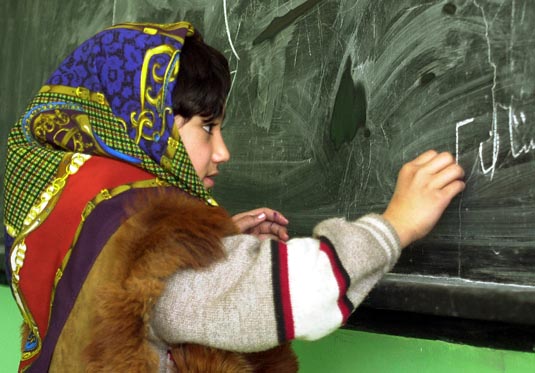
The archival image record on Wikimedia Commons preserves the U.S. Army caption, photographer credit and image identifier. Its embedded metadata names Kabul and Afghanistan. The record links to the former Defense.gov photograph page; the reproduced caption provides the school name and date that the image alone cannot establish.

That caption reports severe damage during the Afghan civil war and describes a planned Coalition Joint Civil Military Operations Task Force reconstruction project. It names Freedom Construction Company as the Afghan contractor engaged to remove debris. Read those statements as a record of the project’s status in March 2002. Completion would require a later project report or other dated evidence.
Three layers of a useful interpretation
1. What is visible
A student stands beside the board with a raised writing hand. The frame shows part of a classroom and a learning activity. Describe those details before using the caption. The tight crop gives little information about the surrounding building, the full class or the school grounds.
2. What the record supplies
The caption gives a school, a date, a photographer and a reconstruction context. These details make the picture locatable in history. Preserve the identifier when saving research notes so another reader can find the same image rather than a different photograph from the same school.
3. What remains a separate question
Attendance totals, the condition of every classroom and the eventual construction outcome require additional records. A national education trend requires evidence covering many schools and a defined population. Match the geographic scale of a claim to the scale of its supporting evidence.
Compare 2002 with later reporting carefully
The photograph’s date belongs in every reuse of its historical meaning. It records that moment; education access has changed over time and differs by educational level.
In its August 11, 2026 statement, updated August 19, UNESCO reported that girls and women remained excluded from secondary and higher education in Afghanistan and estimated that 2.4 million girls were excluded from secondary schooling. That national assessment concerns a later period and a defined level of education. It does not establish the present status of this particular classroom.
When comparing records, write down the date, location, school level and measure: enrollment, attendance, access or completion. A photograph and a national estimate can illuminate different questions when those labels remain explicit.
The historical photograph notes provide separate spaces for visible details, caption information, attributed claims and questions requiring another source.
Related reading
- Sharbat Gula’s portrait: Keep a photographed person, the setting, and later identification evidence in view.
- The 2002 Silk Road Festival: Connect a cultural record with its own place, date, and interpretive choices.
- Shackleton’s expedition photographs: Apply the same attention to date, position, and caption in a different historical setting.
More Geography guides: read photographs and cultural evidence