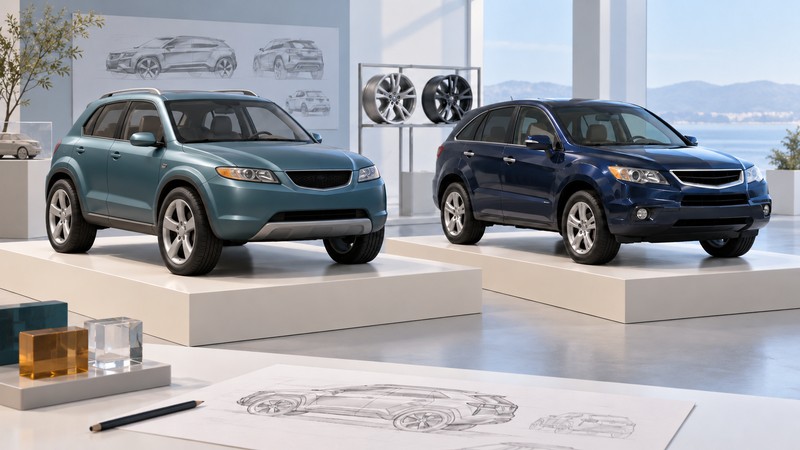
Follow the early Acura RDX through three dated stages: the 2005 RD-X concept, the January 2006 near-production prototype and the April 2006 production debut for model year 2007. Comparing the same feature across those stages reveals what the evidence actually supports.
This is a design-history case about the first RDX, useful when reading old show reports or checking an equipment claim. Keep a document’s publication date, vehicle stage and market together. A photograph establishes visible form; equipment and function need supporting specifications.
Read the three announcements in order
- January 2005: RD-X concept. Honda’s Japanese release dated January 11 reports the US announcement made on January 9. It describes a small SUV concept with SH-AWD, rosewood flooring and proposed communications features. The show interior expressed a direction for the forthcoming vehicle.
- January 9, 2006: RDX prototype. Acura’s near-production announcement specifies a 2.3-liter turbocharged four-cylinder, a five-speed automatic with paddle control, five seats and custom 19-inch wheels.
- April 12, 2006: production debut. The 2007 RDX release lists the turbocharged 2.3-liter engine, five-speed automatic and SH-AWD, with standard 18-inch wheels. It separates standard equipment from the optional Technology Package.
These dates describe announcements. For an individual car, add its own model year, market and build information. The sequence gives a documented path to production without assuming every show feature survived.
Trace a feature through the documents
On a narrow screen, scroll the table sideways. Keyboard users can focus the table region and use the arrow keys.
| Feature | Show-stage evidence | Production evidence to use |
|---|---|---|
| Wheels | The January 2006 prototype release specifies custom 19-inch wheels. | April 2006 lists standard 18-inch wheels; check any fitted replacements separately. |
| Camera function | The 2005 concept describes side views from cameras near the front doors. | The production Technology Package description identifies a rearview camera displayed in reverse. |
| Cabin and cargo | The concept describes rosewood flooring and an experimental interior. | The production release describes a three-person 60/40 split rear seat and a lockable console. |
| AWD | SH-AWD appears in the concept and prototype records. | The production release specifies SH-AWD as standard for the initial RDX. |
Use precise result labels in your notes: “documented at both stages,” “different documented specification,” or “not established in the sources checked.” Silence in a short press release leaves an evidence gap. A feature’s absence from that release alone does not prove it was unavailable in every market or configuration.
Separate the engineering description from the sales claim
The production release explains SH-AWD as distributing torque between the axles and between the rear wheels. That describes a control capability. Claims about sporting character, responsiveness or fuel economy need their own test conditions before they become a comparison. The same April announcement marks its fuel-economy figures as preliminary; they should remain attached to that date and status.
For historical research, preserve both the statement and its qualification. For ownership, check the actual installed equipment and current operation. A period navigation or communications feature also depends on its hardware, media, subscriptions and services. Demonstrate the function you need today instead of treating a 2006 announcement as a promise of current connectivity.
Example: the right feature from the wrong stage
Build a source record you can revisit
Download the RDX concept-to-production record. Choose one feature, cite the dated documents and state the remaining gap. Keep original-language wording beside your own concise translation when a detail matters; distinguish the Japanese publication date from the US event date.
For another documented transition, see the Qashqai concept-to-production guide. For the wider method of interpreting design proposals, use Automotive Design. Each case should stand on its own production evidence.
Explore Autos: vehicle guides, technology and design · Cars: buying, maintenance and ownership