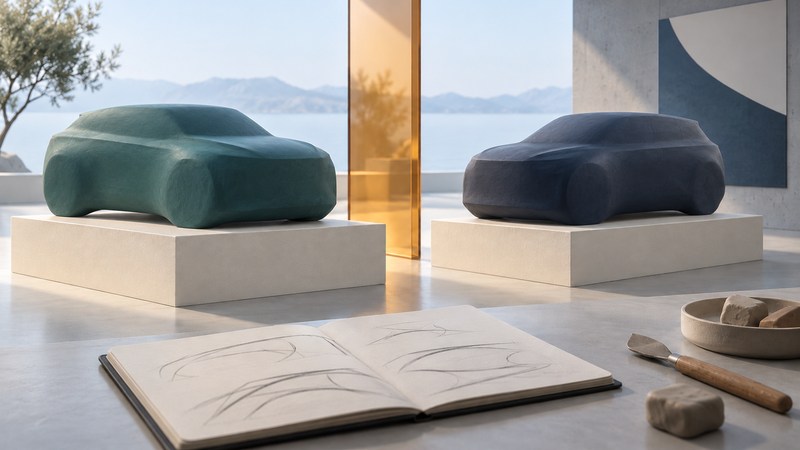
Follow an idea through different kinds of evidence
A concept car makes a design proposition visible. A production car must turn selected ideas into a vehicle that customers can obtain and use. The Nissan Qashqai offers a useful case study because its compact crossover purpose is easier to trace than every detail of its show-car mechanisms.
Begin with three questions: what human activity did the designers want to support, how did the concept demonstrate it, and what did the production documents actually promise? Keep those questions separate while comparing dates, photographs and specifications. Similar styling can support a design comparison; it cannot establish identical construction or equipment.
Keep the milestones in order
On a narrow screen, scroll the table sideways. Keyboard users can focus the table region and use the arrow keys.
| Milestone | What the record establishes | How to use it |
|---|---|---|
| Geneva, 2004 | Debut of the Qashqai concept | Treat this as the show-car stage, with its own mechanisms and design story. |
| September 2006 | Production Qashqai world premiere in Paris | Compare the announced customer vehicle with the concept. |
| December 2006 | Production began at Sunderland | Distinguish manufacturing start from the earlier reveal. |
| February 2007 | European sales launch | Use the relevant launch-market equipment documents for customer availability. |
Nissan’s September 2006 production announcement identifies the Geneva 2004 concept and the new production vehicle. Its December 2006 manufacturing announcement records Sunderland production, while the ten-year Qashqai retrospective describes the February 2007 sales launch. A later date on an archived press-kit webpage should not replace the event date in this sequence.
Read the concept as a proposal for everyday flexibility
Nissan’s Qashqai concept overview describes a vehicle for urban life and active weekends, developed as Nissan Design Europe’s first completed concept project at its London studio. Rear-hinged rear doors and the absence of a conventional center pillar created a broad side opening; a folding-seat arrangement illustrated carrying equipment such as bicycles.
Those features connect an activity to a physical demonstration. Record the activity as “load bulky leisure equipment” and the mechanism as “wide side opening and reconfigured seating.” This makes it possible to ask whether a later vehicle serves a similar activity through a different arrangement. The demonstration alone leaves load dimensions, restraints and production validation to be established.
Compare the purpose and the mechanism separately
On a narrow screen, scroll the table sideways. Keyboard users can focus the table region and use the arrow keys.
| Design question | Concept evidence | Production evidence and limit |
|---|---|---|
| Vehicle purpose | Compact crossover for urban use and active weekends | The 2006 release retains a blend of hatchback usability and SUV character; it does not promise every show-car feature. |
| Access and cabin | Wide side access and folding-seat demonstration | The February 2007 UK brochure shows a conventional passenger cabin and separate side-door openings. Check actual loading arrangements in the matching owner documents. |
| Traction choice | A four-wheel-drive concept proposition | The production announcement describes a model range, with four-wheel drive available on specified versions. Establish the market, engine and grade. |
The February 2007 UK electronic brochure (archived Nissan PDF) is useful for the launch-market cabin, exterior and equipment presentation. Its photos and option lists should be read together. Equipment shown in a photograph may depend on grade, and later Qashqai generations or the longer Qashqai+2 require their own documents.
These records show differences; they do not by themselves establish why every feature changed. Cost, crash performance, sealing, manufacturing and service access are sensible engineering questions to investigate. Label them as questions unless an attributable design or engineering source connects a particular constraint to a particular decision.
Test a claim with a concrete activity
Use the worksheet to give each claim a document, date, market and evidence type. Mark a statement as a documented fact, a manufacturer’s stated intention, your interpretation or an unanswered question. This method also works when a striking concept detail reaches production years later on a different model.
For a broader method of assessing design proposals, explore the automotive-design guide. Keep conclusions narrow enough that another reader can follow the evidence and see where interpretation begins.
Keep the evidence with the decision
Download the Nissan Qashqai Concept worksheet (plain text). Save the completed record with supporting documents, dates and unresolved questions.
Explore Autos: vehicle guides, technology and design · Cars: buying, maintenance and ownership