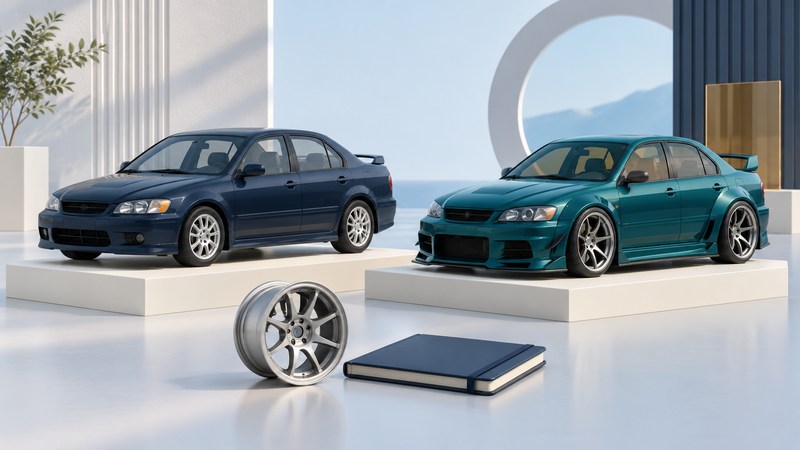
Start a 2004 Acura TL assessment by separating three things: the production sedan, its dealer-installed A-SPEC accessories and the A-SPEC show concept. They share a name, but a photograph or badge cannot establish what is fitted to the car in front of you. Build an equipment record before paying extra for a claimed specification.
Three meanings of A-SPEC
Yenra’s original December 2003 coverage centered on a modified show car. Honda’s 2005 SEMA vehicle list still identifies the 2004 TL A-SPEC Concept separately. For production equipment, Acura’s November 2003 SEMA fact sheet describes the 2004 TL and its accessory package: the six-speed manual car had Brembo front brakes, while the A-SPEC package included suspension, 18-inch wheels and exterior additions. These period descriptions are evidence about the announced configurations, not proof of a particular used car’s contents.
Scroll horizontally on a narrow screen. Keyboard users can focus the table region and use the arrow keys.
| Description | Evidence to request | What it cannot establish |
|---|---|---|
| Production TL | VIN, model year, original market and factory equipment record | A later fitted badge does not identify original equipment. |
| Dealer A-SPEC accessories | Dated installation invoice, part numbers and photographs | An accessory package does not turn the car into the show concept. |
| A-SPEC Concept | Manufacturer show records and original photographs | Concept features are not a production-car specification. |
| Later modification | Installer record, component identity and supporting work | A familiar brand name does not prove compatibility or workmanship. |
Reconstruct the car’s actual configuration
Before viewing, ask the seller for the VIN, transmission type, wheel and tire sizes, a list of modifications and maintenance invoices. At the car, compare the documents with the installed parts. A partial package should be described as partial: wheels and a spoiler alone do not establish that the suspension was changed. Record missing paperwork as unknown rather than assuming factory originality.
Use the owner’s manual and maintenance schedule for the exact year and market. Sort invoices by date and mileage, with separate entries for routine service, repairs and modifications. For time-sensitive work such as belt service, an invoice should identify what was replaced and when; “major service done” is too vague to close the question. Have an Acura-experienced technician establish what is due under the applicable schedule.
Give the inspector a specific brief
Ask for verification of the transmission and brake configuration, wheel/tire fit, suspension alterations, steering behavior, fluid leaks and evidence of prior body repairs. Include a road test appropriate to the car’s condition. Request observations during cold start, warm operation and ordinary shifts rather than a verdict based on one quick drive.
Try the seats, climate controls, windows, locks, audio and any navigation or phone connection while parked. Old infotainment hardware may still power up without supporting your present phone or preferred media. Write down the function you need and test that function, rather than treating a lit display as a pass.
The FTC’s used-car guidance recommends an independent inspection; a vehicle-history report does not replace it. Ask for findings, limitations and written estimates before deciding.
Turn an advertisement into a testable question
Separate three conclusions: the car suits you, the configuration is understood and the inspection findings are acceptable. A car can satisfy one without the others. Resolve title or identity discrepancies and obtain estimates for outstanding work before negotiating.
Finish with the vehicle’s own history
For U.S. cars, check NHTSA recalls and manufacturer campaign records. VIN results omit completed repairs and may omit campaigns over 15 years old.
Keep the equipment comparison, inspection report and campaign evidence together. That record gives a new owner a usable starting point and makes future modifications easier to distinguish from the car’s earlier history.
Save a working record
Download the working record (plain text). Open it in a text editor and save a private copy. Fill in the prompts, write “unknown” where evidence is missing, and attach the documents behind each conclusion. It includes this article’s address and source links.