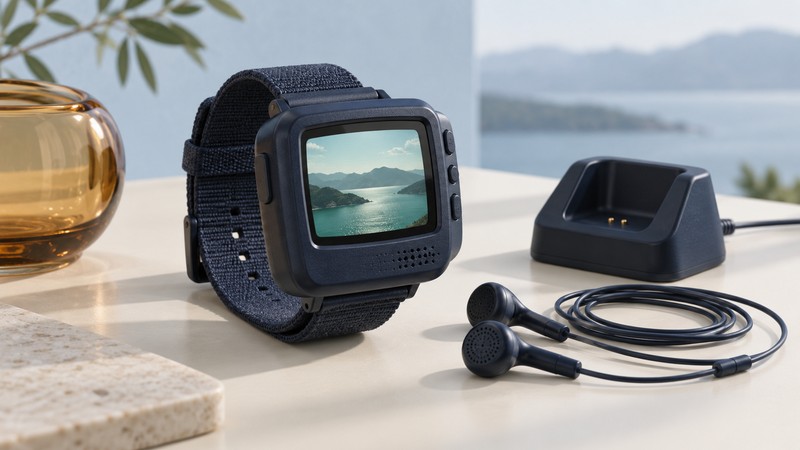
A wristwatch television compressed a screen, broadcast tuner, controls and battery into a wearable object. The NHJ VTV-101 shows both the appeal and the constraints: a tiny color picture depended on an appropriate analog signal and an earphone cable that also served as the antenna.
The VTV-101 as a documented example
The original NHJ VTV-101 owner’s manual, preserved as a scan, carries a 2004 copyright. Its specification table describes a 1.5-inch active-matrix color LCD with 280 × 220 pixels, monaural audio and an earphone antenna. The document identifies the product as made to U.S. specifications. Those are details of this model and manual, rather than a specification for every TV watch.
Four components shaped the experience. The screen made the picture visible; the tuner selected a broadcast; the earphone assembly provided sound and reception; and the power system limited the session. Miniaturizing the screen alone could not eliminate the other requirements.
The manual warns that reception changes with location and orientation, and that coiling the earphone antenna affects reception. That makes the accessory an important part of the artifact. A watch sold with an ordinary-looking replacement headset needs a compatibility check against the original connector and documentation.
The manual’s internal-battery figure is approximately one hour maximum; it separately describes an external AA-powered battery arrangement. Treat those figures as original specifications under the manufacturer’s conditions. They provide no measurement of an individual battery’s condition after years in storage.
Why a good display can still find no television
An analog television tuner expects an analog broadcast format. A digital television signal needs a compatible digital receiver to recover and decode its program. A list of channel numbers or the presence of a color LCD cannot substitute for that compatibility.
In the United States, full-power television stations completed their analog-to-digital transition on June 12, 2009, as recorded in this FCC order. Other transmitter classes and other countries followed their own timetables. Identify the location, date and actual broadcast system before evaluating a claim of over-the-air reception.
Conventional digital-to-analog converter boxes can feed suitably equipped analog televisions, but a wearable receiver also needs a documented compatible input. The VTV-101 manual identifies an earphone terminal and charging connection; that is insufficient evidence for a simple video-cable conversion. A seller should explain a demonstration’s signal source without implying that the device receives today’s local digital broadcasts directly.
Read a “working” listing precisely
Imagine a listing with a lit screen and a visible channel number. That establishes that some display and control functions operated for the photograph. A video showing an identifiable program, accompanied by the source and test conditions, supplies stronger evidence of picture reception. Neither test by itself measures battery endurance or establishes reception at the buyer’s location.
Make a useful collector record
- Identify the hardware. Record the complete model, regional markings and manual edition. Keep a visually similar model as a separate entry until its documentation agrees.
- Inventory the accessories. Photograph the wrist attachment, earphone assembly, cradle and power supply labels. Match them to the manual’s illustrations.
- Separate observed functions. Record clock display, controls, picture, sound and the exact conditions of any reception demonstration individually.
- Describe power evidence honestly. An original runtime specification, a seller’s claim and a timed observation are different kinds of evidence. Record which one you have.
- Preserve the whole context. Packaging, printed instructions and accessory photographs explain how the miniature television was intended to be used.
The manual instructs owners not to disassemble or replace the internal battery. An aged or damaged unit calls for an appropriate service or conservation assessment; historical charging instructions should not be treated as proof that a stored battery is fit for use.
The design’s historical interest lies in how it balanced portability against reception, viewing area and endurance. For the next stage of that technology story, read how tuners, demodulators and decoders divide the work in a digital receiver.