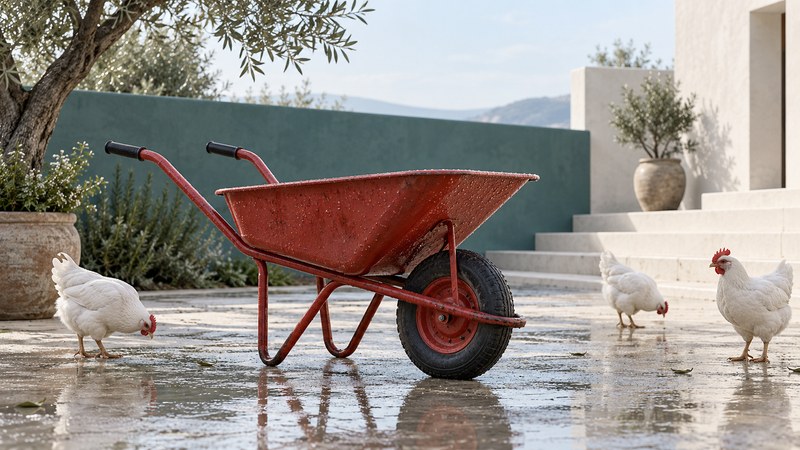
William Carlos Williams asks readers to spend time with things they might pass by: a wheelbarrow, a firetruck, plants emerging beside a road. The words can look simple while their placement changes the pace and force of seeing. Start by asking what the poem makes you notice, and when it allows you to notice it.
This guide follows three poems through image, motion, and emerging form. Open the complete texts linked below; each is short enough to reread while testing an observation. Then try the original exercise near the end to hear what line breaks can do.
Begin with attention to place and speech
Williams (1883–1963) combined a medical career with writing, and lived much of his life in Rutherford, New Jersey. The Academy of American Poets biography introduces his work and his interest in an American poetic language. That background helps explain why ordinary surroundings and the movement of speech are useful places to begin reading him.
For a first encounter, keep the interpretive task concrete. Describe what is present in the poem before proposing what it stands for. Then consider the order in which it appears. A reading becomes stronger when it can point to the exact word or break that produces an effect.
Three questions will carry you through this selection: What do I see or hear? Where does the line make me wait? What changes between the beginning and the end?
“The Red Wheelbarrow”: what depends on looking?
Read the complete poem at the Academy of American Poets. It begins with a statement of dependence, then presents a red wheelbarrow, rainwater, and white chickens. The importance is asserted before its object is revealed.
so much dependsupon
Opening two lines, William Carlos Williams, “The Red Wheelbarrow.”
Each of its four stanzas has a three-word line followed by a one-word line. The breaks separate “wheel” from “barrow” and “rain” from “water.” Familiar combinations momentarily become parts, then join again. The last stanza sets white against red and brings living movement beside the still object.
The poem leaves the dependent “much” open. You can consider work, sustenance, or the act of perception, but test each proposal against the small scene. The precision of its arrangement gives you firmer ground than an elaborate hidden story.
Try this: read it once as a continuous sentence and once following the stanza spaces. Describe where your attention changes. Allow a break to create a slight suspension without turning every line into a separate sentence.
“The Great Figure”: a glimpse in motion
Read “The Great Figure.” A gold numeral on a red firetruck comes into view amid rain and lights. The poem identifies the figure, then lets the vehicle’s motion and sounds carry the scene through the city.
Notice the succession of short lines. Three consecutive one-word lines isolate movement, tension, and being unheeded. Later, the sound words gather around gongs, sirens, and wheels. Read those final phrases aloud: the mouth has more noise to make as the vehicle passes.
The title can draw attention both to the numeral and to its striking appearance. The speaker’s glimpse holds a moment in place while the truck continues moving. Compare this with the wheelbarrow: both scenes are concrete, but one invites lingering and the other registers an encounter in transit.
Try this: mark a visual detail and an audible detail. Explain how their sequence creates the impression of motion. Stay with what the observer can actually see or hear.
“Spring and All”: watching form emerge
Read “Spring and All,” beginning “By the road to the contagious hospital.” The opening gives us cold air, muddy fields, and the remains of plants. Spring approaches through a scene that still looks lifeless. The poem asks us to attend to emergence while it is incomplete.
The description gradually gives plants distinct outlines and actions. By the end, rooted growth has a grip and a beginning. Watch the shift from scattered visible material to the verbs that make it active. An apparently bleak roadside becomes a place where change can be observed closely.
Try this: list three details from the opening and three actions or changes from the ending. What must the observer do to perceive continuity between them? A useful reading follows the gradual change rather than replacing the scene with a general statement about renewal.
The poem appears in the 1923 book Spring and All, which also contains the poem now called “The Red Wheelbarrow.” New Directions’ description of its facsimile edition explains their original numbered positions. The book title and the title commonly used for its opening poem can therefore refer to different scopes.
Try line breaks with a scene of your own
Choose one ordinary object within sight. Write a sentence naming its material, location, and one action or visible condition. Use specific details before adding an explanation of what the object means. This short exercise explores a technique; it produces your own writing.
- Write your observation as one sentence.
- Divide it into lines that follow its ordinary spoken phrases.
- Make a second version with one delayed noun or an unexpected break.
- Read both aloud and describe one change in emphasis.
- Keep the arrangement that serves the observation, and remove a break that only makes reading awkward.
The exercise also helps you distinguish a printed line from a spoken pause. A line ending can emphasize a word while the sentence continues through it. Rhythm comes from managing that relationship.
Read onward through a contrast
Compare Williams’s brief, exact scenes with Whitman’s expansive lines, or with the small objects that become inward experiences in Dickinson’s poetry. Keep one question constant: how does the arrangement of words shape what the reader notices?
Return to the Poets directory or browse the Poetry library. The linked poem pages provide the complete texts; the short quotation here follows the Academy’s display. Check the edition credit when comparing another printing.