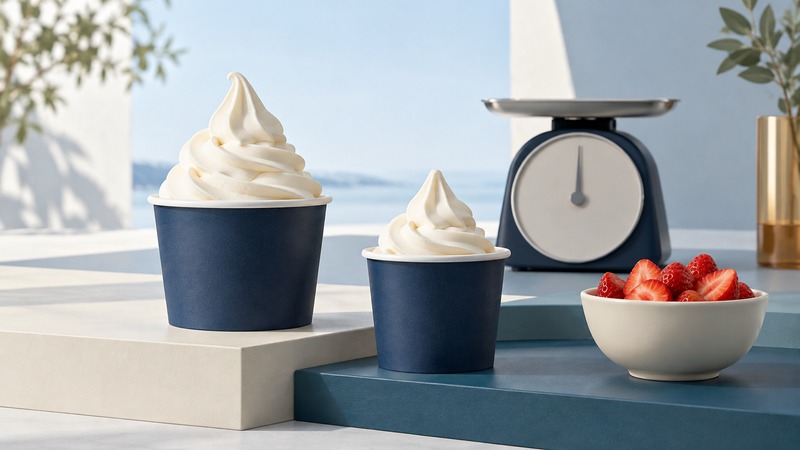
At a self-serve frozen-yogurt shop, the final cup combines the yogurt and every topping. Check the store’s price and ingredient information before filling it, then choose a portion that fits both your appetite and budget.
Start with the actual store
Yogurtini describes a swirl, top, weigh and pay format, with rotating flavors and toppings. Its site says flavors vary by location. Use the official location finder to identify the shop and ask about its current choices and charging method.
Read the posted unit: price per ounce by weight differs from a price per cup. Confirm how the empty cup is accounted for, whether any items carry separate charges and whether tax is included. A delivery menu may use fixed portions and a different price structure from an in-store visit.
Translate a budget into finished weight
For a simple price-per-ounce system, food subtotal = charged food weight × price per ounce. Divide your target food subtotal by the unit price to find the corresponding weight. Use the store’s charged net weight; its cup deduction is a checkout procedure to confirm with staff.
Fictional example, not a Yogurtini quote: at $0.80 per ounce, a 6 oz finished serving costs $4.80 before tax or other charges. Adding 2 oz of toppings makes it 8 oz and $6.40. A $5.60 food-subtotal target allows 7 oz in total: $5.60 ÷ $0.80 = 7.
| Charged food weight | Calculation | Subtotal before tax |
|---|---|---|
| 5 oz | 5 × $0.80 | $4.00 |
| 7 oz | 7 × $0.80 | $5.60 |
| 10 oz | 10 × $0.80 | $8.00 |
A swirl’s height is an unreliable weight gauge. Leave space for toppings and ask whether staff can help estimate or weigh the cup before you add more. If a total spending limit includes tax, reserve room for that too.
Give each topping a purpose
Choose a base flavor first, then one contrasting addition: fruit for a different texture, cookie pieces for crunch, or a sauce for a concentrated flavor. Two or three small additions are easier to judge than a full layer from every bin. Denser toppings can add considerable weight in little space.
For a crunchy finish, put dry toppings on last and eat promptly. Mixing everything together distributes flavor but softens crumbs. For a two-flavor cup, try a small amount of each before building a large serving, following the shop’s sample policy.
Nutrition figures need the same attention to quantity as price. Record the exact flavor’s stated serving weight and scale its values to the amount used; then add each topping. A mixed swirl plus unmeasured toppings supports only a rough estimate.
Check ingredients before the cup is filled
Ask for the current ingredient and allergen information for each selected flavor and topping. Terms such as dairy-free, gluten-friendly and no-sugar-added describe different properties. Check the specific concern instead of treating one label as covering all of them.
The FDA explains allergen cross-contact: ingredients can transfer through shared equipment or handling. Ask staff about machines, utensils and the open topping area. Decide with them whether the store can meet your needs before serving yourself.
For another customizable dessert with quantities you can measure at home, use the four-person sundae plan. Keep the local unit price and a preferred finished portion in your notes if you want to repeat an order.