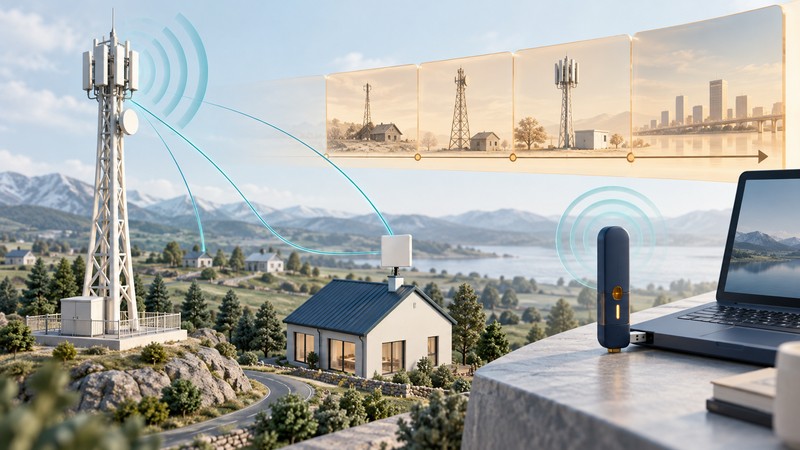
WiMAX is a broadband wireless technology associated with the IEEE 802.16 family and WiMAX Forum interoperability programs. It was developed for provider access networks, with both fixed and mobile ambitions. Wi-Fi commonly supplies a local connection inside a building; a WiMAX link could supply the upstream service to that building.
Understanding the layers helps interpret a historical rollout or an old modem. A technology name, a frequency band and an operator account each answer a different compatibility question.
Follow fixed access into mobile operation
Fixed wireless places a subscriber receiver at a chosen location and connects it to a provider base station. A mobile system must also handle subscribers moving through the network. Those uses introduce different requirements for radio behavior, power and continuity.
The IEEE 802.16 Task Group e record dates approval of IEEE 802.16e-2005 to December 7, 2005 and describes combined fixed and mobile operation in licensed bands. This is a standards milestone. It does not establish when a particular community received service or which devices an operator accepted.
Keysight’s WiMAX overview explains the role of system and certification profiles. Equipment is evaluated against a particular profile. A WiMAX label alone leaves frequency, channel width, implementation and operator support to be established.
Separate the jobs in a broadband connection
On a narrow screen, scroll sideways. Keyboard: focus the table and use the arrow keys.
| Layer | Example role | Evidence needed |
|---|---|---|
| Local network | Laptop joins a home Wi-Fi router. | Supported Wi-Fi and local security configuration |
| Subscriber access | A rooftop receiver connects the premises to a WiMAX base station. | Compatible equipment, profile and provider eligibility |
| Backhaul | The base station reaches the provider’s core network. | Sufficient upstream capacity and maintained infrastructure |
| Service | An account receives internet access and support. | Current operator terms, activation and actual availability |
Wi-Fi and WiMAX can therefore appear in the same working connection. Replacing the indoor router does not automatically replace the provider-facing radio. Likewise, an Ethernet socket on an old receiver describes its local interface, not whether its radio can join a different operator.
Read “4G” with its date and specification
Generation labels summarize an industry period; the underlying standard and profile describe the implementation more precisely. The ITU’s IMT technology explanation identifies LTE-Advanced and WirelessMAN-Advanced as IMT-Advanced technologies while discussing the broad use of the term 4G.
When interpreting a period announcement, retain its date and distinguish a proposed service, a launched service and a measured result. An advertised peak rate needs channel conditions, sharing assumptions and a measurement boundary before it can describe a user’s download. A deployment plan’s coverage or monthly price belongs to its stated location and period.
The WiMAX Forum certification page also describes specialized AeroMACS and WiGRID programs. These are reasons to examine specific applications and product records, rather than assume that the technology’s entire history is one consumer-market story.
Evaluate an old device without guessing
Fictional equipment check: an old USB modem and a used rooftop receiver both say WiMAX. Before considering either for a connection, obtain their model documentation and ask the intended operator about the exact devices, radio profiles and activation process. A matching label is only the first inventory field.
Record the frequency range, profile, firmware, driver requirements, power supply and management access. Confirm who can provision the device and whether supported software is obtainable. Do not infer eligibility from a seller’s demonstration that the device powers on.
For an ordinary present-day internet decision, begin with service available at the actual address and a test of the intended applications. Keep historical WiMAX specifications useful as technical context, while obtaining current equipment and service answers from the responsible operator.
Compare current offers with the fixed wireless service guide, or explore OFDM and useful throughput for the radio background.