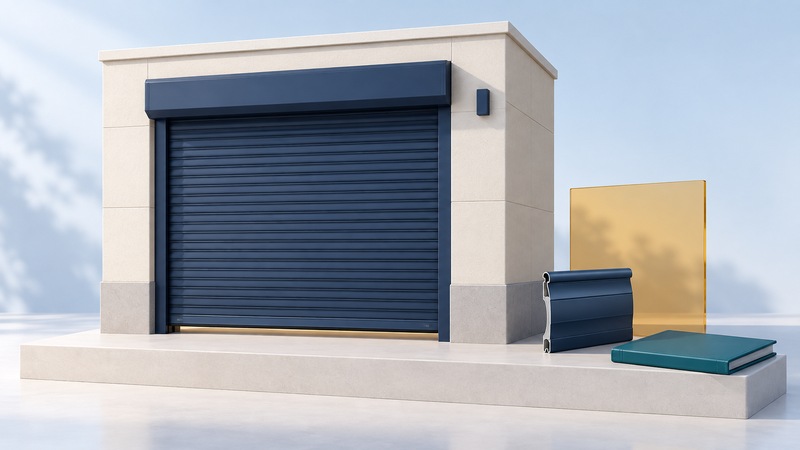
Choose a rolling steel door by defining the opening, the traffic through it and the performance the complete assembly must deliver. A useful purchase brief connects the curtain, guides, operator, controls and service support to the way your building works.
This guide is for facility managers, commercial property owners and project specifiers preparing a replacement or new installation. Start with the existing door's identification, available drawings, a record of busy periods and the reason for the project. Have a qualified supplier verify dimensions and mounting conditions before ordering.
Choose the door type around the opening's purpose
A rolling steel curtain consists of interlocking slats that travel in side guides and coil above the opening. That arrangement concentrates storage overhead; the hood, brackets, operator and access for servicing still need space. Ask for a drawing showing the complete assembly against the actual wall, ceiling and nearby services.
- Service door: closes a commercial opening for access control and protection. Define whether it is operated a few times a day or repeatedly during deliveries.
- Insulated service door: adds thermal features. Evaluate the quoted curtain and perimeter details alongside air leakage and the time the opening stays open.
- Fire door: protects an opening in a fire separation with a specifically labeled assembly and its required closing system. Have the design professional establish the required protection and confirm the selected assembly with the local authority.
- Counter door or grille: serves a different opening or visibility/ventilation need. Request the product family that matches the use before comparing finishes.
For a concrete example of why the configuration matters, Overhead Door's Model 600 information lists choices such as a wind-load package, motor operation and sensing edge. A product-family name leaves these details unresolved; the quotation and approved drawings should identify what is actually included.
Where fire protection is required, retain the label information and test records as part of the building's opening-protection register. DASMA TDS 271 on rolling steel fire doors, revised June 2025, describes inspection and drop-testing at least annually by a trained rolling steel fire-door systems technician under NFPA 80. Confirm the adopted requirements and any more frequent project or manufacturer requirements with the responsible authority and service provider. Arrange this specialist work as part of the service contract.
Describe the opening and workload before requesting prices
Record clear opening width and height in one stated unit system. Add the available headroom, side room, mounting face, wall construction, floor condition and obstructions. Treat owner measurements as preliminary; supplier verification and engineered support details settle the order dimensions and attachment design.
Observe representative operating periods. Record complete opening-and-closing cycles, the busiest hour, consecutive movements, time held open, vehicle queues and whether pedestrians use a separate route. State your counting convention so the supplier can relate it to the product's published limits. Include expected changes such as a second shift or more frequent deliveries.
List how access should work: staffed controls, access credentials, automatic activation, supervision, power-loss arrangements and any connection to alarms or dock equipment. Have the supplier document the appropriate operator and protective devices for that operating mode, their compatibility and the owner checks required by the manual. Agree on pedestrian access and egress with the project designer.
Compare the evidence behind each performance claim
Use the same brief for every bidder. Ask each to identify its exact model, dimensions, operator, options and supporting documents, then mark each requirement as confirmed, excluded or awaiting verification.
On a narrow screen, scroll the table sideways; keyboard users can focus the table region and use the arrow keys.
| Decision | Ask for | How to use it |
|---|---|---|
| Opening and attachment | Dimensioned drawing, mounting details and responsibility for support design | Resolve clashes and structural work before the order is released. |
| Operating demand | Cycle definition, permitted duty, opening/closing speeds and operator limits | Compare both daily use and concentrated busy periods with the proposed configuration. |
| Wind exposure | Required positive/negative design pressures and matching product documentation | Have the design professional confirm the site requirement and the supplier confirm the assembly's suitability. |
| Thermal performance | Test or calculation method, units, tested size and whether the value covers a slat or complete door | Compare results on the same basis; request air-leakage information separately. |
| Controls and protection | Operator/control schedule, protective-device details, manuals and commissioning responsibilities | Check that the complete operating arrangement is documented and supported. |
| Service and ownership | Maintenance requirements, parts support, response arrangements and written warranty exclusions | Include inspection, callout, labor and downtime assumptions in the ownership comparison. |
For wind, use project-specific pressures. DASMA's explanation of pressure versus wind-speed specifications shows why building geometry, exposure and the applicable code affect the conversion. A broad miles-per-hour claim leaves the door's actual design requirement unresolved. Keep the required pressure units and the supplier's rating basis explicit.
For insulation, ask what was measured. DASMA TDS 196 on thermal ratings distinguishes calculated section R-value from whole-door U-factor testing. Its thermal verification program covers sectional garage doors and explicitly excludes rolling steel and high-speed doors. Use the distinction to question the evidence, while requesting documentation applicable to the rolling door being offered.
A claim about one component's cycle life also needs context: ask which parts it covers, the test conditions and any required replacement or maintenance. A warranty term is a contractual coverage statement; read the operating conditions, exclusions, labor provisions and start date alongside it.
Example: the busiest hour changes the specification
Then compare complete proposals. If one includes installation, commissioning and the first scheduled service while another quotes only the supplied door, request the missing amounts and responsibilities before choosing. Record the currency, quotation date and assumptions; use actual project quotations for costs.
Make service planning part of acceptance
DASMA TDS 270 for building maintenance supervisors, revised June 2021, calls for manufacturer-specific maintenance and trained technicians for repairs and adjustments. It warns that counterbalance parts can remain under extreme spring tension. Do not adjust springs, tension wheels or counterbalance assemblies yourself.
Ask the service provider to distinguish owner observations from technician tasks, specify the schedule and define what requires taking the door out of service. Keep a log of unusual noise, binding, impact damage, control faults and the action taken. After high wind, flooding or an earthquake, arrange an evaluation as recommended by TDS 270. Use the manufacturer's procedure for any authorized user checks.
- Identify the installed system. Record the door and operator model/serial numbers, approved drawings, options and manual revisions.
- Document commissioning. Obtain the installer's records for operation and protective devices, any required authority sign-off, and unresolved items with named owners.
- Receive operating instruction. Have the provider demonstrate the intended controls and explain power-loss and fault reporting arrangements using the actual manuals.
- Schedule support. Record the service contact, inspection dates, warranty details and spare-parts route. Keep fire-door test documentation with the relevant opening record.
Download the editable door-selection brief to record the opening, workload, evidence gaps and handover responsibilities. Save a separate copy for each opening and send the same completed requirements to bidders.