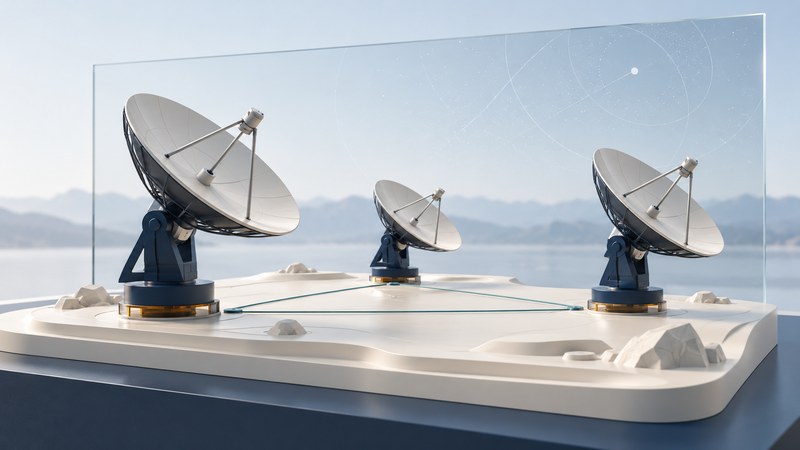
A radio telescope array combines signals from separated antennas to measure the sky at several spatial scales. Its longest separations help resolve fine detail, while shorter separations and single-dish measurements help recover broad emission. To read an array image well, look beyond the number of dishes to wavelength, configuration, calibration and the image's resolution scale.
From an antenna to a correlated signal
A parabolic dish gathers incoming radiation and directs it to a receiver. The receiver preserves information about the changing signal. In an interferometer, a correlator compares signals from pairs of antennas after accounting for their different arrival times. Each pair forms a baseline.
The measurement from a baseline is called a visibility. It contains information about brightness structure on a particular angular scale and orientation. Combining many baselines, and the changing projected geometry as Earth rotates, gives a richer sampling of the sky. ESO's ALMA interferometry explanation introduces why this arrangement achieves detail that one practical millimeter-wave dish could not.
The array's span sets a resolution scale, but the gaps between its antennas remain important. An array spread over a kilometer has neither the collecting surface nor the complete sampling of a filled kilometer-wide reflector.
Four different meanings of “seeing more”
| Quantity | Question it answers | Important influences |
|---|---|---|
| Angular resolution | How close can two structures be and still be distinguished? | Wavelength, projected baselines, weighting and signal quality. |
| Sensitivity | How weak a signal can be measured? | Collecting area, receiver noise, bandwidth and integration time. |
| Field of view | How much sky is covered by one pointing? | The individual antenna's response; mosaics combine pointings. |
| Recoverable angular scales | Which broad structures survive the sampling and reconstruction? | Short baselines, single-dish information and observing strategy. |
The ALMA Science Portal's basics explains the role of the compact array and total-power antennas in recovering extended emission. A very extended configuration can resolve compact knots beautifully while missing smooth emission around them. The appropriate configuration depends on the source as well as the desired sharpness.
Worked example: change the baseline
At a fixed baseline, doubling the wavelength doubles this ideal angular scale. That is why comparing telescope diameters or array spans without the wavelength can be misleading. Optical, infrared and radio facilities answer different questions using different signals.
How measurements become an image
Calibration first estimates effects introduced by the atmosphere, receivers and signal paths. Observations of suitable reference sources help establish phases, amplitude scale and frequency response. Imaging then combines the calibrated samples into an estimate of the sky.
Incomplete sampling produces a point response with sidelobes. Reconstruction methods seek a sky model consistent with the data and account for that response. Choices about weighting and deconvolution can change the balance between noise and resolution. ALMA's primer collection covers calibration, imaging weights and missing spatial scales as separate parts of this process.
For a spectral line, the result may be a cube: two sky coordinates plus frequency or velocity. A displayed integrated-intensity map sums selected channels. Record which channels and mask were used; the final colored image alone hides those choices.
Read an ALMA image in five steps
- Identify whether the image shows continuum radiation, a spectral line or a derived quantity such as velocity.
- Read its wavelength or frequency, angular scale and displayed units.
- Find the synthesized-beam ellipse, usually near a corner. It marks the resolution footprint, which can be elongated.
- Check the noise level, observing configuration and whether short-spacing or total-power data were included.
- Before comparing another image, check alignment, resolution, units and channel selection.
A smooth halo absent from an image may fall below its sensitivity or outside its well-sampled angular scales. A dark feature deserves the same checks before it becomes a physical hole. Conversely, repeated structure across independently calibrated observations and suitable configurations strengthens an interpretation.
Radio maps can complement optical galaxy photographs by tracing neutral or molecular gas. See how to read interacting galaxies for a case where the gas extends beyond the bright stellar structures. For the different challenge of atmospheric blur in optical imaging, continue with laser guide stars and adaptive optics.