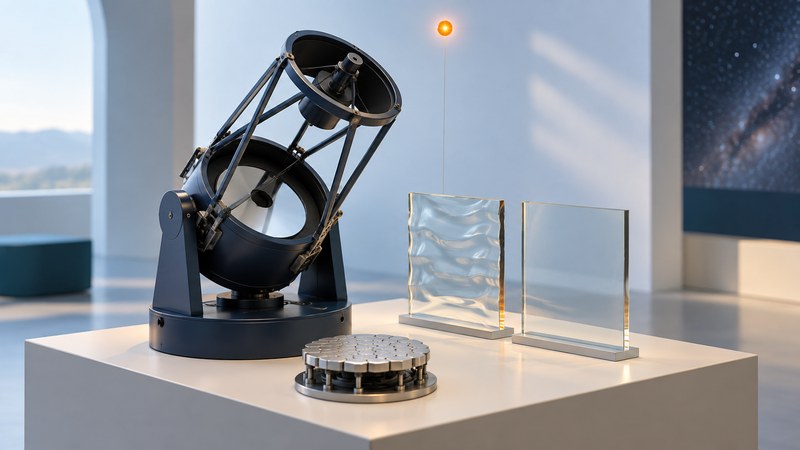
A laser guide star gives a telescope a bright reference for measuring atmospheric distortion near a science target. An adaptive-optics system uses that information to reshape a mirror rapidly, concentrating more of the target's light into a sharp image. The laser creates a reference in Earth's atmosphere; the distant object supplies the light being studied.
Why the atmosphere blurs a telescope image
Air with changing temperature and density bends light by slightly different amounts along different paths. Across a large telescope aperture, the incoming wavefront becomes distorted. A long exposure averages the moving pattern into a blurred image, often described through the atmospheric seeing.
Adaptive optics measures and corrects those changing distortions during the observation. This differs from active optics, which maintains the telescope's overall mirror shape and alignment on slower timescales. ESO's adaptive-optics overview explains the role of a bright reference source close to the direction under study.
Follow the correction loop
- Measure a reference. A wavefront sensor samples light from a suitable star or artificial beacon and estimates its distortion across the aperture.
- Calculate a correction. A real-time controller turns the sensor information into commands, accounting for the instrument's response and delay.
- Change the mirror. Actuators alter a deformable mirror's surface so reflected light carries a compensating change.
- Repeat. The atmosphere continues to evolve, so correction proceeds throughout the exposure.
The sensor needs enough light, enough spatial sampling and sufficiently fast measurements for the conditions. Errors left by imperfect sensing, finite actuator spacing and control delay contribute to a residual halo around the sharpened image.
ESO's explanation of adaptive-optics components connects the sensing cameras, guide stars and correcting optics. Individual systems implement that loop differently, so compare their observing modes before applying a performance figure to another instrument.
What the laser reference adds
Suitable natural reference stars are unevenly distributed across the sky. A sodium laser guide star excites atoms in a layer roughly 90 kilometers above Earth, creating a reference near a desired pointing direction. ESO's four-laser facility description shows how several such references sample different directions around a field.
A beacon at finite altitude samples a different volume of turbulence from a star effectively at infinity. This geometric difference is often called the cone effect. Multiple beacons can help reconstruct atmospheric structure, but performance still depends on the particular correction architecture.
Conventional laser-guide-star systems also need natural-source information for overall image motion, known as tip and tilt. The outgoing laser path makes that motion ambiguous in the returning beacon. ESO's comparison of adaptive-optics modes explains these limitations and the distinction between correcting one direction and a wider field.
Compare corrected images fairly
| Check | Why it matters |
|---|---|
| Wavelength and aperture | They set the diffraction scale; a sharper-looking infrared image and a visible image may sample different emission. |
| Exposure and display stretch | Contrast adjustments can hide a faint halo or exaggerate apparent improvement. |
| Reference position and brightness | Sensing quality and separation from the science target affect correction. |
| Field position and time | Correction can vary across the image and as atmospheric conditions change. |
| Point-spread function | A narrow core and a broad residual halo can coexist. |
The point-spread function is how the system records an unresolved source. Its width describes one aspect of sharpness. The Strehl ratio compares the peak intensity with an ideal diffraction-limited image at the same total flux; it provides another measure. Neither number alone establishes the accuracy of every faint feature near a bright source.
Worked example: a sharper core
When reading a discovery, look for a measured reference response, repeated observations and checks on instrumental artifacts. This turns “sharper than before” into a specific statement about which structures the observation can resolve.
For related comparisons, read how infrared wavelengths and thermal background shape observations. The radio-array guide explains another way to obtain fine angular detail through separated antennas.