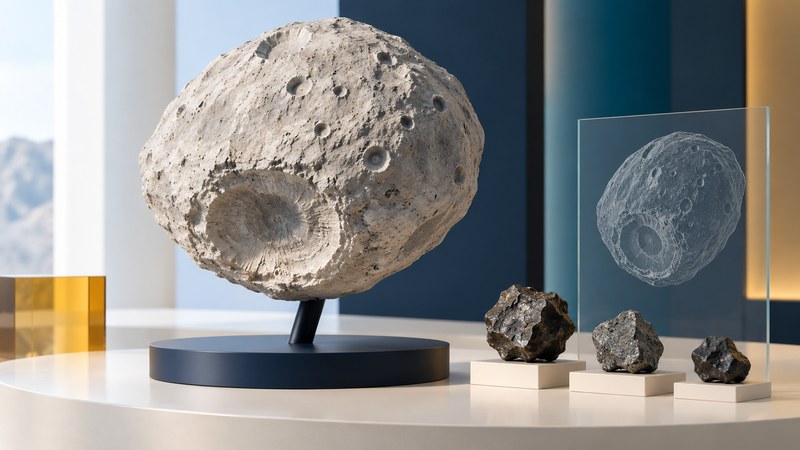
Dawn transformed Vesta from a distant point of light into a mapped rocky world with giant impact basins, varied surface materials and a strong connection to meteorites. Its deeper structure remains a scientific question: a 2025 reanalysis challenged the familiar picture of a large iron core. Read the mission's results by separating surface observations, laboratory comparisons and models of the interior.
What the Vesta campaign measured
Dawn orbited Vesta from July 16, 2011 to September 5, 2012 before traveling onward to Ceres. NASA's Vesta overview records those dates. The spacecraft's cameras, compositional measurements and precise tracking supplied complementary evidence about shape, terrain, materials and gravity.
A photograph records reflected light. Spectra constrain the minerals contributing to that light. Tracking changes in spacecraft motion constrains the gravity field. Combining these observations is powerful because they address different properties, although each retains its own resolution, coverage and modeling assumptions.
Read the great southern basins
Two enormous southern impact basins, Rheasilvia and the older Veneneia, dominate Vesta's geological story. NASA's Dawn science summary describes their overlapping structure, associated trough systems and material excavated during impacts. Rheasilvia is roughly 500 kilometers across, comparable to Vesta's overall size.
When reading an image, first find the basin outline, central terrain and later craters. Their spatial relationships help establish a relative sequence. An impact crater superposed on an older basin records a later event. Converting crater populations into absolute ages requires assumptions about the impact history and how surfaces preserve or erase craters.
Use a caption's illumination and projection information when judging relief. Brightness can change because of slope, lighting, grain properties or composition. A color-enhanced mineral map adds another layer of interpretation. It needs its own legend rather than being read as natural surface color.
How meteorites connect the surface to laboratory evidence
The howardite, eucrite and diogenite meteorite group, abbreviated HED, provides samples associated with Vesta and related fragments. Dawn's mineralogical and elemental measurements strengthened the link between the asteroid's surface and those laboratory specimens. This connection allows remote observations to be interpreted alongside detailed measurements of rocks on Earth.
Eucrites record igneous processing; diogenites represent a different assemblage of igneous minerals; howardites mix material. The combined evidence indicates a history involving heating, melting, impacts and mixing. A particular meteorite's association with this family is distinct from proving the exact crater that launched it toward Earth.
Surface materials also include contributions from later impactors. The Dawn study of dark material connected low-reflectance deposits with incoming carbonaceous, volatile-bearing material. A dark patch therefore needs compositional and geological context before being treated as a window into Vesta's original interior.
Why the interior picture changed in 2025
Early interpretations combined the basaltic surface, HED meteorites and gravity data into a model of a differentiated body with crust, mantle and a substantial iron core. Differentiation means that materials separated into layers during evolution. A cutaway of those layers illustrates a model inferred from evidence.
A 2025 Nature Astronomy study led by Ryan Park used Dawn tracking and imaging to constrain Vesta's rotational properties and moment of inertia. That quantity describes how mass is distributed relative to the rotation axis, adding information beyond overall mass and shape.
NASA's explanation of the reanalysis describes a more uniform interior consistent with a very small iron core or none. Possible evolutionary explanations include incomplete layering or reassembly from debris after a major collision. Those alternatives remain interpretations to test; the result warrants updating the simple large-core story.
The surface evidence for igneous processing and the revised mass-distribution evidence address different parts of the history. A useful account keeps both in view and asks which formation model can explain them together.
Distinguish the observation from the reconstruction
| Evidence | What it constrains | Interpretation still required |
|---|---|---|
| Images and terrain models | Surface shape, basin geometry and overlapping landforms. | Impact sequence, excavation and absolute ages. |
| Spectra and elemental measurements | Properties of sampled surface materials. | Mineral mixtures, processing and provenance. |
| HED laboratory measurements | Rock chemistry, textures and histories. | Association with particular regions and delivery pathways. |
| Gravity and rotational constraints | Mass distribution compatible with the observations. | Internal layering and the history that produced it. |
A useful way to read the next Vesta result
Record the instrument, measured quantity, model date and competing explanation. This makes an older mission productive long after its observing campaign: archived measurements can answer new questions as analysis improves. For related interpretation skills, see reading lunar terrain maps and the historical Cassini encounter with Phoebe.