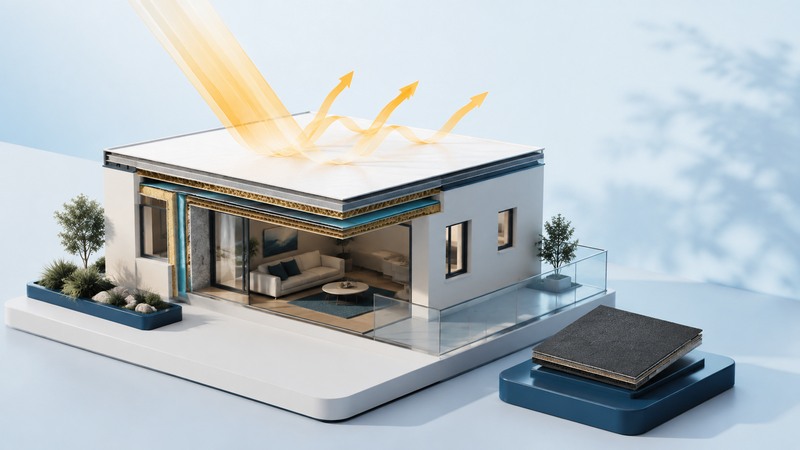
A cool roof reflects more sunlight and can reduce heat entering a building. Its value is easiest to assess when a roof already needs replacement or a compatible coating. Start with the roof’s condition and local climate, then compare material ratings and a building-specific estimate of heating and cooling effects.
Gather the roof type, slope, age, leak history, insulation information and recent energy bills. A homeowner can assemble this brief; a roofing professional should assess the assembly, drainage, moisture and product compatibility.
Identify the temperature or energy result
DOE’s guide to cool roofs explains two material properties: solar reflectance measures the fraction of sunlight reflected, and thermal emittance describes the ability to release heat by thermal radiation. Both influence roof temperature. A roof can have a cool-colored finish as well as a white one.
On a narrow screen, scroll the table sideways. Keyboard users can focus the table region and use the arrow keys.
| Outcome | What it tells you | Evidence to request |
|---|---|---|
| Roof-surface temperature | How hot the exposed material becomes | Comparable sun, weather, time and measurement method. |
| Indoor temperature or comfort | Conditions experienced in occupied space | Room location, insulation, ventilation and cooling operation. |
| Cooling electricity | Energy used by air conditioning | Weather-adjusted consumption or a model of this building. |
| Outdoor air temperature | Neighborhood or city-scale conditions | Area treated, urban form, weather and model assumptions. |
For historical context, a 2015 Berkeley Lab study of Guangzhou modeled citywide roofs with the reflectance of aged white roofing. Its average urban midday air-temperature reduction was 1.2°C during simulated heat waves and 0.8°C in typical summer conditions. Those are regional-model results under extensive roof adoption. A single roof proposal needs its own building assessment.
Compare the exact rated products
Ask each bidder for the product, color, model and Cool Roof Rating Council identification. The CRRC rating process distinguishes initial properties, interim laboratory-aged Rapid Ratings and actual three-year weathered ratings. Record which type is quoted. An attractive initial value tells you less about weathered performance than an appropriate aged comparison.
Keep solar reflectance, thermal emittance and solar reflectance index (SRI) in separate fields. SRI combines radiative properties in a standardized calculation; it is a different quantity from reflectance. A rating describes tested material properties. For suitability, also obtain the manufacturer’s written requirements for the substrate, preparation, application, maintenance and warranty.
Compare complete roof systems with the same work included. A coating proposal may require repairs first; a replacement may include tear-off, insulation and flashing. Ask the contractor to identify those differences before treating the totals as competing prices.
Include winter and the rest of the building
Reflecting sunlight can reduce beneficial winter heat gain. Evaluate annual heating and cooling together, including your insulation and cooling equipment. Berkeley Lab’s China building study illustrates why climate matters: it compared multiple cities and building types, finding benefits in hot-summer regions under the modeled conditions.
Request two otherwise identical building scenarios: the proposed roof and the baseline roof. Keep weather, thermostat schedules, occupancy, insulation and equipment efficiency consistent. If insulation also changes, ask for a separate estimate of its contribution. For an unconditioned building, ask about occupied-room temperatures and hours of overheating instead of assuming an air-conditioning bill reduction.
Fictional proposal comparison: a compatible cool finish adds $600 to a roof replacement already planned. A building model estimates $90 less cooling expense and $20 more heating expense per year: net $70 per year. Simple recovery of the extra $600 is about 8.6 years. This illustration excludes discounting, maintenance differences and changing energy prices; substitute project-specific inputs and compare the result with the expected service period.
Turn the assessment into a contractor brief
Ask for a roof-condition finding, exact product documents, drainage and moisture assessment, itemized scope, annual energy assumptions and maintenance obligations. Resolve who is responsible if existing leaks or trapped moisture are found. Keep the installation and performance warranties with the final proposal.
Use the home energy conservation guide to compare other ways to reduce cooling demand. If rooftop solar is also planned, coordinate roof life, attachments and future panel removal using the solar quote guide. A useful decision combines roof serviceability, comfort, cost and maintenance.
Cool-roof contractor brief
Cool-roof contractor brief — plain-text download. Save a copy and fill it in with your own information. The file includes instructions, assumptions and references so it can be used independently.