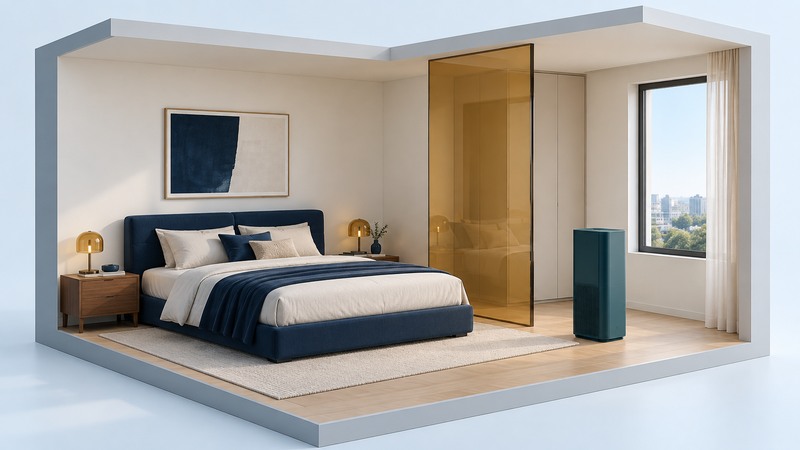
Improving apartment air starts with the source and the room where exposure happens. A practical plan combines reducing indoor emissions, using ventilation when outdoor conditions are suitable, and filtering airborne particles with equipment sized for the space.
Begin with a floor sketch, room dimensions, a list of recurring sources and the air cleaner’s manual if you already own one. Prioritize a frequently occupied room, such as the bedroom, so the first changes are specific and manageable.
Identify the source and the building constraint
Keep a short log of cooking, smoking nearby, fragranced products, cleaning, moisture and outdoor smoke. Note the room, time and existing exhaust arrangement. EPA’s indoor-air guidance puts source control at the center of improvement, alongside ventilation and air cleaning. Report leaks and persistent moisture to building management; filtering particles leaves the moisture source unresolved.
Check whether the kitchen hood exhausts outdoors or recirculates air. Use installed exhaust as intended, and discuss malfunctioning fans or recurring smoke entry with the landlord. Follow building and equipment instructions before changing shared HVAC filters or ventilation settings.
Match filtration to the pollutant
On a narrow screen, scroll the table sideways. Keyboard users can focus it and use the arrow keys.
| Concern | Useful starting point | Limit to check |
|---|---|---|
| Fine airborne particles | A portable particle cleaner with an appropriate smoke CADR | Gas removal needs a different treatment mechanism. |
| Odors and gases | Reduce the source; assess ventilation and suitable sorbent media | A particle-filter rating does not specify gas-removal capacity. |
| Moisture and visible mold | Resolve leaks and moisture with the responsible building team | A portable cleaner does not repair a damp assembly. |
| Outdoor smoke entering | Follow official smoke guidance; plan a cleaner indoor room | Consider heat, ventilation and the actual building systems together. |
The EPA Guide to Air Cleaners in the Home explains CADR and room sizing. Smoke CADR describes clean-air delivery for small test particles. Compare the rating at a speed you can tolerate, the room-size basis, replacement-filter availability and operating costs. A percentage attached to filter material describes a different quantity from room clean-air delivery.
EPA warns against ozone generators sold as air cleaners: ozone is a lung irritant. Choose equipment that avoids intentional ozone production.
Work through a room-volume example
Write down both the floor area and ceiling height. When comparing marketing “coverage” figures, check the number of air changes and the fan speed behind each figure. Two products can advertise the same floor area using different assumptions. Use the manufacturer’s verified rating and official guidance for your circumstances.
Place, operate and maintain the cleaner
Follow the manual’s clearance requirements and keep the intake and outlet away from curtains, furniture and other obstructions. Select a sustainable operating speed; the loudest setting is of little use if it leads you to leave the machine switched off. Record the filter model and replacement instructions where you can find them.
Make an initial check with the filter installed correctly, packaging removed and the desired fan setting selected. Recheck after moving the unit or changing the filter. A drop in airflow, unusual noise or an illuminated service indicator calls for the manual’s troubleshooting steps, not an assumption that the room is still receiving the rated airflow.
During wildfire smoke, use AirNow’s smoke guidance and local instructions to balance cleaner indoor air, cooling and outside-air entry. The air-quality report guide explains the outdoor readings used in that decision.
Look for repeatable improvement
If you use a consumer particle sensor, keep its location consistent and follow its manual. Log the pollutant and unit it reports, sources, windows, fan speed and time. Compare similar periods before and after one change. Cooking next to the sensor on one day and measuring a quiet bedroom on another creates a misleading comparison.
A lower particle reading supports a narrower observation about those measured particles. It does not certify that all gases, biological agents or other hazards are absent. Continue using working smoke and carbon-monoxide alarms according to local requirements and their instructions. For an emergency alarm or acute concern, follow the relevant emergency guidance rather than waiting for a consumer air-quality display.
A useful first-week result is a documented source change, a correctly operating cleaner and a maintenance plan. Add another room after you understand the first one.
Apartment air planning sheet
Apartment air planning sheet — plain-text download. Save a copy and fill it in with your own information. It includes instructions, example assumptions and source references.