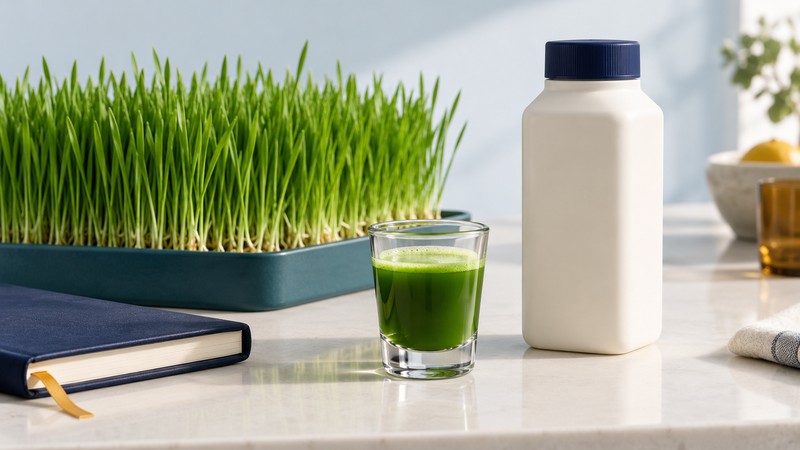
Wheatgrass juice is pressed from young wheat shoots. Its value depends on the product, the serving, and the reason for using it. Human research includes small exploratory studies; a claim about treating disease needs evidence for that particular condition and preparation. Start with the label and the study behind the claim.
Identify the product and serving
Fresh juice, dried juice powder, whole-grass powder, and mixed “greens” products can have different ingredients and concentrations. Read whether the serving is measured in milliliters, grams, or scoops, and whether the nutrition panel describes the powder or the prepared drink. A scoop of a blend may contain several plants, sweeteners, or added vitamins.
Use the actual label to assess nutrient contribution. A list of vitamins detected in wheatgrass gives little information about how much a small shot supplies. The FDA guide to Nutrition Facts explains serving sizes and percent Daily Value. Compare equal prepared portions when choosing between products; keep any added juice or sweetener in the comparison.
Read the small trial in its setting
In a 2002 randomized, blinded trial, 23 people with active distal ulcerative colitis were assigned wheatgrass juice or placebo for one month. Twenty-one completed the study and complete information was available for 19. The researchers reported improvements in disease activity and rectal bleeding with wheatgrass. This was a small, short study in a specific patient group.
The result supports further investigation of that clinical question. It leaves uncertainty about lasting benefit, uncommon harms, other digestive conditions, and products prepared differently. The research amount is a study detail, not a self-treatment schedule. People with inflammatory bowel disease should discuss any proposed add-on with their gastroenterology team and continue prescribed care.
On a narrow screen, scroll the table sideways. Keyboard users can focus the table region and use the arrow keys.
| Claim | What evidence would answer it? | Useful reading habit |
|---|---|---|
| “Contains antioxidants” | A chemical assay identifies activity under laboratory conditions. A health benefit requires an outcome measured in people. | Find the measured outcome; avoid treating an assay as a clinical result. |
| “Supports digestion” | Evidence for the named symptom or diagnosis, using a comparable preparation. | Ask which people were studied and for how long. |
| “Detox,” energy, skin, or cancer claims | A clearly defined intervention, comparison, benefit, and safety assessment. | A testimonial or an unrelated study leaves the promised benefit unestablished. |
When a seller links a paper, check that it studied wheatgrass itself rather than a different ingredient in the blend. Record both the favorable findings and the unanswered questions. For a second example of product differences, see soy foods, extracts, and cancer research.
Check how the juice was treated
The FDA’s juice-safety guidance explains that raw produce can introduce harmful bacteria into untreated juice. Children, older adults, pregnant people, and people with weakened immune systems face greater risks. Choose pasteurized or otherwise appropriately treated juice, especially for these groups.
At a juice bar, ask whether the juice has received a treatment to destroy harmful bacteria. Juice sold by the glass may have no warning label. Refrigeration, a fresh smell, and careful rinsing do not establish that an untreated drink is free of pathogens. Follow the packaged product’s storage directions and use-by instructions.
Keep gluten and wheat allergy separate
A gluten-free claim addresses gluten criteria; wheat allergy concerns an allergic response to wheat proteins. The FDA’s labeling explanation shows why “gluten-free” and “wheat-free” are different questions. People with celiac disease need a product meeting gluten-free requirements; people with wheat allergy should seek individualized advice before using a wheat-derived product. Review ingredients and possible cross-contact in either case.
- Write down the exact product, ingredients, serving, and hoped-for benefit.
- Check the nutrition label and treatment/storage information.
- Find the cited human study and compare its preparation and participants with your situation.
- For use during cancer treatment or management of a digestive condition, bring the label to the care team before starting.
A wheatgrass purchase can be a taste preference. A disease-treatment decision needs stronger, specific evidence. See the wheat allergy and celiac disease guide for the underlying distinctions.
Explore more guides in Understanding nutrition research.