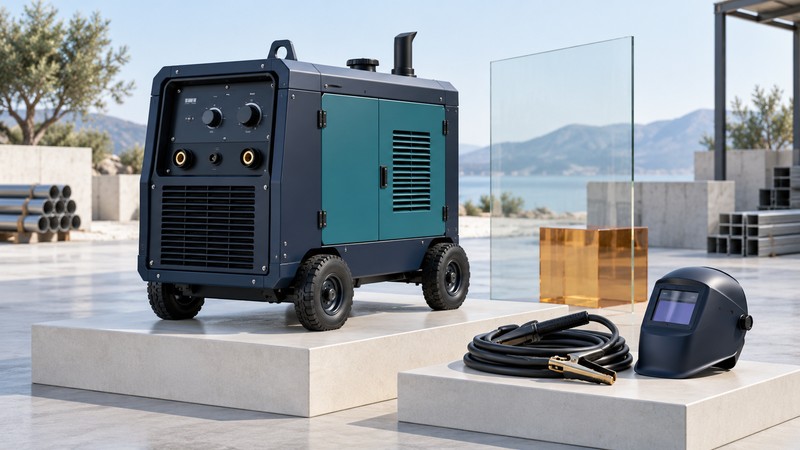
Define the welding job before choosing the machine
Choose an engine-driven welder around the required welding process, the expected work cycle and the other equipment it must power. The machine’s largest amp or watt figure answers only part of that question. A useful comparison keeps the welding output, generator output and accessory configuration on separate lines.
Start with the material, thickness, joint, position and applicable welding procedure. Have a qualified welding professional establish the process and consumables, then use those requirements to compare machines. Structural, pressure-containing and other regulated work also needs the relevant qualifications and acceptance requirements. This guide helps read equipment information; practical welding instruction and an approved procedure provide the operating method.
Record the exact model, product/code number and manual revision. Lincoln uses code numbers to identify applicable documentation. The examples below use the Ranger 260MPX/330MPX instruction manual, IM10480-G, January 2026 and specifically discuss the 330MPX where numbers are given.
Keep current, voltage and duty cycle together
A welding rating combines current, voltage and duty cycle under stated conditions. Duty cycle describes the permitted proportion of a reference interval at that output. Read the interval and cooling requirements in the applicable documentation. A hypothetical 60% rating over ten minutes represents six minutes welding and four minutes cooling under the specified conditions.
| Specification | What to ask |
|---|---|
| Process and output type | Does the required process use the machine’s available constant-current or constant-voltage mode, and the required AC or DC output? |
| Rated current and voltage | Are both values stated for the chosen process and rating standard? |
| Duty cycle and conditions | At what output, ambient temperature and reference interval does it apply? |
| Accessories | Which feeder, gun or torch, control, leads and shielding equipment complete the supported configuration? |
Lincoln’s 330MPX product overview advertises 330 A at 28 V and 100% duty cycle. The manual separately lists process-specific IEC ratings at 40°C: for example, its DC stick row reaches 292 A at 31.7 V at 100%, with 330 A/28 V/100% in an “other ratings” column. Keep the rating basis with the number when comparing another machine.
A process name on a brochure is a starting point for a parts list. Check the exact connection diagrams and accessory compatibility before assuming a wire feeder, spool gun or TIG system is included. Ask the dealer for a complete configuration matched to the welding procedure.
Budget generator power and simultaneous loads
Continuous generator power supports sustained loads; peak power is a separate limit. Lincoln’s 330MPX specifications list 10,000 W continuous and 11,500 W peak auxiliary output. The full generator rating is not available alongside every welding load: the manual’s simultaneous-load table must also be satisfied.
For the 330MPX example, section B-17 lists 3,900 W permissible auxiliary power at 200 A welding output, 2,400 W at 250 A and zero at 330 A. Those watt figures assume unity power factor. Individual receptacle, branch, cord and connected-equipment limits still apply; motor starting demand also needs checking.
Make a load list that includes voltage, running watts, starting demand, plug/receptacle and whether each item must run while welding. If that information is missing, get it from the equipment manufacturer. For building connections, have a qualified electrician design the required transfer, grounding and protection arrangement; never backfeed a building through an outlet.
Plan exhaust, welding hazards and access
An engine produces exhaust independently of the welding arc. NIOSH guidance on carbon monoxide at work says gasoline-powered equipment belongs outside, away from air intakes, with exhaust kept from occupied areas. Open doors or fans do not make an indoor engine setup acceptable. Placement also needs the manufacturer’s ventilation, clearance and mounting requirements.
Welding fumes depend on the metals, coatings and consumables involved, as the NIOSH welding-fume reference explains. Have the site assess fume control, arc radiation, fire risk, electrical exposure and nearby workers before work begins. A welding helmet addresses only part of that plan.
- Identify the trained operator and required welding qualifications.
- Confirm safe mounting, lifting and transport against the machine instructions.
- Arrange welding screens, suitable protective equipment, fume controls and any hot-work permit or fire-watch requirements.
- Plan fuel handling, inspection and maintenance with the engine stopped as directed by the manual.
Use a complete quote to compare options
Ask each supplier to return the same information: exact model/code, supported process configuration, rated output at the intended duty cycle, continuous and peak auxiliary power, simultaneous-load limits and all required accessories. Add transport, training and maintenance needs to the comparison.
For a used Lincoln Ranger, obtain the code-specific manual and a condition assessment before applying current 330MPX figures to it. Earlier Ranger models have different ratings and features. A clear equipment list and documented site plan make the purchase decision much more reliable than comparing the largest number on each brochure.
Choose your next guide
- Workshop Power Strips — Check load, ratings and placement when planning outlet use.
- Hearing Protectors — Choose protection for the exposure and check the fit.
- Machine Tool Training — Compare supervised courses and practical skills assessment.
Browse workshop setup and skills or explore all 47 tool guides.