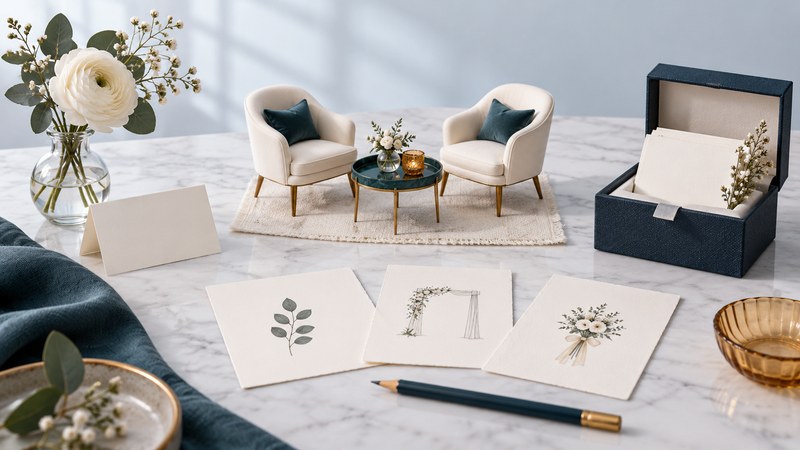
A useful wedding idea starts with an experience you want to share: a warm welcome, an unhurried conversation, or something worth keeping. Choose three possibilities, try a small version of each, and keep the ones that fit your people, place and available help.
Translate the image into a purpose
Write one sentence beneath a saved image: “I like this because…” Be specific about the effect. A long candlelit table might appeal because it feels intimate; a wall of photographs might suggest belonging. That observation opens several ways to achieve the same feeling at different scales.
Keep the original creator and source link with each reference so you can find the context again and credit work you discuss. A photograph gives a view of the result. Ask separately about materials, setup, staffing, removal and the venue’s permission. Bring vendors a description of what matters to you and invite their own solution.
Give each candidate a short brief: who it serves, where it happens, what a guest is invited to do, who prepares it and what success looks like. “Guests can leave a short message without joining a queue” is a usable brief. “Make it unforgettable” leaves everyone guessing.
Three original ideas to adapt
These are Yenra examples for a small indoor celebration with a host-approved table or seating area. Quantities and effort below are trial assumptions, not supplier quotes or promises. Confirm space, access routes and setup arrangements with your venue before making the full version.
| Idea and purpose | Trial materials and effort | Guest choice and fallback |
|---|---|---|
| A welcome in your own words | One folded card, a pen and a stable card holder; allow 20 minutes to draft, assemble and read it from the approach. | Guests may simply pass by. A greeter can say the same welcome if the table becomes crowded. |
| A shared story pause | Two seats, one original conversation prompt and an agreed host cue; allow 15 minutes to rehearse the transition. | Talking, listening or continuing a conversation are all fine. Omit the cue if the room is already happily occupied. |
| A future-memory box | Ten blank cards, two pens and one box; allow 30 minutes to test the wording, writing surface and collection. | Guests can write a wish, draw or skip it. Leave cards on a quiet table if a hosted activity feels intrusive. |
1. A welcome in your own words
Draft two sentences: “We’re glad you’re here. Today we’re most looking forward to sharing a meal and a little time together.” Add a practical direction only if it helps, such as where coats belong. Make the wording yours. Test a full-size card in its proposed position: can someone approaching read it without stopping in a doorway? If the welcome needs a paragraph of explanation, shorten it or ask a greeter to convey the detail.
2. A shared story pause
Invite an optional conversation at a natural lull: “If you’d like, tell someone nearby about a small kindness you still remember.” This works without testing knowledge of the couple or asking anyone to speak to the room. Agree the timing with the person running the reception. Rehearse how the host returns attention to the next event; a simple “Thank you—dinner is ready” is enough. Keep the prompt on a card for anyone who would rather read it.
3. A future-memory box
Use a prompt that produces something the couple wants to keep: “A small joy we hope you share…” Put one sample card beside the box, with room for a drawing and an optional name. Decide who collects the box, when the couple will open it and where the cards will live afterward. Treat messages as private unless their writers agree to sharing. The trial should reveal whether the pen writes well, the box opening is easy to use and the instructions make sense without a host explaining them.
Make a keep, change or drop decision
- Set a ceiling. Record your own maximum spend, preparation time and setup time. Include transport and collection. Put confirmed costs into the wedding budget.
- Try one complete unit. Time it with the intended materials. Ask a willing helper to use it without coaching. Note the confusing step.
- Check the full scale. One handmade card taking six minutes means 30 cards require three hours of making time, before purchasing and setup. Decide whether that work still feels worthwhile.
- Choose. Keep an idea when the trial meets the brief. Change the part that causes friction and retest. Drop it when its purpose is already served or its demands exceed your ceiling.
Give every kept idea an owner, a ready-by date and a fallback that needs less effort. Hand room setup to the decoration plan and timing to the overall wedding plan. A short, finished shortlist is easier to carry out than a growing collection of possibilities.
Download the editable idea-test worksheet (TXT). It includes the purpose, trial observations, full-scale estimate and final decision; open it in any text editor and duplicate it for each idea.