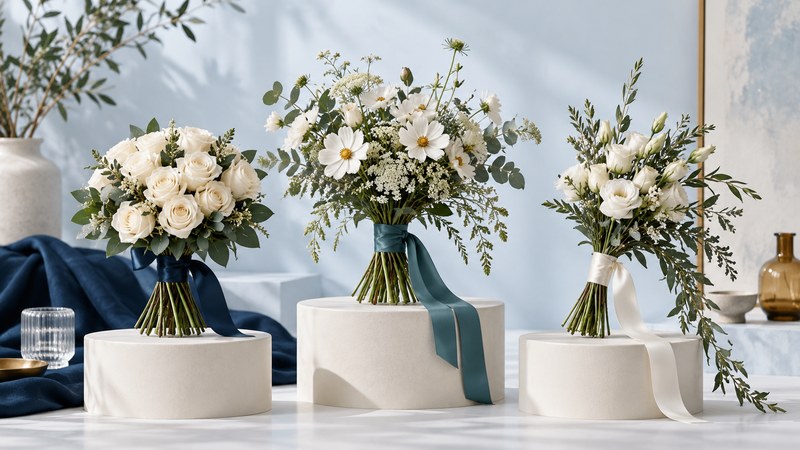
Choose a wedding bouquet for how it looks with your outfit and how it feels in your hand. A clear florist brief covers shape, scale, weight, scent, substitutions and the plan for carrying, resting and caring for it through the day.
Start with the silhouette and the outfit
Bring a photograph of the outfit, including its neckline, sleeves and the details you want to remain visible. Choose a few bouquet references and label what attracts you: a compact outline, loose movement, an asymmetric shape or trailing stems and ribbon. This gives the florist something more precise than a general style name.
Describe your preferred scale in relation to your body and clothing. A photograph can make a bouquet look larger or smaller depending on how it is held and framed. Ask the florist how the proposed dimensions will look when carried at a comfortable height and in the photograph positions you expect to use.
Decide what matters most: a color relationship, a particular flower, texture, movement or a restrained overall shape. Rank those priorities so substitutions preserve the part you care about most. For the broader floral order, room arrangements and supplier proposal, use the wedding flower planning guide.
Think about carrying as well as appearance
Ask about the likely weight, handle thickness and how the stems or holder will be finished. Discuss a smaller or lighter version if you expect to carry it for a long period or have difficulty gripping. Where possible, hold a representative sample and tell the florist which part feels comfortable or awkward.
Consider the ceremony actions: walking, holding another person’s arm, exchanging rings, reading and signing. Decide who takes the bouquet when you need both hands and where it rests afterward. Check that ribbon length works with the outfit and route, and ask how damp stems will be managed before the bouquet is handed over.
| Direction | Visual aim | What to ask the florist |
|---|---|---|
| Compact | A defined outline and concentrated color | How will size, density and handle thickness feel? |
| Loose or airy | Space between flowers and visible movement | Which stems project, and how should it be carried? |
| Asymmetric | A shape that extends further to one side | Which face and orientation show the intended design? |
| Trailing | Flowers, foliage or ribbon extending downward | How will the length work with walking and the outfit? |
Agree priorities and substitutions before ordering
Share the event date, locations, delivery time and the maximum amount you want to spend on the bouquet, including any delivery allocation or extras. Tell the florist about scent preferences, flowers you want to include or avoid, and any known sensitivities relevant to the person carrying it. Ask which choices they can realistically source for that date and order.
Agree a substitution process. For example, you might prioritize ivory and soft green, an airy shape and a comfortable handle, while allowing the florist to change specific flowers within the agreed budget. If a particular flower is essential to you, ask what happens if it is unavailable and when you would need to make an alternative decision.
A consultation checklist
- Outfit photograph, preferred silhouette and approximate scale.
- Two or three priorities, plus any details to avoid.
- Comfort, grip, scent and ribbon preferences.
- Flower requests and approved substitution boundaries.
- Itemized price, delivery, approval date and payment terms.
- Recipient, arrival time, resting container and care instructions.
- Afterward: return, gifting or preservation arrangements.
Ask for these decisions in the proposal, along with a way to identify the bouquet on delivery. If attendants have bouquets too, specify their number and relationship to the main design. A shared palette can work across different sizes; ask the florist to show how the group will relate.
Give the bouquet a clear handoff and resting place
Name the person who receives the delivery and checks the count, labels and condition. Have them contact the florist promptly about an issue, using the order reference and a photograph. Confirm where the bouquet waits before the ceremony and who brings it to the person carrying it.
The RHS guidance on cut-flower care recommends clean containers, water maintenance and keeping flowers away from heat. For a finished bouquet, follow the florist’s instructions for its particular stems, bindings or holder. Ask whether it should stand in water, how much is appropriate and how the handle should be dried before use.
During travel, agree who carries the bouquet and what supports it. At the reception, give it a designated resting place and make any reuse arrangement clear to the florist and venue. Keep it available for planned photographs, and tell the person managing the schedule where it will be.
Choose an after-wedding plan in advance
If you want to preserve part of the bouquet, speak to a specialist before the wedding about suitable methods, condition on arrival, timing, price and the result you can expect. The RHS guide to drying flowers describes methods suited to different materials, including air drying, pressing and silica gel. Discuss which approach suits the flowers and the kind of keepsake you want.
For gifting or keeping flowers fresh at home, obtain the florist’s care instructions and arrange the transfer. Keep a photograph of the bouquet and the agreed design details whatever you choose to do afterward. Coordinate its ceremony handoff with the wedding party so the person helping knows the plan.