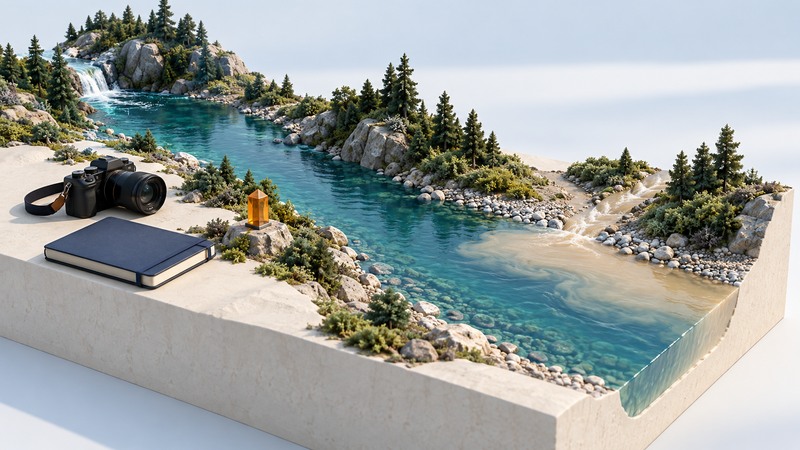
A photograph can document a waterway’s appearance, the extent of a visible plume and change over time. Pair it with the location, time, weather and a plain description of what you saw. That combination helps a receiving agency decide what to investigate.
Clear water can contain invisible contaminants, while naturally colored water can look dramatic. Treat visual clues as observations to interpret, and use official advisories and testing for health or compliance decisions.
Read the picture without assigning a cause too soon
On a narrow screen, scroll the table sideways. Keyboard users can focus it and use the arrow keys.
| Appearance | What the picture establishes | What remains to investigate |
|---|---|---|
| Brown or cloudy plume | A visible contrast and its approximate extent | Suspended particles, source, concentration and whether conditions changed after rainfall. |
| Green streaks, mats or paint-like scum | Surface accumulation and color at that time | Organism identification and toxin evidence through the responsible authority. |
| Surface sheen or foam | A film or foam pattern at the photographed location | Whether the material is natural or associated with a release. |
| Litter or damaged habitat | Visible objects and their distribution | Source, duration, ecological effect and appropriate removal arrangements. |
| Water appears clear | Visibility under that lighting and depth | Microbial or chemical quality and suitability for a particular use. |
USGS explains turbidity as an optical property related to how material scatters light. A photograph cannot supply an instrument’s turbidity value. USGS also explains natural and other causes of water color, including dissolved organic material. Describe color, location and pattern before proposing a source.
Recognize when to keep away
CDC’s bloom-recognition guidance describes scum, paint-like appearances and discoloration, and advises staying out when signs suggest a harmful bloom. Keep people and pets away from suspect water and follow posted advisories. A photo cannot identify toxin concentration or establish when an area is safe again.
Check EPA’s harmful-algal-bloom resources for links to monitoring and local information. Use the relevant health or water authority’s advice for the location; avoid touching or tasting material to help identify it.
Create a useful observation record
- Stay at a safe, legal vantage point. Avoid entering water, approaching an unknown discharge or crossing a barrier.
- Record the waterbody, nearest public landmark, date, time and time zone. Add coordinates if available and indicate their approximate accuracy.
- Take a wide context view and a closer view from the same safe position. Keep the originals and note the viewing direction.
- Describe visible conditions plainly: color, approximate extent, flow direction and any nearby outfall visible from your position.
- Record recent rain or other relevant conditions, separating observation from information obtained elsewhere.
For repeat observations, use the same viewpoint when feasible and record changes in lighting or water level. Editing brightness or adding arrows creates a derived image; retain the unedited original. An AI-generated illustration can explain a process but should be labeled and kept separate from an incident report’s evidence.
Choose the right reporting channel
For a US environmental concern, EPA’s reporting information distinguishes ordinary reports from emergencies. Use local emergency services for an immediate threat. Oil and hazardous-substance releases have dedicated reporting arrangements; EPA describes the National Response System and the National Response Center.
For a recurring creek concern, a state, tribal or local environmental agency may be the appropriate first contact. Submit the observation record and ask for a reference number. Report what you directly observed, and label a suspected source as a hypothesis. Follow the agency’s instructions about additional documentation or sampling.
Separate the evidence from the interpretation
An agency may compare upstream and downstream measurements, inspect drainage connections or collect appropriate samples. Those steps require methods and authority suited to the question.
Keep drinking-water questions on a testing pathway
For public drinking water, contact the supplier and follow current notices. For a private well, use EPA’s private-well guidance and the local health authority to select tests and a qualified laboratory. Tell them the concern before collecting a sample so containers, preservation and timing fit the analysis.
A photograph of the nearby stream does not assess water at a household tap. Record the source, use and testing question separately. For a planned community study, the monitoring guide explains how to establish a sampling and quality plan.
Water observation and reporting record
Water observation and reporting record — plain-text download. Save a copy and fill it in with your own information. It includes instructions, example assumptions and source references.