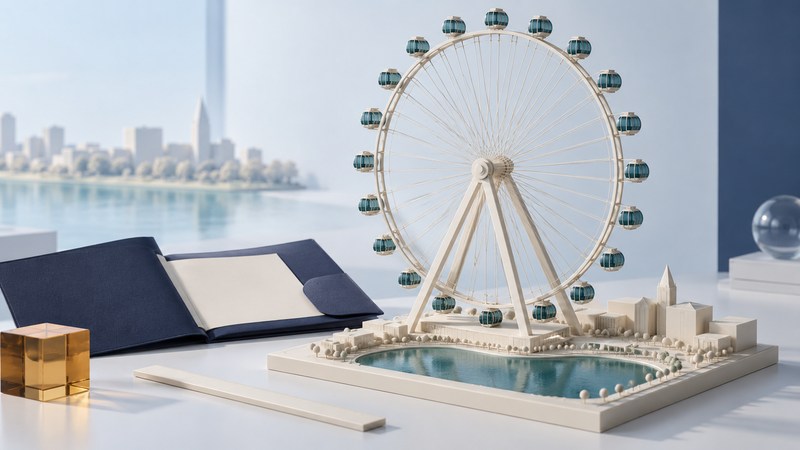
The Voyager observation wheel announced for the Dallas–Fort Worth area in July 2003 remained an unrealized proposal. Company filings identify its intended location as Euless, near DFW Airport, and show that it was still awaiting financing and definitive agreements in September 2004. The record explains how far the project progressed—and why its renderings, projected ridership and proposed ticket price should be read as development history.
Which Voyager project was this?
Voyager Entertainment International promoted observation wheels in several places. The Texas proposal involved Bennett Realty Group and land within a larger, approximately 200-acre planned community. The company’s annual report for 2003, filed March 31, 2004, says a memorandum of understanding was signed on June 18, 2003 for up to 15 acres in Euless. “Voyager Dallas” was the project’s regional shorthand.
Two areas therefore matter: the proposed wheel site and the much larger surrounding development. Treating all 200 acres as the wheel’s own footprint would confuse the attraction with the community it was meant to help draw visitors to.
The July 10, 2003 announcement described a 600-foot wheel, 32 passenger vehicles called sky cruisers, 20 passengers per vehicle and a 27-minute revolution. It envisioned galleys and lavatories in the vehicles and a surrounding mix of retail, entertainment, hotels, offices and housing. These were proposed features. The advertised $18 ticket and 7.5-million annual capacity were projections attached to the concept.
What the filings establish
On a narrow screen, scroll this table sideways. Keyboard users can focus it and use the arrow keys.
| Record | Documented event | Limit of the evidence |
|---|---|---|
| June 18, 2003 MOU | Bennett Realty and Voyager outlined a Texas joint venture with up to 15 acres in Euless. | A preliminary land-and-development arrangement. |
| 2003 annual report | Financing was unsecured at December 31, 2003; definitive agreements were still unsigned at February 18, 2004. | The announcement had not become a funded, definitive project. |
| Quarter ended September 30, 2004 | The Dallas project still had a non-binding MOU, no secured financing and no definitive agreements. | A later, explicit record of the same unresolved conditions. |
| 2004 annual report, filed April 2005 | The proposed locations listed were Las Vegas, the UAE and Shanghai; Dallas was absent. | Evidence of a changed stated program, not a precise Texas cancellation date. |
| September 2011 quarterly report | The company still described Las Vegas development as dependent on sufficient capital. | A later company record concerning Las Vegas, not progress at Euless. |
| August 7, 2015 SEC order | Revocation of Voyager’s securities registrations became effective after reporting failures. | A securities-reporting outcome, not a construction or land-use ruling. |
The strongest Texas status statement is in the September 2004 quarterly filing: the company explicitly characterized the MOU as non-binding and said funding and definitive agreements remained outstanding. That is more informative than an enthusiastic launch description because it identifies the missing steps.
In the 2004 annual report, Voyager listed a different set of proposed locations and said inadequate financing had prevented successful project launches. Dallas’s disappearance from that list suggests that it had fallen out of the stated development program. The filing does not name an exact termination date for the Bennett arrangement.
The September 2011 report continued to describe a development-stage company pursuing Las Vegas, with construction dependent on capital. Finally, the SEC’s August 2015 final order and attached decision revoked the company’s registered securities because of failures to file required periodic reports. That action should be described in its actual scope; it supplies neither a Texas cancellation permit nor a finding that every earlier design claim was fraudulent.
What happened—and what remains unresolved
The evidence supports treating the Euless Voyager as an unbuilt proposal, with no verified operating attraction to visit under that identity. It also establishes that financing remained a concrete obstacle well after the announcement. A proposed site, a recognizable developer and an architectural concept had not yet produced the definitive agreements and capital described as necessary in the company’s own filings.
The precise cancellation date, the full contractual disposition of the land arrangement and the later parcel history remain unverified in this account. A later business elsewhere using “Voyager,” or a completed wheel by another developer, cannot supply those missing links. Completing the land history would require matching the original site to municipal application and parcel records, then following later approvals and construction documents.
Reading the 7.5-million-rider projection
A large annual capacity can sound like a prediction of popularity. Capacity instead describes what a system could accommodate under stated assumptions. Actual attendance also depends on demand and the operation delivered. The July 2003 figures permit a useful arithmetic check, even though the complete operating model was not supplied.
A simplified calculation using the announced figures
Assumptions: all 32 cabins carry 20 new riders per revolution, one ride lasts 27 minutes, and the service runs continuously with no additional cycle time. This is an explanatory calculation, not a certified operating capacity or a forecast.
- Passengers per fully occupied circuit: 32 × 20 = 640.
- Ideal throughput: 640 × 60 ÷ 27 = approximately 1,422 riders per hour.
- To carry 7.5 million riders over 365 days: approximately 20,548 riders each day.
- At that ideal throughput, the annual figure requires approximately 14.45 fully occupied operating hours every day.
For illustration, a 16-hour day on all 365 days produces an ideal ceiling of about 8.31 million rides. Reaching 7.5 million would use about 90.3% of that simplified ceiling. Those 16 hours are an assumption for comparison, not an announced schedule.
Loading arrangements, partly occupied cabins, maintenance, weather, accessibility procedures and the actual opening calendar would change the result. The arithmetic does not prove the projection impossible; it reveals the operating assumptions needed to evaluate it. A credible attendance forecast would separately explain demand, seasonality, pricing and competing attractions. Multiplying capacity by a proposed ticket price would describe a hypothetical gross amount before costs, not demonstrated revenue or profitability.
Separate Voyager from wheels that opened
The State Fair of Texas identifies the Texas Star as its 212-foot Ferris wheel in Dallas. That attraction has its own identity and event calendar. It is a useful current starting point for someone seeking a Dallas wheel ride; check the Fair’s dates, admission, ride payment and operating information for the intended visit.
Las Vegas’s High Roller is also a separate project. Arup’s engineering retrospective identifies the 550-foot wheel as a Caesars Entertainment commission for the LINQ that opened in 2014. A shared city or a broadly similar attraction concept does not establish that one proposal became another. The customer, site, design team and completed-project record provide the identity check.
Voyager’s own filings also separated its Las Vegas and Dallas proposals. Features described in one version—such as a particular cabin count or arrangement of entertainment spaces—should stay attached to that version and date. Combining specifications from several announcements creates a design that no single source actually proposed.
A useful way to read an attraction announcement
- Identify the exact project. Record company, municipality, location, announcement date and named land partner. Preserve distinctions between a city label and the actual municipality.
- Separate the milestones. A memorandum, a land transaction, a planning approval, financing, construction and public opening establish different things. Look for a dated record of each claimed step.
- Read the conditions. Words such as proposed, subject to financing and non-binding identify work still to be completed. Keep them attached when summarizing the record.
- Check numerical assumptions. Cabin occupancy, cycle time, operating hours and opening days determine a capacity estimate. Attendance needs evidence about customers as well.
- Plan a visit from operating information. Use the actual operator’s current calendar, location, admission rules and accessibility information. Historical renderings are useful for understanding an idea; dated visitor information establishes what can be booked now.
Voyager’s significance lies in the gap its records make visible: a compelling destination concept can remain at the agreement-and-funding stage long after publicity makes it feel imminent. Preserving that sequence gives the proposal a useful place in travel and development history without turning it into a present-day attraction listing.
Related travel resources
- Las Montanas: the outcome of an announced Indian Wells resort
- Plan visits to operating parks and attractions
- Browse all travel guides
Researched and updated October 3, 2026. Historical claims are tied to the dated records above; unresolved project details are identified in the text.