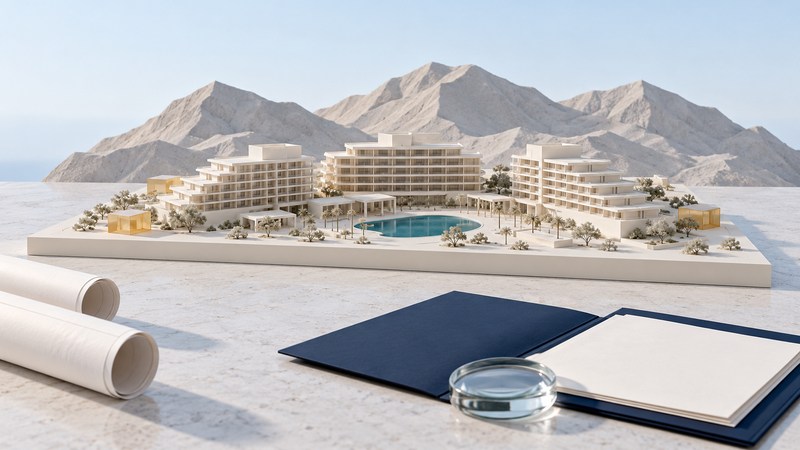
Remington Las Montanas was a proposed condominium hotel in Indian Wells, California. Announced in 2005 and promoted in 2006 for a 2008 opening, the development did not become the promised resort. Its history is a useful case study in reading hotel announcements: the proposed experience, the financing plan and the eventual outcome are separate parts of the story.
What Remington proposed
The company announcement dated December 2, 2005, preserved by Hotel Online, placed the resort south of Miles Avenue and immediately west of Washington Street. The partners included Remington, an affiliate of Sanderson J. Ray Development and Trillium Resorts. The development pitch combined accommodation, meetings, leisure facilities and individually sold hotel condominiums. Remington expected to manage the resort, rental program and owners association; Trillium would lead condominium sales.
The release used both 530 hotel rooms and 265 condominium units to describe the scheme. Its typical unit included a main living area and a junior lockout suite. The document does not supply a final approved inventory that would justify adding those figures into a 795-room total. Preserve both the developer’s room count and its unit count, with their different labels, when comparing descriptions of the plan.
The January 2006 promotion emphasized large terraces, indoor-outdoor living, separate adult and family aquatic areas, a spa and substantial conference space. It also promised proximity to the Indian Wells Tennis Garden and a future shopping and dining development. Groundbreaking and opening dates were forecasts. The detailed amenity list described what buyers and guests were being offered in the plan.
From announcement to withdrawal
On a narrow screen, scroll this table sideways. Keyboard users can focus it and use the arrow keys.
| Date | What the record says | How to read it |
|---|---|---|
| December 2005 | The developer announced the resort and a planned 2008 opening. | A development proposal with named participants and a location. |
| January 2006 | Promotion described a condominium-hotel flagship and anticipated construction later that year. | Sales expectations and planned amenities, rather than an opening record. |
| January 27, 2008 | The Press-Enterprise reported that Remington had left, deposits were returned and the site remained vacant. | Contemporary evidence that the announced project had stalled and its original sales effort had unwound. |
| October 2026 review | The documented history supports an unbuilt-project retrospective. A parcel-by-parcel successor history remains unverified. | Use current hotel sources for a stay; treat later land-use questions as a separate records inquiry. |
The decisive follow-up is Kimberly Pierceall’s January 27, 2008 report for The Press-Enterprise, carried in Hotel Online’s archive. It reported Remington’s departure; an assistant to executive Robert Haiman confirmed repayment of deposits. City development director Corrie Kates was uncertain about the landowners’ future hotel intentions.
This contemporary report supplies a documented outcome, with named interview sources. An exact formal cancellation date has not been established here.
How the condominium-hotel model shaped the pitch
The central idea joined two transactions. An individual would buy a condominium interest; a guest would later book accommodation through a managed hotel operation. The proposal therefore depended on both a property-sales market and a viable hospitality business. A reservation list measured interest in buying into the development. It did not measure completed construction, operating rooms or future guest demand.
Consider the distinction from a traveler’s perspective. A hotel room can appear in an architectural rendering, a developer’s unit schedule or a future rental pool before any guest can check in. Each is useful evidence about intent. The operational questions come later: who takes the reservation, which room is confirmed, what facilities are open, and what happens if the stay cannot be delivered?
The 2008 reporting describes a weakening condo-hotel market and the promoter’s dependence on unit sales. A precise account of the project’s financing failure would require its actual contracts and financial records. Assigning a single lender, legal dispute or loss amount as the cause would go beyond the evidence available here.
Likewise, owner-use limits, rental splits and obligations belong to the documents for a particular development. Historical descriptions of the condo-hotel model should not be turned into universal rules for every condominium hotel, vacation ownership product or furnished rental.
Keep the property’s identity straight
“Remington” identifies the company attached to this proposal; “Las Montanas” identifies the planned development. Searching either term alone can lead to other management assignments or unrelated properties. The useful identifying combination is Las Montanas + Indian Wells + Miles Avenue/Washington Street + the 2005–2006 proposal.
The operating Indian Wells Resort Hotel has its own history beginning in 1957 and lists its address at 76661 Highway 111. Its similar geographic name does not make it a renamed Las Montanas. A claim that an existing hotel is the successor would need a documented connection through the site, approvals and development history.
The same care applies to the land. The 2008 report describes its condition at that time. It is not a current site survey. This research has not established a continuous parcel history from the original proposal to today, so it does not identify a present building or owner as the project’s replacement.
Planning an Indian Wells stay today
For tennis travel, start with the BNP Paribas Open’s official accommodation list. It identifies hotel partners and transportation features, including properties such as Renaissance Esmeralda, Grand Hyatt Indian Wells and Tommy Bahama Miramonte. These are current planning leads, each with its own history and booking conditions.
- Match the booking to a real property. Record the full hotel name, street address, operator and confirmation contact. Resolve any name change before payment.
- Check the journey you will actually make. Confirm the tournament entrance, shuttle eligibility and hours, or the walking route. A development described as nearby in an old announcement supplies none of those details.
- Confirm the usable facilities. Ask whether the pool, spa, dining and any meeting rooms you need will be available on your dates, including access restrictions.
- Compare the complete stay. Include room type, taxes, mandatory fees, transport and cancellation terms. Keep the dated confirmation alongside the itinerary.
What would complete the site history?
A deeper land-use history would connect the original parcel numbers to planning applications, approval conditions, amendments, expiration or withdrawal records, and any later development. Search by applicant and location as well as project name. A dated staff report can establish what officials considered; an approval records permission; a completion or occupancy record addresses a different milestone.
Keep a short evidence log with document date, issuing body, parcel or application identifier, and the exact event established. If two documents concern different corners of an intersection or different parcels, leave them separate until a record connects them. That approach preserves what is known about Las Montanas while allowing a future, documented successor history to be added accurately.
Related travel resources
- Compare resort rooms, facilities and the full cost of a stay
- Voyager: another proposed destination and its documented history
- Browse all travel guides
Researched and updated October 3, 2026. Historical claims are tied to the dated records above; unresolved project details are identified in the text.