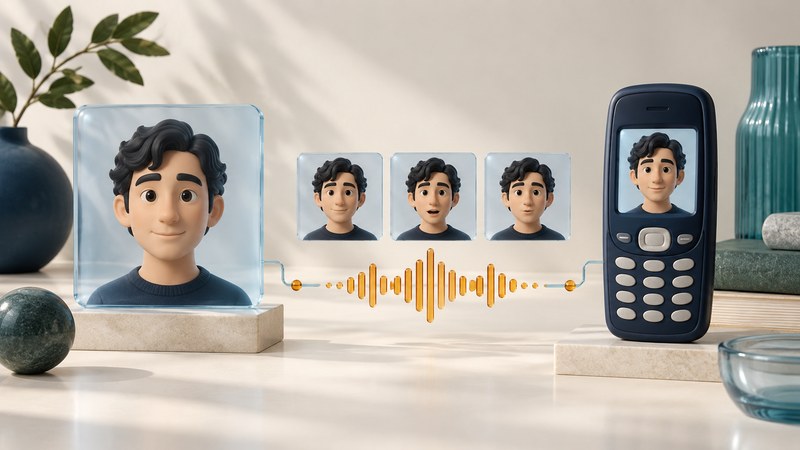
Mobile Veepers belongs to an early chapter of talking-photo media: giving a still face movement and synchronized speech for a small screen. The useful questions are where the face came from, where the voice came from, how movement was controlled, and what the receiving phone actually played. A speaking portrait alone cannot answer those questions.
What the early record establishes
Anne Chen's report from DEMOmobile 2003 records Pulse Entertainment introducing Mobile Veepers as animations of camera-phone photographs. That is evidence of the public introduction, not a test of every advertised handset or a record of completed customer deployments.
A later primary source, Pulse Mobile's March 2006 announcement, describes its Veepers technology as converting still images into animated characters with recorded or text-to-speech audio. It also describes a Veepers Content Engine application for personalized wallpaper. The later date matters: it documents the company's description in 2006, without proving that every component was present in the first mobile release.
Pulse's three-dimensional animation patent application published in July 2003 provides a technical record of its approach to distributing character data and behavior. It describes persistent character data, separately delivered behavior files, caching, and a player. A disclosed design is not a complete specification of every commercial Veepers implementation, but it helps explain the distinction between an animated character and an ordinary movie file.
Follow five stages instead of treating the portrait as one effect
The following is a general explanatory workflow for a talking-photo system. It identifies the jobs that must be done; it does not claim to reproduce Pulse's private software or the exact division of work between server and handset.
- Choose an image. Establish the source picture and the person or character it depicts.
- Prepare the character. Define which parts can move and how the appearance will be represented.
- Supply speech. Use a recording or generate speech from text; keep the audio's origin separate from the face's origin.
- Coordinate motion. Arrange mouth movement and other behavior over time.
- Render and deliver. Produce something the destination can display, whether a finished clip or data for a compatible player.
This separation answers a common question: a photograph that appears to speak is not evidence that the photographed person recorded those words. The image and sound can be independent inputs. Nor does synchronized mouth motion show that a system understands the sentence. It establishes a relationship between visible motion and an audio timeline.
| Element | Question | Useful evidence |
|---|---|---|
| Face | What source image or character was used? | Original image and its provenance. |
| Voice | Was it recorded or synthesized? | Original audio or a documented speech-generation step. |
| Motion | What controlled the expressions and timing? | Authoring record, behavior data, or technical documentation. |
| Playback | Is this a finished movie or an executable experience? | File inspection and observation in its intended environment. |
A rendered movie and an interactive character are different deliverables
A movie stores a sequence ready for playback. A character player can instead combine a representation with instructions at runtime. This distinction is visible in Pulse's patent disclosure: downloading reusable character data separately from behaviors can avoid sending the complete character repeatedly. It does not establish a universal file-size advantage; total data depends on what is cached, what changes, and what must be delivered.
The 3GPP Release 5 media specification published by ETSI defines the 3GP file format using the ISO base media file format and supported media types. “3GP” names a container, not one compression algorithm. A filename ending in .3gp does not tell you the complete codec, dimensions, audio, or playback requirements.
That is why a historical claim about broad device delivery needs qualification. A compatible renderer, a compatible exported movie, and a working delivery service solve different problems. Receiving bytes is not the same as decoding them; decoding a clip is not the same as running interactive behavior.
Describe what a surviving example proves
Compare the output with source material when available. A voice recording, a still image, and a saved clip can establish a useful chain of evidence even when the intermediate project is missing. Label a missing step as unknown rather than reconstructing it from appearance alone.
Calling this early work “AI” without specifying a method can obscure the evidence. Recorded speech, text-to-speech, scripted behavior, and generative image synthesis are distinct operations. The sources above support an early character-animation history; they do not establish the use of a modern generative model. Describe the documented operation before applying a broad label.
When presenting a recreated talking portrait, identify it as an animation and explain the origin of its voice. That small piece of context helps an audience understand what it is seeing and prevents the finished effect from being mistaken for an authentic recording of the pictured person.