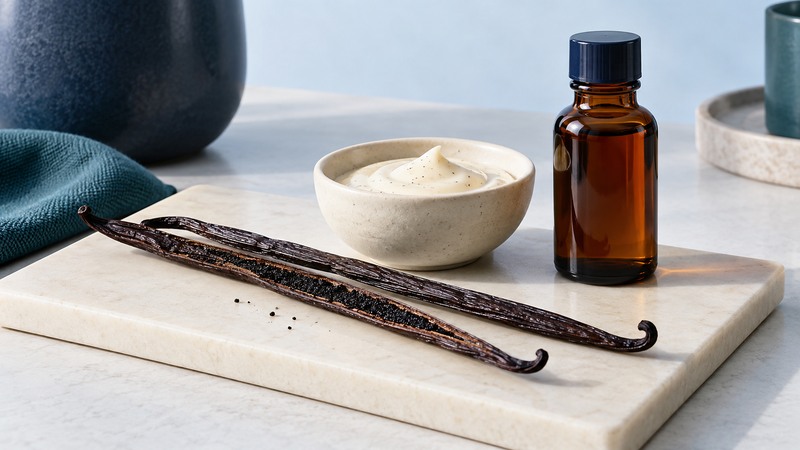
Use a vanilla bean when you want its aroma and the visible seed specks in a custard, cream or sauce. Extract is easier to measure and distribute; paste can provide specks without splitting a pod. Choose the form for the recipe, then follow product-specific substitution guidance.
Split and scrape a bean
Set out a clean board, a small sharp knife and the bowl or pan where the vanilla will go. Keep fingers clear of the blade.
- Lay the pod flat and make a lengthwise cut to open it.
- Open the cut faces and scrape the dark seed paste along the pod using the back of the knife.
- Mix the scraped material into the recipe’s liquid or other appropriate ingredient so it disperses.
- If the recipe uses an infusion, add the opened pod as well. Remove the pod before serving or straining the mixture.
Nielsen-Massey’s preparation guidance recommends steeping the seeds and pod in a warm liquid base. The whole pod participates in flavor extraction; visible seeds alone do not measure the final intensity.
Follow your custard, ice cream or sauce recipe for heating, infusion time and cooling. The vanilla step adds flavor; it does not replace temperature or food-safety instructions for milk and eggs.
Choose a form by the result
On a narrow screen, scroll the table sideways. Keyboard users can focus it and use the arrow keys.
| Form | Why choose it? | Check before substituting |
|---|---|---|
| Whole bean | Pod infusion and visible seed specks | Bean size, condition and the recipe’s preparation method. |
| Pure vanilla extract | Easy measurement and even distribution | Product strength, including whether it is concentrated. |
| Vanilla bean paste | Convenient specks and flavor | Sugar, thickeners and the maker’s equivalence instructions. |
| Vanilla powder | A dry-format product | Whether it is ground beans or an extract carried on another ingredient. |
The word “paste” describes a format, not a universal concentration. Likewise, powders can have different compositions. Read the ingredient list and keep the manufacturer’s instructions with the product if you decant it.
Use a scoped conversion
As a concrete manufacturer example, Nielsen-Massey lists one tablespoon of its pure extract as equivalent to one whole bean or one tablespoon of its paste. That is a useful starting point for those products, not a guarantee that every bean and every concentrated extract are interchangeable.
For delicate recipes, use an author-tested alternative when available. Increasing extract indefinitely to imitate an old dry bean can add more liquid and alcohol flavor. Replacing a weak ingredient is often easier to evaluate.
Buy and store for repeatable flavor
Choose beans with a recognizable vanilla aroma and a condition appropriate to the seller’s intended use. For direct culinary use, pliable pods are easier to split than brittle ones. Dry extraction-grade beans can be sold for a different purpose; read that designation instead of treating every dry pod as the same product.
Store whole beans in an airtight container at room temperature, protected from heat and sunlight. Nielsen-Massey advises against refrigerating its vanilla beans, because refrigeration can encourage mold. Follow the storage information supplied with your beans.
Keep unneeded pods dry and separate from a bean that has been in milk or cream. Use the steeped pod only within the handling and storage rules for the dish; storing a wet used pod with dry pantry beans introduces moisture. If you suspect mold or spoilage, discard it rather than relying on aroma alone.
Fix the cause of a disappointing result
- Seeds clump: disperse the scraped paste in a little of the recipe’s liquid before adding it to the main batch.
- Weak vanilla: check freshness, bean quantity and infusion instructions. A dark-looking pod is not a strength measurement.
- Too much vanilla: next time reduce the measured amount or use a less concentrated product. Record the brand and strength with the recipe.
- Wrong texture after a swap: check whether a paste added sugar or whether a powder included a carrier.
For warm-spice pairings, see the cinnamon guide. For a crunchy topping instead of an infused flavor, see turbinado sugar uses.
Explore all seasoning and ingredient guides · Food, cooking and meal planning