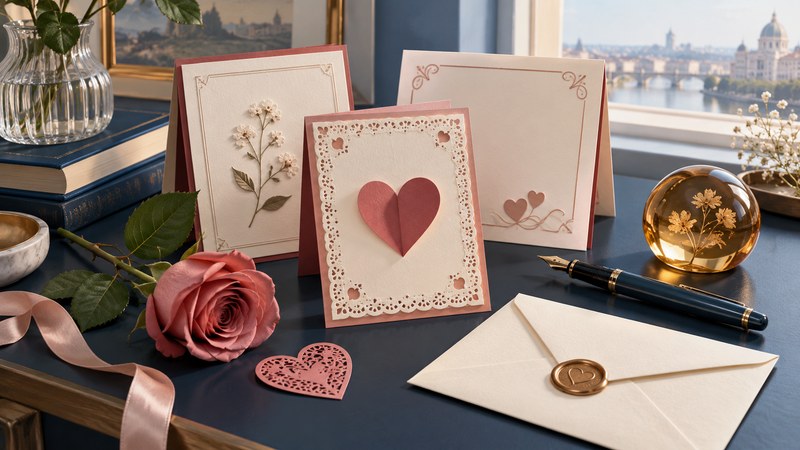
Valentine’s Day, observed on February 14, has a history that can be explored through letters, printed cards, paper craft, and the people who exchanged them. Surviving objects provide firmer ground than a single story claiming to explain every custom.
Evidence and origin stories
The Library of Congress overview describes the holiday’s origins as uncertain. Accounts connect it with saints named Valentine and with the Roman festival of Lupercalia, but proximity on a calendar alone cannot establish a continuous path from an ancient festival to modern cards.
Treat a story about a priest secretly marrying couples as a legend unless the account supplies historical evidence for its details. Ask when the story was written, which person it identifies, and what record supports it. A saint’s life, a later literary tradition, and a surviving message are different kinds of evidence.
That distinction makes room for a richer history. Customs can acquire new meanings as people reuse them. A printed card may tell us much about the period when it was sold while telling us little about how an ancient observance began.
From a personal letter to a commercial craft
The British Library identifies a letter sent by Margery Brews to John Paston in February 1477 as the oldest surviving Valentine’s Day letter in English. That careful description matters: “oldest surviving” and “in English” define the evidence. They do not establish that nobody sent an earlier message elsewhere.
By the nineteenth century, elaborate cards offered a different form of expression. The Library of Congress account of Esther Howland’s valentine business describes a Worcester, Massachusetts enterprise that combined imported paper materials with organized hand assembly. Howland had launched the business by the end of 1849. Workers divided tasks such as preparing backgrounds and adding decorative elements.
Layered paper, lace effects, and inserted verses let craftsmanship and commerce work together. Howland helped popularize elaborate American valentines; cards already circulated before her business. Her later verse book also addressed a familiar problem: finding a design you like whose printed message does not quite fit the recipient.
These examples show two routes to a personal message. A handwritten letter can draw its power from the sender’s own words. A purchased card can supply a visual form that the sender adapts through the choice of design and added writing.
Look closely before assigning a meaning
Hearts, flowers, lace, and Cupid are familiar visual ingredients, but an individual card offers more evidence than a list of symbols. Start by describing what is actually present. Then connect the design with its words, intended recipient, and catalog information.
| Detail | What to inspect | Question to ask |
|---|---|---|
| Hearts and figures | Placement, gestures, and relationship to the verse | Does the design express affection, humor, longing, or something else? |
| Flowers and color | Specific flowers, repeated colors, surrounding text | Does the object or catalog actually support a symbolic reading? |
| Paper construction | Cut edges, layers, folds, openings, and moving parts | How would the recipient handle and reveal the message? |
| Writing and printing | Printed verse, handwriting, date, signature, and address | Which choices came from the maker and which from the sender? |
Use the Library of Congress overview’s linked collections to try these questions on an actual object. Preserve qualifications in the catalog: “about 1890” gives an estimated date, while an exact handwritten date may document when a particular person used the card. The date of use and the date of manufacture can differ.
A missing envelope or inscription also sets a useful limit. You can describe the design without inventing the identity of the sender, the recipient’s reaction, or a universal meaning for a flower. Label your interpretation as an interpretation and point to the detail that prompted it.
Make a card that belongs to the recipient
A small handmade card can apply the same attention to words and materials. Decide first whether the message is romantic, friendly, or a note of family appreciation. Choose a person who would welcome it and keep the tone comfortable for that relationship.
- Fold a sheet of sturdy paper and leave a generous blank writing area.
- Choose one visual idea: a paper heart, a flower drawing, a repeated pattern, or a simple layered border.
- Write a specific memory or quality you appreciate. Concrete details make the message personal.
- Read it aloud once. Remove any wording that feels more formal or intimate than you intend.
- Add a date and name if you want the card to become a keepsake.
For another occasion built around the recipient’s preferences, see Mother’s Day Activities. Browse more traditions in Holidays.