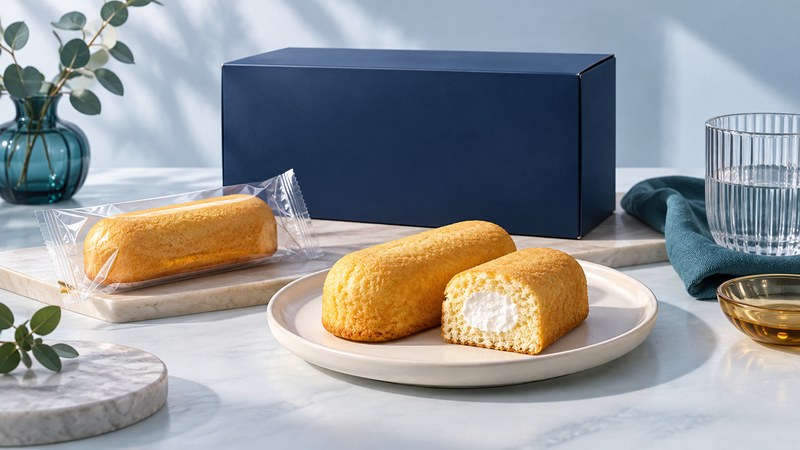
Read the full product name, serving size and date wording on the package. Twinkies come in different flavors and pack formats, so cake count alone is an incomplete comparison. The package you have supplies the most useful information about its ingredients and care.
Identify the product and serving
Hostess’s Twinkies product family distinguishes the standard snack cake from other flavors and variety packs. Match the exact name, net weight and count, then use that product’s nutrition panel. Save the outer box until all its individually wrapped contents have been used.
For the standard Twinkies Snack Cake page checked October 2, 2026, the displayed serving was two cakes (77 g), 280 calories and 360 mg sodium. The same page tells shoppers to use the actual package for the most current information.
Swipe the table sideways, or focus it and use the arrow keys.
| Amount | Calories | Sodium |
|---|---|---|
| One average cake: half the listed serving | 140 | 180 mg |
| Two cakes: the listed serving | 280 | 360 mg |
These are proportional calculations from rounded label values. For a different size or flavor, start again with its own serving weight and values. One wrapper can hold a different quantity from one label serving.
Read the words beside the date
Hostess’s FAQ explains that its “Best By” date indicates expected best quality. Copy the complete date phrase as well as the numbers. A separate lot or production code helps the manufacturer trace a package; its meaning should come from the manufacturer rather than a guessed decoding rule.
If the date is smudged or the code is ambiguous, photograph the package, its barcode and every printed code, and contact Hostess through the support route on the package or FAQ. Include the country and place of purchase. That gives the team enough detail to identify the product and printing convention.
Use the date to plan stock rotation and purchasing. A quality date does not tell you everything about how a package has been handled. Follow explicit storage directions and any recall instruction, and set aside a damaged or suspicious product while you resolve the question with the manufacturer.
Store the actual package appropriately
The standard product page specifies a clean, cool, dry place at ambient temperature, away from direct sunlight. Keep wrappers intact until needed and protect the cakes from crushing or heat during transport. Follow your package if its directions differ.
Choose a pack you can reasonably use within its stated best-quality period. For an event, retain the outer box with the ingredients and codes; distribute intact individual packs where appropriate. A photograph of the box is a useful backup when dividing a purchase across households.
There is no need to assign every Twinkie a single universal number of shelf-life days. Formulation, format, packaging and the manufacturer’s printed instructions define the product in front of you. The internet’s long-storage anecdotes do not identify your package.
Compare value on a consistent basis
Fictional price example: ten equal-size cakes for $4.50 cost 45 cents each; sixteen for $6.40 cost 40 cents each. The larger pack is cheaper per cake, but it only saves money if you will use the extra six. If cake sizes differ, divide each price by its net weight and compare the same weight unit.
For nutrition, use: amount you eat ÷ label serving amount × the listed nutrient. Keep units consistent. For shopping, use: total price ÷ the usable count or net weight. These are two different calculations, so record both when deciding between packs.
For another branded bakery-format comparison, see Cinnabon bakery, retail and partner products.