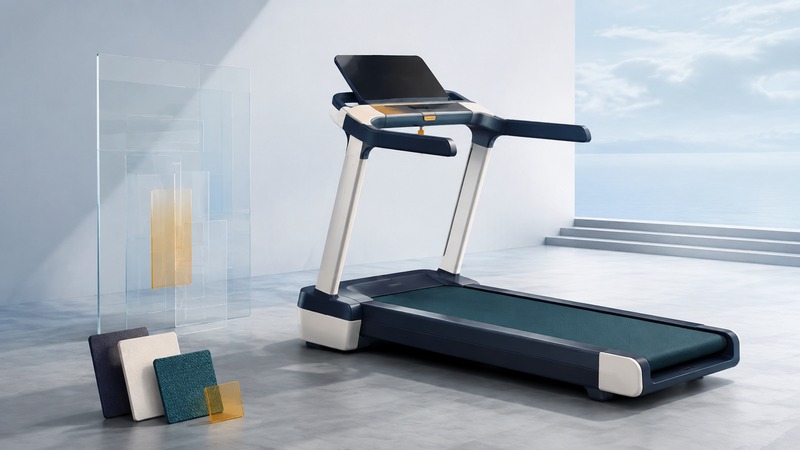
A useful treadmill rating explains who the machine suits, how it was evaluated and what ownership requires. Start with your intended walking or running, available space and service needs. Then compare exact models using documented specifications and observations from a suitable demonstration.
This is a buying framework with a blank comparison worksheet. It assigns no product rankings: Yenra has not performed comparative treadmill testing for this guide.
Start with the user and the room
Write down who will use the treadmill, whether they intend to walk or run, typical session length and how many sessions it must support. Include the fastest speed and incline actually needed. A compact walking pad, a folding running treadmill and a commercial machine may solve different problems even when a listing uses similar language.
Separate the machine’s footprint from its usable belt area and the clear space required around it. Measure the room, delivery route and ceiling height. Account for deck height and the user’s movement at the intended incline. Get the exact model’s manual before ordering, including its electrical requirements, user limits and installation clearances.
For example, the Life Fitness T3 specification page lists external dimensions separately from the running surface. Those fields answer different questions: whether the machine fits in the room and whether the belt provides suitable space for the user. Specifications and console options should be confirmed for the model and market being purchased.
The manufacturer’s manuals hub is one example of where to obtain installation and operation documents. A clearance quoted for another treadmill provides context; the instructions for your exact machine govern its placement.
Keep specifications, observations and claims separate
On a narrow screen, scroll the table sideways. Keyboard users can focus it and use the arrow keys.
| Criterion | Evidence to collect | Decision it supports |
|---|---|---|
| Belt and frame fit | Usable belt dimensions; observed comfort at intended pace. | Can each intended user move naturally? |
| Speed and incline | Supported ranges, operating limits and control increments. | Does it support the planned sessions? |
| Controls and stopping | Manual instructions; accessible buttons and safety-key arrangement. | Can the user control it confidently? |
| Noise and vibration | A demonstration with the user running; room and floor noted. | Is the installation suitable for this household? |
| Service | Written parts, labor and travel coverage; local repair availability. | What happens if it needs repair? |
| Connected features | Functions available with and without a paid account. | Which ongoing costs buy features you will use? |
A motor-power figure needs its rating definition and operating context. Avoid turning a peak-power claim into a prediction of sustained performance. Likewise, a user-weight limit is an operating constraint, while noise, belt behavior and comfort call for relevant observations. Record “unknown” when the evidence is missing.
Ask reviewers how long they used the machine, who tested it, what conditions they used and whether they distinguish paid placement from testing. A score becomes more useful when its method allows you to decide which findings apply to you.
Use a demonstration to answer specific questions
- Ask the demonstrator to explain the model’s startup, normal stopping and emergency-stop instructions before use.
- With suitable supervision and within the manual’s limits, try the intended activity at a comfortable pace.
- Notice belt space, access to controls, display readability and whether the console obstructs your normal movement.
- Listen under actual footfalls. An empty moving belt gives little information about the sound of someone running.
- Ask for a demonstration of folding, transport and storage if those features matter. Record the space and effort required.
Follow the machine’s instructions for the safety key, footwear, shutdown and keeping children and pets away. Before buying new or used, check the U.S. CPSC recall database and the manufacturer’s notices using the model and serial number.
Warnings deserve the same attention as recalls. On April 16, 2026, CPSC issued a stop-use warning for Sperax walking pads and treadmills, identifying Pro, Q1, RM-01 and RM-02 among the affected models and describing fall, burn and fire hazards. Check current notices again at purchase; a retailer listing or attractive price supplies no assurance that a warning has been resolved.
Compare the cost of owning it
Collect written prices for delivery, assembly, optional subscriptions and removal of an old machine. Check whether warranty coverage changes for commercial use, secondhand ownership or a different country. For a used treadmill, ask for its identity label, service history, demonstrated operation and confirmation that replacement parts remain available.
Apply the same time horizon to every candidate. Record what the machine can do after a subscription ends and whether the basic controls depend on a network or account. A preference for connected classes is perfectly reasonable; write it down so its value can be compared with its cost.
Download a comparison worksheet
Download the blank treadmill comparison worksheet (CSV). It has space for three candidates, your requirements, evidence links, price components and unresolved questions. Open it in a spreadsheet application or print it.
Use the worksheet in two passes. First eliminate machines that fail a firm requirement such as installation space or supported use. Then compare the remaining candidates on comfort, controls, service and total cost. This keeps an impressive optional feature from obscuring a basic mismatch.
If you also compare treadmill records with outdoor activities, our GPS watch guide explains why activity settings and definitions of time and distance matter.