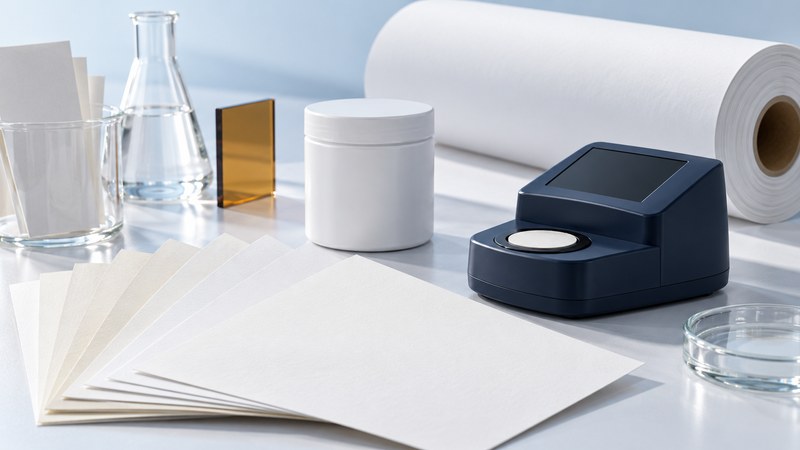
Evaluate titanium dioxide in the paper application where it will be used. Define the required optical properties, hold key sheet and process conditions comparable, and record both pigment consumption and acceptable output. The useful result is a trial-based choice for a specified paper grade, rather than a comparison of pigment price alone.
Start with the paper and addition point
Identify whether the pigment enters the wet end or a coating, and state the paper's intended use. Record furnish, fillers, coating formulation where applicable, target basis weight and relevant process conditions. Ask the supplier for a grade suited to this system and obtain current technical and handling documentation.
Chemours describes Ti-Pure R-942P as a rutile pigment supplied in slurry form for paper applications, including coating and wet-end uses. This illustrates why grade and delivery form belong in the comparison. Confirm the actual dry-solids fraction when converting a slurry's mass or price to dry pigment equivalents.
Keep dispersion, retention and runnability observations alongside the optical results. Added pigment and retained pigment in the sheet answer different questions. Use the mill's material balance or analytical method when retention is part of the decision, and state the method's assumptions.
Separate opacity, brightness and whiteness
On a narrow screen, scroll the table horizontally. Keyboard users can focus it and use the arrow keys.
| Property | Question it addresses | Context to preserve |
|---|---|---|
| Opacity | How well does the sheet obscure what is behind it under the test? | Method, backing, basis weight and sample conditioning |
| Brightness | What is the defined blue-light reflectance response? | Method, instrument, illuminant and UV condition |
| Whiteness | What white appearance does the chosen index represent? | Index, illuminant, observer and fluorescence conditions |
| Color and appearance | Does the sheet meet its shade and visual requirement? | Color method and agreed viewing conditions |
The public scope of ISO 2471:2008 defines paper-backing opacity by diffuse reflectance and specifies limits for fluorescent materials. Use the applicable full method through the laboratory; an index value should carry its test basis.
IGT's optical-testing descriptions treat brightness and whiteness separately and explain the role of illumination and fluorescence. Keep instrument and UV conditions consistent when comparing samples. Record basis weight, caliper and moisture so a sheet change is visible alongside a pigment change.
Run a controlled comparison
Retain a baseline and define candidate changes before the trial. Record the dosing basis, actual addition, process settings and sampling locations. Collect representative replicates and inspect variation as well as averages. If basis weight or coating weight changes, either restore comparability or explain that the trial is evaluating a broader process change.
Agree acceptance for optical properties and practical requirements such as strength, print behavior and machine operation. A higher opacity result may still be unsuitable if another required property falls outside its limit. Keep all rejection reasons in the output record.
Calculate consumption from the pigment actually used during the defined trial interval. Align that interval with gross paper production and accepted output. State how startup waste, rework and inventory changes are treated, especially when the comparison will inform purchasing.
Worked example: cost per acceptable tonne
Fictional dry-mass comparison: candidate A uses 20 kg of dry pigment per gross dry paper tonne at $3.00/kg, giving $60.00/t. Candidate B uses 18 kg/t at $3.20/kg, giving $57.60/t.
If the acceptable-paper fractions are 0.95 for A and 0.90 for B, pigment cost per acceptable tonne is $60.00 ÷ 0.95 = $63.16 for A, rounded, and $57.60 ÷ 0.90 = $64.00 for B.
The lower gross-tonne pigment cost changes order after accounting for these invented acceptance fractions. Those fractions describe output acceptance, not pigment retention. The calculation excludes other materials, energy, downtime and rework credits; all prices are teaching inputs, not supplier quotations.
For a real decision, use dated quotations, a common currency and dry-pigment basis, and an agreed full-cost boundary. Confirm repeatable performance across relevant production conditions before changing the approved grade. Record the trial evidence and specification in the purchasing and acceptance workflow.
Use the working record
Download the editable paper pigment trial. Save a copy, complete the actual requirements and evidence fields, and review open issues with the responsible owner. The plain-text record includes instructions, units where needed, the fictional example, and source references.