
Teoma belongs to the history of search engines that used links between pages to investigate authority within a topic. Its results interface also separated answers, query refinements and collections of useful links. Those ideas help explain why a search engine needs more than a count of how often a page or website is mentioned.
Follow the research before the marketing claims
The Rutgers researchers' 1999 DiscoWeb paper investigated link analysis for ranking pages and discovering web communities. It described a prototype that examined multiple patterns in a graph of linked pages, seeking useful topic groupings beyond those exposed by a single dominant pattern. Its authors also identified computational and retrieval-time constraints.
Teoma cofounder Apostolos Gerasoulis's Rutgers profile records the company's acquisition by Ask Jeeves in September 2001. That places the search engine within a research-to-commercialization story and subsequent ownership change. A research prototype, a commercial search service and a later search product are separate stages; a method described at one stage needs evidence before being attributed unchanged to another.
The early research supports an explanation of topic-sensitive link analysis. It does not supply a current comparative benchmark or a complete specification of every commercial Teoma ranking signal. Read the following example as a way to understand the problem, rather than as a reconstruction of proprietary scoring.
Three visible routes through a search result
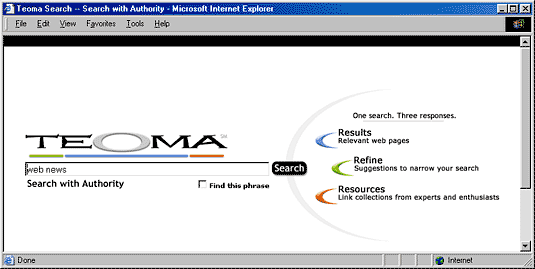
The homepage screenshot presents three intentions: Results for relevant pages, Refine for suggestions that narrow a query, and Resources for link collections. These are useful distinctions even when they lead to some of the same destinations.
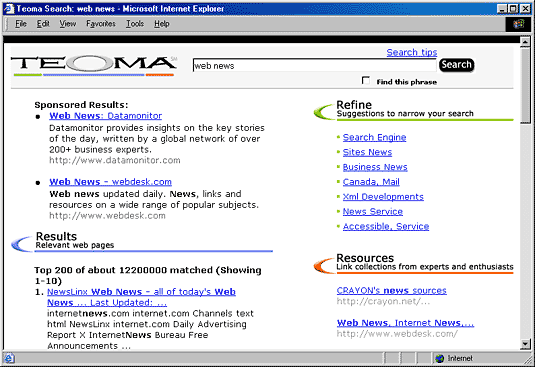
For a broad question, a useful refinement introduces a more specific interpretation. A resource page can offer a human-curated route into a subject. A direct result may already answer the question. The screenshot documents this presentation; it cannot establish how accurate every result was, whether each suggested link was useful, or how the engine compared with competitors.
Worked example: popularity within a subject
A page may help because it contains an answer, or because it directs readers to strong answers elsewhere. Link-analysis research often describes these roles as authorities and hubs. A useful hub might be an observatory's annotated maintenance bibliography; an authority might be the relevant manufacturer's procedure. A page can play more than one role.
The choice of collection still matters. If the initial query mixes mirror cleaning with household glass, the graph can include a different community. A text match helps identify the subject; a link pattern offers another piece of evidence. Neither establishes that the procedure is suitable for a particular instrument. The reader still needs the correct model, source and instructions.
DiscoWeb's paper explicitly discussed finding additional communities and the difficulty of choosing useful graph patterns. That makes it a richer historical source than an assertion that one engine simply “understood authority.” The research question concerned how to turn link structure into useful retrieval under practical time constraints.
Separate a promising method from demonstrated search quality
To evaluate a claim about better results, ask what queries were used, how relevance was judged, which collections were searched and which version of each system was tested. A favorable example illustrates a possibility. A comparison needs repeatable queries and a stated success rule.
- Choose a concrete information need, such as finding a manual for an exact model.
- Identify acceptable sources before judging the results.
- Record the query, search service, date and first useful result.
- Inspect whether a refinement improved the intended task or changed it.
- Distinguish a useful link collection from an independently verified answer.
For a measured exercise, use the search-evaluation guide and query worksheet. For present-day searching, use Search Engines: Choose a Tool and Improve Your Query. This retrospective treats the early Teoma interface as a historical artifact and makes no claim about an operating service at a reused domain.
Teoma's enduring interest is the combination of topical relationships and several ways to continue a search. It encourages a productive question: which part of the result helps the reader make progress, and what evidence supports that judgment?