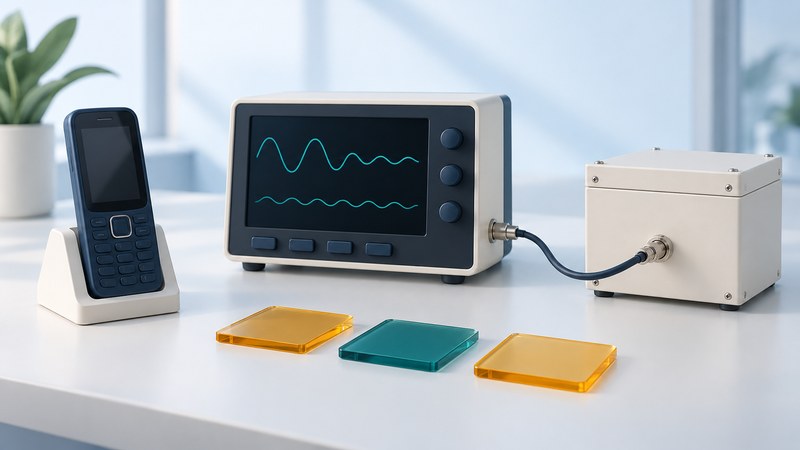
A useful phone interruption test starts with an observable task, introduces one controlled event, and checks what survives and what recovers. Define the expected behavior before running it. Then capture enough evidence to distinguish an application problem from a signaling or radio problem.
What the MD8470A example contributes
Anritsu's MD8470A was a signaling tester used for mobile application and protocol work. The manufacturer's archived product page marks it discontinued and describes network simulation and application testing. Its supported radio systems and installed software belong to its own product generation.
The August 2007 service-interruption application note includes SMS arrival during a voice call and voice-call arrival during packet communication. Its tables distinguish WNS operation from sample scenarios and attach conditions to particular software options. Those details matter: a scenario name alone does not establish that a particular instrument configuration can perform it.
The durable lesson is controlled interaction between services. Use current instrument documentation, installed licenses, supported radio technology, test subscription, and the lab's approved connection/isolation procedure for a real setup. This guide provides test design, not RF connection instructions or a claim that the MD8470A covers present-day radio generations.
Write a test another person can repeat
Choose one task, such as transferring a file from a controlled server while an incoming call arrives. Identify the handset, firmware, application build, network configuration, file, server, and starting state. Include screen state, background restrictions, battery conditions, and relevant application settings when they could affect the observation.
Specify the event and its timing precisely. “Receive a call after five seconds of confirmed transfer progress” is reproducible; “interrupt the phone while downloading” leaves room for several different tests. Include whether the call is answered, rejected, or left unanswered and how the initial state is restored afterward.
| Field | Example to define | Why it matters |
|---|---|---|
| Precondition | A known file is transferring and progress is observed. | Establishes that the primary task actually started. |
| Interruption | A controlled incoming call arrives at the chosen point. | Makes runs comparable. |
| Expected behavior | State retention and recovery follow an agreed product requirement. | Gives the result a defensible pass/fail basis. |
| Evidence | Timestamped screen events, application logs, and relevant network traces. | Connects the symptom to the underlying sequence. |
| Cleanup | End the call, remove the test artifact, and restore the documented starting state. | Prevents one run from altering the next. |
Use the interruption test record to define a case and record a run. Its example thresholds are deliberately fictional; replace them with an approved requirement before judging a real product.
Choose evidence for the question being asked
Application evidence shows what the user and software experienced: progress, errors, saved state, retries, and completed output. Signaling evidence records protocol exchanges and state transitions visible to the configured test system. RF measurements address radio performance under specified conditions. A screen recording alone supplies the first kind of evidence.
A desktop network simulation can help explore application reactions to an imposed delay or loss. To claim a cellular signaling result, you need a setup that produces and records the relevant cellular exchanges. Name the test environment in the result so a reader can tell what was actually exercised.
Correlate clocks or record their offset before comparing logs. Mark the trigger, user-visible response, service release, and first useful recovery event. Define “recovered” in task terms: a moving spinner is different from received file bytes, and received bytes are different from a complete verified file.
Interpret a small trace against a stated rule
Keep the individual verdicts. “The download worked” loses the timing failure; “the phone failed” loses the successful state retention and integrity checks. If timestamp uncertainty could alter the verdict, report that uncertainty and improve the measurement before drawing a close-threshold conclusion.
Repeat deliberately and keep the conclusion narrow
Run a baseline without the interruption, then the defined case. Repeat from the same initial state and report every run, including intermittent failures. After establishing that comparison, vary one condition at a time: event timing, foreground/background state, or accepted/rejected call. Track each as a separate scenario.
For a failure report, attach the requirement, configuration, event sequence, observed result, relevant evidence, and reproducibility count. Redact personal account information and use controlled test content. Reserve a broader claim until the corresponding devices, software versions, and network conditions have actually been covered.
For the difference between IP reachability and application continuity, see Mobile IP. For provider responses and application fallback behavior, see mobile network API evaluation. Consumer troubleshooting begins with phone software checks.