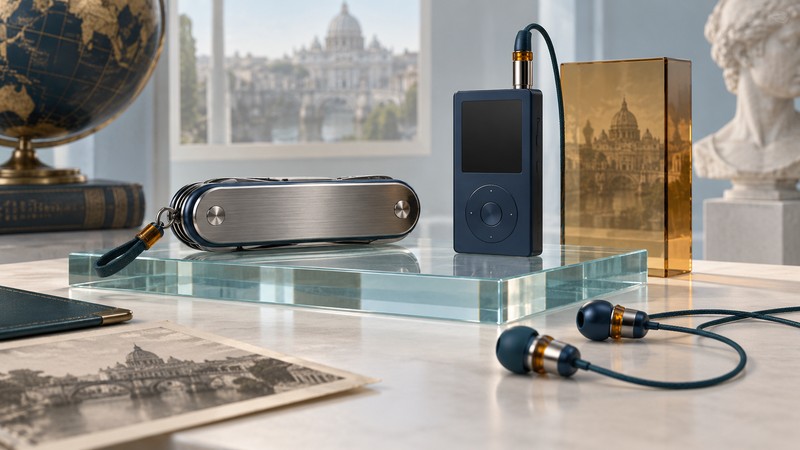
The SwissMemory s.beat combined a pocket multi-tool with a detachable digital audio player. Its most useful historical feature is that separation: the mechanical tool and the electronic module could be understood as different components, while the player’s flash memory held both playable audio and ordinary data.
A compact collection of functions
The manufacturer’s s.beat manual, version 1.2, reproduced by Manualzz is based on firmware 1.002.00X. It documents the detachable player, USB mass storage, audio playback, FM reception and recording. It also describes a remote control with two earphone connections. These belong to the documented version; identify the hardware and firmware of a surviving unit before comparing its behavior.
The design brought several carried objects together, but each function still needed its own working parts. A sound mechanical tool says little about the display, battery, audio output or readable storage. A preservation record should therefore describe each component and observed function separately.
Read the folders as clues
The manual’s file-organization section assigns distinct roles to four folders:
DATA: ordinary documents and other data.MUSIC: music files, with MP3, WMA, WAV and OGG listed.BOOK: audiobooks in the listed MP3, WMA and WAV formats.RECORD: WAV recordings made from the radio, an external source or microphone.
These names provide a useful map when examining a preserved copy. Keep the original folder structure before organizing files elsewhere. A document in DATA and a track in MUSIC have different intended uses, even though both occupy flash storage.
Preserve the device and the evidence separately
Record the model, capacity, firmware information if available, accessories and visible condition. If the storage reads reliably in a documented setup, preserve wanted files on separate storage and verify them before any reset, formatting or firmware change. Keep an unchanged copy while testing file organization or playback on another system.
Use three separate observations: whether the host can read files, whether copied files open in appropriate software, and whether the s.beat itself plays them. An unsuccessful player test leaves the first two questions open. Conversely, a successful playback test on the device leaves independent preservation still to be checked.
The manual describes a period product, so its battery figures and old software requirements are historical specifications. Record a surviving unit’s actual state instead of assuming its original runtime. Keep the closed tool body, player module and accessories associated in the collection inventory.