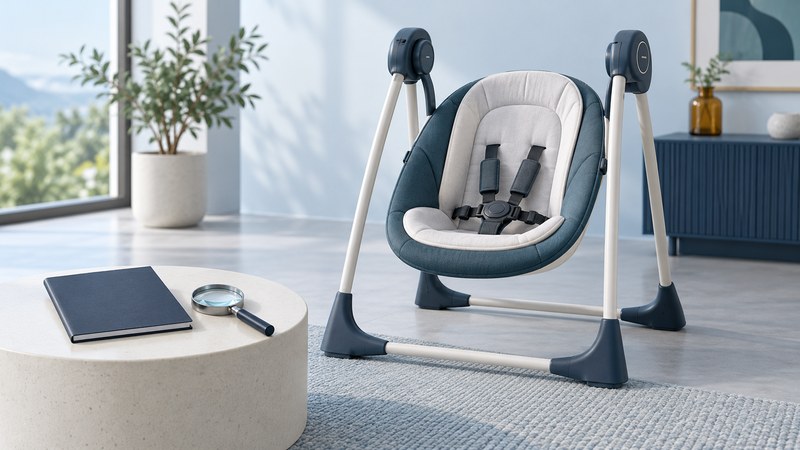
Before using an infant swing, identify the exact product, check its recall status, and read its current instructions. Use an eligible swing only as directed for an awake baby under supervision. When the baby falls asleep, move them to a firm, flat sleep surface on their back as soon as possible.
This guide concerns indoor infant swings and U.S. recall resources. It includes the Fisher-Price Smart Response recall of April 10, 2002, as a specific historical case. Outdoor playground swings have different equipment and supervision requirements.
Start with the label, not the photograph
Put the baby somewhere safe before examining the equipment. Find the manufacturer, full product name, model number, and any manufacturing or date code. Photograph the label and the whole swing. Keep purchase information if available.
A seller's description such as “cradle swing” or “baby rocker” is too broad to establish which instructions apply. Similar-looking products may have different seats, fasteners, weight limits, and recalls. If a label is missing or unreadable, ask the manufacturer to identify the product before using it.
Use the swing identification and recall worksheet to keep the product details, source links, and next action together.
Match the recall to the complete product identity
- Search the official record. Use the CPSC recall search and the manufacturer's recall page. For Fisher-Price, use the Mattel and Fisher-Price recall list.
- Compare identifiers. Match model numbers, any date ranges, and the description. Read the entire notice, including the hazard and remedy.
- Follow the exact action. A recall may call for a refund, disposal, replacement, inspection, or another specified remedy. Keep a recalled product out of use while its status is unresolved.
- Keep evidence. Save the notice URL, the date checked, and correspondence or documentation of a completed remedy.
Finding no match in one search leaves a question to resolve, especially when the model number is uncertain. Likewise, completing a remedy for one defect does not establish that every part of a used swing remains suitable. You still need the manual, an intact product, and a child who meets the manufacturer's limits.
The 2002 Fisher-Price Smart Response recall
The CPSC notice dated April 10, 2002 identifies Smart Response Swings with product numbers 79644, 79645, and 79647, molded onto the back of the seat. The hazard was a seat that could look secure despite incorrect assembly and then tip forward with the child.
The notice directed owners to stop use and contact Fisher-Price for help checking the seat, with a replacement seat and revised instructions specified where attachment was incorrect. That describes the historical recall remedy; contact the company to establish what support is available for your particular unit today.
The manufacturer's Smart Response recall page provides an identification route and links to its product support. Use those official instructions rather than a seller's assurance that the swing “was fixed.” Avoid improvised fasteners, straps, padding, or repairs.
Read the manual as a set of stop conditions
Before use, locate these items in the manual for the exact model:
- Eligibility: minimum or maximum weight and any developmental limits, such as the ability to sit up or climb out. Stop at the first applicable limit.
- Assembly and condition: required parts, locking points, and what damage or wear means the product should be taken out of service.
- Position and restraint: permitted recline settings for the baby's age and the correct harness routing and fit.
- Placement: the specified support surface, clearances, and access to cords or other hazards.
Use the supplied restraint as directed and supervise the awake baby. The AAP's infant-swing safety advice emphasizes restraint, age-appropriate positioning, and manufacturer weight limits. The exact product manual supplies the details for your equipment.
If a part is missing, the harness is damaged, or the manual cannot be matched to the swing, stop and contact the manufacturer. An improvised substitution creates a setup the instructions do not cover.
Plan a separate place for sleep
The AAP advises moving a baby who falls asleep in a swing to a firm, non-inclined sleep surface as soon as possible. Place the baby on their back. See AAP safe-sleep guidance. Supervision and a harness do not turn the swing into a sleep product.
Keep the crib or bassinet ready before trying a soothing session. If you are getting too tired to supervise, use that safe sleep space and ask another adult for help. Our newborn-care guide covers the setup, and the crying and colic guide offers other comforting approaches and caregiver breaks.
Make a clear decision about borrowed equipment
A useful handoff includes the label photograph, matching manual, recall check, and any remedy documentation. If those pieces are missing, keep the swing out of use until the manufacturer resolves the gaps. An infant swing is optional equipment; a safe sleep space and attentive care remain the priorities.
Recheck when obtaining a secondhand unit, when a new notice names the product, or when condition or the child's abilities change. Follow a recall's disposal or return directions so an affected product does not pass to another family.
Continue exploring
Explore baby care, feeding, and safety. Sources are linked beside the guidance they support. Updated October 11, 2026.