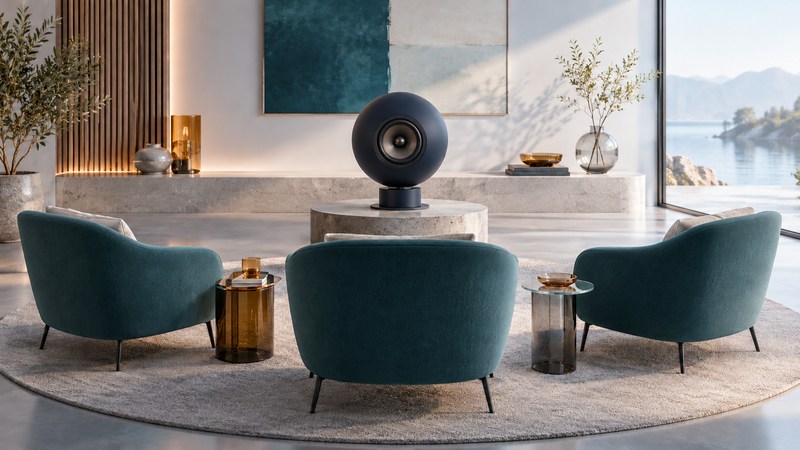
A speaker serves a listening area, whether that means one chair or a sofa full of people. Point-source and coaxial designs aim to make different frequency ranges behave as though they originate together. The useful question is how a particular speaker changes as you move sideways, stand up, or sit closer. Combine its published measurements with a repeatable listening comparison.
Separate driver layout from system performance
A coaxial layout places drivers on a common axis, often with a tweeter at the center of a midrange cone. A point source is an acoustic ideal: sound appears to originate from one location. A real loudspeaker has finite size and a frequency-dependent radiation pattern. Read the manufacturer’s explanation of which drivers share an axis and over what frequency range.
A crossover divides the signal between drivers. Their outputs overlap around the crossover region, where their relative timing, level, and spacing affect the combined sound. Genelec’s coaxial-driver explanation describes both the alignment benefit and the engineering work needed to manage diffraction and the transition between surfaces. Coaxial construction is a design choice with implementation details worth examining.
Read the response away from the main axis
Directivity describes how output varies with direction at each frequency. An on-axis response shows one direction. Horizontal and vertical off-axis curves show what changes for listeners elsewhere and for sound traveling toward room surfaces. Genelec’s waveguide overview explains how a shaped surface can control that angular distribution and help match adjacent drivers through the crossover region.
| Evidence | What to examine | Useful limitation |
|---|---|---|
| On-axis frequency response | Overall balance and the measurement axis. | One direction leaves other seats untested. |
| Horizontal and vertical off-axis curves | Smooth changes with angle, especially near crossover. | Compare plots with the same axes, scale, and smoothing. |
| Level and distortion measurements | Behavior at the distance and playback level reported. | A low-level response curve gives limited evidence about loud playback. |
| Room measurements | Differences between seats and placement options. | Room reflections and speaker behavior are combined. |
Look for the test distance, microphone position, level, smoothing, and whether curves are normalized. A normalized directivity plot emphasizes angular differences; a separate absolute response is useful for tonal balance. Where a published test omits its conditions, keep that gap visible in your comparison notes.
Use La Sphère as a complete-system case study
Cabasse’s La Sphère illustrates how the drivers and electronics work together. In its 2020 UK presentation of an updated La Sphère, Cabasse describes a three-way coaxial assembly aligned with a 55-centimeter bass driver, with digital processing for crossover and time alignment. That is a specific generation and system configuration; keep its documentation separate from the original mid-2000s design and later models.
When comparing an active multiway system, include the required processor, amplifier channels, setup service, and room adjustments in the inventory. A photograph of a spherical cabinet tells you about the enclosure’s shape. The acoustic evidence comes from its complete operating system and the conditions under which it was tested.
Make a level-matched comparison across seats
- Mark your normal center seat and two side seats. Record speaker spacing, distance, height, and angle.
- Choose a short, familiar passage with clear speech or a centered voice. Keep the recording, source settings, and processing fixed.
- For a comparison between systems, match the level at the center seat using the same measurement method and test signal. Record the setting and leave it fixed as you move to the other seats.
- Listen at seated ear height in each position. Note voice clarity, tonal change, apparent location, and whether the nearer speaker dominates.
- Change one placement variable, such as the aiming angle, then repeat the same route. Retain both sets of notes.
Keep test levels comfortable. A phone measurement can help repeat your own setup, but its calibration and microphone behavior limit claims about absolute accuracy. If you need defensible acoustic measurements, use an appropriate measurement microphone and documented procedure.
Illustrative comparison
Suppose the center seat sounds balanced while a side seat loses vocal clarity. Repeat after a small aiming change at the same recorded level. Improvement at that seat supports the new placement for that room. It leaves open whether the original difference came mainly from directivity, reflections, distance, or their combination.
Choose for the room you share
Set your priorities before deciding: one precise listening position, consistent dialogue across a sofa, discreet placement, or high output at a longer distance. Record the weakest seat as well as the best one. When a tradeoff appears, decide which seats and uses matter most.
Use the Home Theater room plan to coordinate the screen and seats, and the amplifier comparison guide to interpret power and load specifications. For coverage beyond the living room, continue with outdoor speaker planning.