Isaac Newton brought falling objects and orbiting worlds into one mathematical account. His laws let us connect forces with changes in motion; his experiments with light made color a question that could be tested. Understanding those achievements starts with a small distinction: an object can keep moving even when the forces on it balance.
This introductory profile needs only everyday arithmetic. It follows Newton's life, explains the three laws through a cart example, and connects gravity and optics with the evidence behind them.
A life across mathematics, experiments, and public service
Newton was born at Woolsthorpe in Lincolnshire: December 25, 1642 in the English calendar then in use, January 4, 1643 in the Gregorian calendar. The date difference explains the two birth years in biographies. He entered Trinity College, Cambridge in 1661 and became Lucasian Professor of Mathematics in 1669.
- 1665–1667: During time away from Cambridge amid plague, he developed early work in mathematics and optics.
- 1687: The Principia presented his mathematical account of motion and gravitation, with Edmond Halley's encouragement and financial support.
- 1696 onward: Newton took up work at the Royal Mint; his career extended beyond the university.
- 1704: Opticks brought his investigations of light to a wider readership.
- 1727: Newton died in London.
The Newton Project chronology places these milestones alongside contemporary discoveries. His manuscripts also encompass alchemy, theology, and biblical chronology. Reading them in context reveals the breadth of his interests; individual scientific claims still stand on their arguments and evidence.
Three laws, three questions
Use these laws in an inertial frame: a reference frame in which an object with zero net force maintains constant velocity. For everyday classroom problems, a stationary laboratory often provides a useful approximation. NASA's introduction to Newton's laws gives the basic relationships.
1. What changes the motion?
Zero net force means constant velocity: an object stays still or continues at the same speed in the same direction. A cart that slows after a push has forces such as friction acting on it. Continued forward motion itself does not require a continuing forward force.
2. How much does it change?
For constant mass, net force = mass × acceleration, usually written F = ma. Acceleration is the change in velocity per second. Turning a corner counts as acceleration because direction changes.
3. Which objects interact?
Two interacting objects exert equal and opposite forces on each other. Your hand pushes a cart; the cart pushes your hand. These forces act on different objects. When calculating the cart's acceleration, include the forces acting on the cart.
Work the problem by choosing one object
Try changing one input. With the same net force and twice the mass, acceleration halves. With the original mass and equal opposing horizontal forces, acceleration becomes zero; the cart's existing velocity stays constant in this idealized model. This is why identifying every relevant force comes before inserting numbers into a formula.
Why an orbit is continuous falling
Newton's gravitational model connects two masses by an attractive force. For idealized point masses, F = Gm₁m₂/r², where r is their separation and G is the gravitational constant. For non-overlapping spherically symmetric bodies, use the distance between their centers. Double that distance, holding the masses fixed, and the force becomes one quarter as large.
A satellite has sideways velocity while gravity continuously changes its direction toward Earth. At a suitable speed and altitude, its curved path keeps clearing the surface. An astronaut and spacecraft fall together, producing the familiar floating appearance. NASA's free-fall explanation connects this with terrestrial falling bodies.
The historical achievement was to explain patterns such as Kepler's planetary orbits through a common mathematical framework. Halley, Robert Hooke, and other contemporaries were working on related questions; the Newton Project introduction to the manuscripts shows the arguments developing through drafts and correspondence.
What a prism helped establish
A prism separates white light into a range of colors because its material bends different wavelengths by different amounts. Newton investigated how the separated colors behaved and how they could be recombined. The key experimental question was whether the prism created the colors or separated components already present in the incoming light.
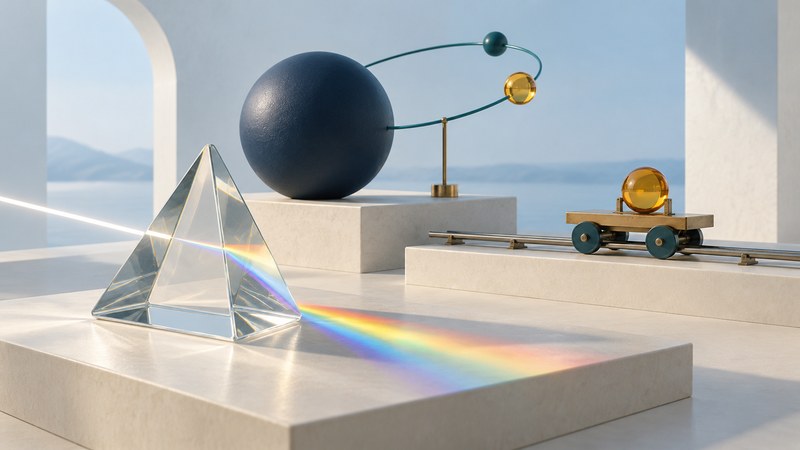
Following a selected color through another prism helped test the explanation; recombining the separated light provided another check. Together, these experiments supported the account of white light as a mixture. Read the optical papers overview for the sequence of reasoning and the history of Opticks for the published work. The hero illustration represents these themes conceptually; it is not an optical setup to copy.
How to use Newton today
Newtonian mechanics remains a powerful model for ordinary speeds and many engineering calculations. Its usefulness depends on the required precision and the situation being modeled. Relativity becomes essential for high speeds, precise clock comparisons, and gravitational effects beyond the Newtonian approximation; quantum theory describes behavior at atomic scales.
Newton's mathematical work also helped develop calculus: a way to describe continuous change and accumulation. The manuscript record makes the development more informative than a single moment-of-genius story. Start with a question, follow the argument, and check how it was tested.
Continue with Einstein's account of time and gravity, or look back to Galileo's measurements and observations. The Scientists collection connects all three profiles.